Crime and Minor Children - Part II
NewsBharati 01-Dec-2025 13:15:57 PM
Total Views |


Dharm and its influence in society
Especially when we talk about crimes in society, we need to understand it in a larger perspective, otherwise it would be an incomplete analysis.
Society is a complex phenomenon. When we approach any social issue, there is no simple solution available. Many factors are at work. Besides that, we were under foreign rule for many centuries, our social fabric is distorted beyond recognition to a great extent. We were forced to adopt non-indigenous faith, language, culture and even change the total way of thinking and life. Everything that was native was treated to be inferior, which resulted in a way into the inner struggle or existential crisis.
Dharm has been the guiding light of our social life. Spreading awareness about the eternal principles that hold our existence is essential. So the role of Dharm is to be analysed carefully.
These two separate encounters with two types of people might throw a little light and probably help us see the role of Dharm in our lives.
Probably in 2010, I had been to Kolkata in the last week of January for a conference. We were allotted rooms in the Jadavpur University guest house. Every day we would get up early in the morning, go for a morning walk and take a walk after dinner too. It is a big campus, and we tried to explore all the areas of the campus. We came across three pandals where the mother Sarswati idol was raised and worshipped. Bengal was under left rule then; its ideology describes religion as the opium of the people. Thus, it leaves no room for blind faith, nor should any sort of pooja have any place, but it did exist. The celebration was a couple of days back. We were amused by the strange blend of religion and Marxist ideology. The rest was in tune with the ideology, every day students protested against some or the other policy or some decision. Even the canteen had some students protesting one day and were preventing others from entering the facility. But no one seemed to have anything against the pooja pandals. It probably reflected some need of the people's psyche.
On the contrary, in Pune, the city where Lokmanya Tilak started the Ganapati festival, there are quite a few schools where it is not celebrated at all. Met a pre-primary school child during Navratri; there was no celebration in her school. It was obvious that it didn't have a Ganpati festival celebration either. Are the children taught some Artis or Shlokas I inquired in vain, knowing the answer well. " Aunty meaningful poems of the celebrated poets are learned and recited in the school ", the mother exclaimed. I wondered whether the Stotras or Artis are not meaningful enough to be recited? I realised that the school management strictly (!) adheres to the constitution and boasts of its secular credentials too.
The question that lingered in my mind was, why are we weaning our children from our heritage and the Sanatan treasure of values? If Marxism can accommodate Durga and Saraswati pooja, why can the festival of Ganapati not be a part of school life? In Maharashtra, festivals like Ganapati, Navratri, Diwali and many more are celebrated with enthusiasm and faith, so why create confusion by giving no space to these festivities in schools?
Obviously, no institutions for higher studies give room to such gatherings. I remember a principal objecting to the practice of lamp lighting at every event. Fortunately, he couldn't ban it.
An answer that unsettled everyone and compelled them to contemplate
One of the dedicated teachers of a vocational institute once witnessed a unique silence in her class. Sometimes the discussion in the class takes an unexpected and interesting turn. During the discussion, she happened to ask, How many students had read the Gita or any other book and know a couple of shlokas? To her surprise, no hand was raised. There was a Muslim girl in the class, the teacher asked whether she knew the Quran, can if she could recite some couplets. Instantly came the answer that she reads the Quran every day and can recite some couplets.
It was this answer that made the rest of the students speechless, and for a few minutes, no one knew how to deal with this stark reality. There fell a deafening silence. For a long time, the teacher and her students were dumbstruck and baffled. The teacher also gave them time to recover as they were thunderstruck.
Once she had all gained composure, she started the dialogue. She tried to explain why one should read and try to understand books like the Gita at a young age, and how it can change the perspective of any reader.
Indian philosophy is the treasure that is handed over to us, but unlike science, philosophical thoughts can enrich or benefit only those who try to understand and implement them.
We, as Bharatiya Hindus or Sanatani, cannot afford to pretend that we have not noticed the existence of the treasure of knowledge that we actually possess. Disregarding or discarding it would only result in our loss; we were already under the spell of self-denial. We, unfortunately, under the influence of the British, have been refusing the value of everything that is Hindu or Sanatani. Now, as a result, we are facing an identity crisis.
Once the discussion started again, the girls honestly accepted that no one at home or around made them aware of the value of our culture and philosophy, too. ' Why do you describe our culture and philosophy as great? ', This was the question which could not be answered in short. Some students belong to a joint family, but probably their interaction with their grandparents too never had this focus.
Our education system too is silent on this topic; most of the time, picking up such topics is treated to be useless or old-fashioned, so it is shut out with scorn. We think it disturbs our secular credentials; being modern negates everything indigenous or Hindu.
Now it is our responsibility to introduce our culture and philosophy, which is the strong foundation of life; it keeps us grounded. It guides us when we hit an impasse, and helps us to balance when the excellent empirical achievements fall short of peace of mind. Gita comes to our rescue, helps us in understanding that extending a helping hand to the fellow members of our society can bring tranquillity of mind. 'NOT ME, US ' is the mantra of our philosophy.
All this has to be institutionalised, along with the curriculum; this has to become a part of our school syllabus. Even higher education needs to have a platform where all such topics can be freely discussed. These are the life values which we all need to realise before it is too late.
There are no fixed dictates or commands or traditions which just cannot be changed, but the basic principles remain the same. These are the principles that sustain us as a society. With the changing times, some traditions or customs are to be changed, no doubt, and this is accepted. The concept of Sanatan principles or Dharm cannot be equated with the concept of Religion. Sanatan principles or Hinduism is a way of life that guides us in every phase of life.
Under the spell of British rule, we are taught to treat our treasure or culture to be totally useless. It was hammered that we had no scientific knowledge, no social institutions, obviously had no education system and the British introduced all this to us. The Mughal era constricted our social space, forced their religion, culture, language and their systems on us. As a result, it created an identity crisis.
Coexistence is a way of life. Here, rivers, trees even the earth are worshipped. It is not a matter of ridicule, on the contrary, it helps us sustain. Equilibrium is attained. Material or empirical achievements alone are not focus. Everyone ought to have space to grow well. The only condition is we need to understand and implement these thoughts to be able to benefit from them. If the treasure is locked in books alone,it cannot help us.
Our Philosophy cannot enrich us till we practice it. We have to wake up from slumber and get back to our roots.
Now we have to make sincere efforts and save our future generations.
( More about the role of the education system and the role of teachers and parents in the next write-up. A sincere request to all to share your thoughts on the issue. )
Vidya Madhav Deshpande
Especially when we talk about crimes in society, we need to understand it in a larger perspective, otherwise it would be an incomplete analysis.
Society is a complex phenomenon. When we approach any social issue, there is no simple solution available. Many factors are at work. Besides that, we were under foreign rule for many centuries, our social fabric is distorted beyond recognition to a great extent. We were forced to adopt non-indigenous faith, language, culture and even change the total way of thinking and life. Everything that was native was treated to be inferior, which resulted in a way into the inner struggle or existential crisis.
Dharm has been the guiding light of our social life. Spreading awareness about the eternal principles that hold our existence is essential. So the role of Dharm is to be analysed carefully.
These two separate encounters with two types of people might throw a little light and probably help us see the role of Dharm in our lives.
Probably in 2010, I had been to Kolkata in the last week of January for a conference. We were allotted rooms in the Jadavpur University guest house. Every day we would get up early in the morning, go for a morning walk and take a walk after dinner too. It is a big campus, and we tried to explore all the areas of the campus. We came across three pandals where the mother Sarswati idol was raised and worshipped. Bengal was under left rule then; its ideology describes religion as the opium of the people. Thus, it leaves no room for blind faith, nor should any sort of pooja have any place, but it did exist. The celebration was a couple of days back. We were amused by the strange blend of religion and Marxist ideology. The rest was in tune with the ideology, every day students protested against some or the other policy or some decision. Even the canteen had some students protesting one day and were preventing others from entering the facility. But no one seemed to have anything against the pooja pandals. It probably reflected some need of the people's psyche.
On the contrary, in Pune, the city where Lokmanya Tilak started the Ganapati festival, there are quite a few schools where it is not celebrated at all. Met a pre-primary school child during Navratri; there was no celebration in her school. It was obvious that it didn't have a Ganpati festival celebration either. Are the children taught some Artis or Shlokas I inquired in vain, knowing the answer well. " Aunty meaningful poems of the celebrated poets are learned and recited in the school ", the mother exclaimed. I wondered whether the Stotras or Artis are not meaningful enough to be recited? I realised that the school management strictly (!) adheres to the constitution and boasts of its secular credentials too.
The question that lingered in my mind was, why are we weaning our children from our heritage and the Sanatan treasure of values? If Marxism can accommodate Durga and Saraswati pooja, why can the festival of Ganapati not be a part of school life? In Maharashtra, festivals like Ganapati, Navratri, Diwali and many more are celebrated with enthusiasm and faith, so why create confusion by giving no space to these festivities in schools?
Obviously, no institutions for higher studies give room to such gatherings. I remember a principal objecting to the practice of lamp lighting at every event. Fortunately, he couldn't ban it.
An answer that unsettled everyone and compelled them to contemplate
One of the dedicated teachers of a vocational institute once witnessed a unique silence in her class. Sometimes the discussion in the class takes an unexpected and interesting turn. During the discussion, she happened to ask, How many students had read the Gita or any other book and know a couple of shlokas? To her surprise, no hand was raised. There was a Muslim girl in the class, the teacher asked whether she knew the Quran, can if she could recite some couplets. Instantly came the answer that she reads the Quran every day and can recite some couplets.
It was this answer that made the rest of the students speechless, and for a few minutes, no one knew how to deal with this stark reality. There fell a deafening silence. For a long time, the teacher and her students were dumbstruck and baffled. The teacher also gave them time to recover as they were thunderstruck.
Once she had all gained composure, she started the dialogue. She tried to explain why one should read and try to understand books like the Gita at a young age, and how it can change the perspective of any reader.
Indian philosophy is the treasure that is handed over to us, but unlike science, philosophical thoughts can enrich or benefit only those who try to understand and implement them.
We, as Bharatiya Hindus or Sanatani, cannot afford to pretend that we have not noticed the existence of the treasure of knowledge that we actually possess. Disregarding or discarding it would only result in our loss; we were already under the spell of self-denial. We, unfortunately, under the influence of the British, have been refusing the value of everything that is Hindu or Sanatani. Now, as a result, we are facing an identity crisis.
Once the discussion started again, the girls honestly accepted that no one at home or around made them aware of the value of our culture and philosophy, too. ' Why do you describe our culture and philosophy as great? ', This was the question which could not be answered in short. Some students belong to a joint family, but probably their interaction with their grandparents too never had this focus.
Our education system too is silent on this topic; most of the time, picking up such topics is treated to be useless or old-fashioned, so it is shut out with scorn. We think it disturbs our secular credentials; being modern negates everything indigenous or Hindu.
Now it is our responsibility to introduce our culture and philosophy, which is the strong foundation of life; it keeps us grounded. It guides us when we hit an impasse, and helps us to balance when the excellent empirical achievements fall short of peace of mind. Gita comes to our rescue, helps us in understanding that extending a helping hand to the fellow members of our society can bring tranquillity of mind. 'NOT ME, US ' is the mantra of our philosophy.
All this has to be institutionalised, along with the curriculum; this has to become a part of our school syllabus. Even higher education needs to have a platform where all such topics can be freely discussed. These are the life values which we all need to realise before it is too late.
There are no fixed dictates or commands or traditions which just cannot be changed, but the basic principles remain the same. These are the principles that sustain us as a society. With the changing times, some traditions or customs are to be changed, no doubt, and this is accepted. The concept of Sanatan principles or Dharm cannot be equated with the concept of Religion. Sanatan principles or Hinduism is a way of life that guides us in every phase of life.
Under the spell of British rule, we are taught to treat our treasure or culture to be totally useless. It was hammered that we had no scientific knowledge, no social institutions, obviously had no education system and the British introduced all this to us. The Mughal era constricted our social space, forced their religion, culture, language and their systems on us. As a result, it created an identity crisis.
Coexistence is a way of life. Here, rivers, trees even the earth are worshipped. It is not a matter of ridicule, on the contrary, it helps us sustain. Equilibrium is attained. Material or empirical achievements alone are not focus. Everyone ought to have space to grow well. The only condition is we need to understand and implement these thoughts to be able to benefit from them. If the treasure is locked in books alone,it cannot help us.
Our Philosophy cannot enrich us till we practice it. We have to wake up from slumber and get back to our roots.
Now we have to make sincere efforts and save our future generations.
( More about the role of the education system and the role of teachers and parents in the next write-up. A sincere request to all to share your thoughts on the issue. )
Vidya Madhav Deshpande
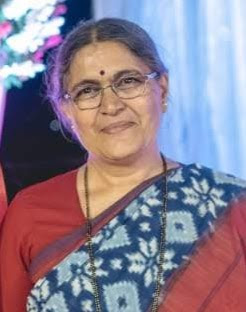
Prof. Vidya Deshpande
Professor Vidya Deshpande has had a journey of more than four decades in the field of education. Her main expertise is in the subject of Philosophy, and she has worked as a teacher of philosophy and logic with Nowrosjee Wadia college for 36 years. She has been associated with the Janakalyan Blood bank for last for 38 years and has also carried out the responsibility as a management committee member of Karve Stree Shikshan Sanstha for 10 years. Her special fields of interest are Philosophy of social sciences, school education, development of skills for self reliance, and top up skills to make students profession ready,