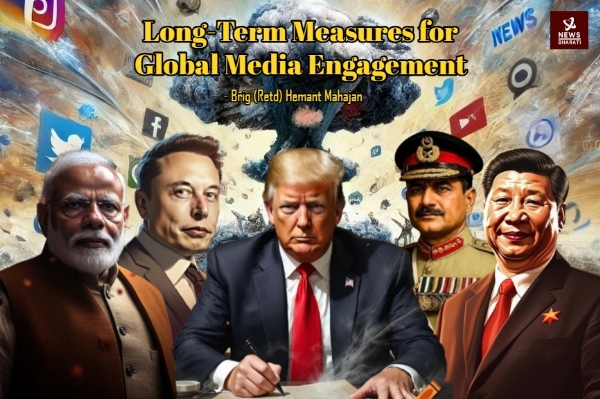
Long-Term Measures for Global Media Engagement
13 Aug 2025 11:49:32
Reframing Strategic Communication as a Core National Security Objective Operation Sindoor underscored the centrality of media based information warfare in modern conflict. Information dominance increasingly shapes strategic outcomes, demanding that India treat communication as a key component of its national security doctrine. Timeliness and credibility are crucial: India's delayed responses allowed adversaries to dominate the narrative, highlighting the need for rapid, verified messaging.
Excessive secrecy, while aimed at preserving operational security, can inadvertently fuel misinformation. Controlled transparency—such as redacted footage or official summaries—can mitigate this risk. Additionally, messaging that resonates domestically may not be effective internationally, necessitating audience-specific strategies that factor in global perceptions and editorial biases.
Institutionalizing Civil-Military Coordination and Diplomatic Messaging To ensure sustained narrative control, India must develop a robust information warfare infrastructure. This includes offensive operations to shape global narratives, defensive capabilities to counter propaganda, and real-time response mechanisms. Civil-military coordination is essential to preserving both domestic morale and international legitimacy.
The interdisciplinary control room set up during Operation Sindoor represents a promising start. Institutionalizing such efforts and integrating them into permanent frameworks will ensure preparedness during future crises. Strategic partnerships—including with tech platforms, fact-checkers, and intelligence allies—can amplify India's reach and effectiveness.
Leveraging AI for Media Monitoring and Disinformation Detection With the proliferation of AI-generated content and bot-driven campaigns, India must invest in AI-enabled tools for real-time media monitoring and threat attribution. These capabilities are essential for building resilience against fast-moving disinformation campaigns.
Proactive Global Media Engagement and Narrative Shaping India must move beyond reactive fact-checking to proactive narrative building. This includes:
- Controlled transparency in crisis communication
- Factually accurate yet emotionally resonant storytelling
- Targeted engagement with Western media and think tanks
- Relationship-building with global opinion leaders
Efforts must also focus on sensitizing international stakeholders to Pakistan-sponsored terrorism and highlighting India's counter-terrorism credentials. Consistent global messaging aligned with democratic values can counteract existing biases.
Elevating the Cognitive Domain in Strategic Planning Victory in modern conflicts extends beyond the battlefield into the cognitive domain. India must formally integrate psychological operations, influence campaigns, and perception management into its strategic planning. These must be pursued responsibly, adhering to democratic principles and international norms.
A clear ethical doctrine governing information warfare is necessary to distinguish India from authoritarian adversaries like China. Internal oversight and accountability will ensure strategic legitimacy and public trust, which are vital long-term assets in the information age.
Winning the Narrative Battle: Strategic Imperatives
Information Dominance: A National Security Priority
In today’s digital age, winning the narrative battle is not an ancillary effort—it is a central pillar of national security. With the boundaries between war and peace, state and non-state actors, and physical and virtual domains becoming increasingly blurred, information dominance has become indispensable. Strategic outcomes and public sentiment can be shaped or shattered by narratives. Without a structured and forward-looking information warfare strategy, India risks ceding the cognitive battlefield to adversaries like China and Pakistan, both of whom have already mastered manipulative influence operations.
Crafting a Balanced and Targeted Information Strategy
A key lesson is the urgent need for a well-balanced information strategy tailored to diverse audiences. A one-size-fits-all approach is ineffective. Messages that resonate domestically may not translate on the international stage. India must identify key target audiences—domestic population, international community, diaspora, and adversaries—and design specific themes and dissemination channels for each. Emotional appeal must be combined with factual accuracy to ensure both credibility and impact.
Empowering Citizens Through Digital Literacy and Platform Accountability
Digital literacy has emerged as a frontline defence against disinformation. Citizens must be equipped with tools and awareness to evaluate the authenticity of information. Simultaneously, there must be regulatory mechanisms to hold tech companies and social media platforms accountable for moderating harmful AI-generated content. The scale of disinformation during Operation Sindoor revealed significant shortcomings in platform responsiveness, highlighting the need for enforceable accountability and transparency frameworks.
Proactive Public Diplomacy and International Engagement
India must leverage public diplomacy to expose proxy-war strategies, particularly Pakistan’s use of terrorism as statecraft. Continued international sensitization, such as through diplomatic delegations, must reinforce India’s narrative on cross-border terrorism and the legitimacy of its position on Jammu, Kashmir, and Ladakh. Global forums must be actively used to list Pakistan-based terrorists and hold Islamabad accountable.
A Whole-of-Nation Approach to Information Warfare
Information warfare is not solely the domain of the armed forces or intelligence agencies—it must involve every segment of Indian society. India needs a "whole-of-nation" approach that includes:
- Incorporating information warfare modules into education systems.
- Encouraging public-private partnerships for cybersecurity and fact-checking.
- Empowering civil society to counteract disinformation.
- At the same time, a robust legal framework is essential—one that balances the need for security with the protection of digital freedoms.
Shaping Global Norms for Information and Cyber Warfare
India must not remain a passive participant but should shape global conversations on cyberspace norms. By advocating for international frameworks against state-sponsored disinformation and cyberattacks, India can align global norms with its interests and limit adversary manoeuvrability. This demands sustained diplomatic engagement and intellectual leadership in multilateral platforms like the UN, G20, and BRICS.
Hybrid Conflicts Demand Hybrid Responses
Future conflicts will be fought as much in the digital and cognitive domains as on physical battlefields. India's ability to shape and control narratives will determine its global standing, internal unity, and strategic success. A reactive posture is no longer viable. India must transition to a proactive and coordinated information warfare strategy that is technologically empowered, institutionally robust, and globally resonant.
Table: Strategic Recommendations for Enhancing India's Information Warfare Capabilities
| Area of Focus | Specific Recommendation | Key Action Points | Expected Outcome |
| Institutional Reform | Establish a National Information Warfare Command | Integrate military, intelligence, diplomatic, and civilian resources under one command with a clear mandate. | Unified response, strategic clarity, and seamless coordination. |
| Capability Development | Build Offensive Cyber and Info-Ops Capabilities | Recruit and train cyber warriors; acquire AI-driven monitoring tools; design pre-bunking mechanisms. | Greater deterrence and faster threat neutralization. |
| Strategic Communication | Adopt Doctrine of Controlled Transparency | Set protocols for information release during crises; leverage OSINT; improve internal coordination. | Reduced disinformation spread and enhanced public confidence. |
| Formulate Audience-Specific Strategies | Define themes and dissemination modes for domestic, international, and diaspora audiences. | More effective, emotionally resonant messaging. | |
| International Engagement | Build Long-Term Global Media Relationships | Engage with journalists, think tanks, and global media even in peacetime; counter biases proactively. | Wider narrative reach and enhanced international credibility. |
| Lead Norm-Setting on Info-Warfare | Influence global frameworks on state behavior in cyberspace and disinformation control. | Constrains adversaries; strengthens India’s diplomatic leverage. | |
| Public Resilience | Launch National Digital Literacy Campaigns | Include in education curricula; create verification apps; educate on narrative manipulation. | A vigilant, resilient society resistant to manipulation. |
| Enforce Tech Platform Accountability | Mandate timely action on harmful content; strengthen laws around AI disinformation. | Safer digital space with greater corporate responsibility. |
Towards Narrative Dominance in Future Conflicts
Operation Sindoor demonstrated India’s capacity for swift and decisive military action. However, it also revealed the increasingly vital role of narrative control and cyber security in shaping the outcomes of modern conflict. India can no longer afford to treat information warfare as an auxiliary domain—it must be integrated into national defence and foreign policy planning.
Going forward, India must focus on establishing global credibility, building counter-disinformation capabilities, and fostering indigenous narrative platforms. Narrative dominance—shaping how the world perceives India’s actions—is now a strategic imperative as crucial as battlefield success.
Toward Narrative Dominance in a Digital Battlefield
India’s response during Operation Sindoor marked a significant evolution in its information warfare doctrine. By combining real-time communication, digital regulation, indigenous technology, and fact-checking, India successfully blunted much of Pakistan’s and China’s disinformation campaigns.
However, the experience also exposed areas for improvement—delayed responses, limited offensive capabilities, and lack of anticipatory communication. Going forward, India must institutionalize offensive information strategies, invest in digital influence capabilities, and develop agile communication protocols to dominate the narrative battlespace of future conflicts.
A Call for Media-Savvy Strategic Communication
Operation Sindoor revealed that in modern warfare, military victories must be complemented by victories in the information domain. India must no longer be reactive or rely solely on press releases. Instead, it needs an institutionalized, proactive strategic communication doctrine—built on trust, consistency, and cultural fluency in the Western media environment
In sum, India's experience during Operation Sindoor offers critical insights into the evolving nature of warfare. Building institutional capability, leveraging advanced technologies, and crafting proactive media strategies are essential steps toward achieving long-term information dominance.
Operation Sindoor: A Wake-Up Call for India's Info-War Doctrine
Operation Sindoor demonstrated that information warfare is now a decisive and integral part of modern hybrid warfare. While India's efforts during the operation neutralized immediate threats, they also exposed significant doctrinal and operational gaps in its information warfare apparatus. The China-Pakistan information nexus showcased the sophistication and impact of coordinated narrative attacks, underscoring the urgent need for India to invest in proactive and institutionalized info-war capabilities.
Final Word: Seizing the Strategic Moment
India stands at a strategic inflection point. The next conflict will not wait for preparation. The opportunity to institutionalize robust information warfare capabilities is now. By embracing a multi-dimensional strategy—combining policy reform, technological excellence, and diplomatic engagement—India can not only safeguard its cognitive space but also shape global opinion and strategic outcomes. Ensuring India’s influence in the international information order is no longer optional—it is essential to national security and sovereignty.
--