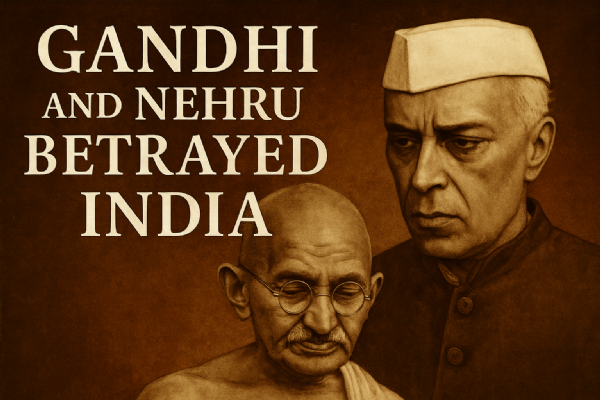
Fifteen Days of Betrayal: How Gandhi’s Idealism and Nehru’s Politics Bled India
14 Aug 2025 15:47:33
It was August 1947, and India stood at the edge of a dream — and a cliff. The tricolour was ready to rise, speeches were being polished, and Delhi’s power circles buzzed with the excitement of freedom. But beyond the polished floors of the Constituent Assembly, the nation’s soil was wet — not with monsoon rain, but with the blood of its own people. Trains groaned under the weight of refugees who might never see their destination. In Punjab, villages burned under the green flags of the Muslim League; in Bengal, the ghosts of Direct Action Day still stalked the streets. Leaders spoke of unity, but the map of India was being torn in backrooms and redrawn in rivers of fire. These were not the days of celebration we remember; they were fifteen days when freedom was born, bleeding.
The Political Theatre and Its Shadows
In Delhi’s corridors of power, Jawaharlal Nehru’s residence at 17 York Road was a hive of activity — anthem debates, ministerial line-ups, and even wardrobe discussions for the big day. Vallabhbhai Patel worked with precision, securing the accession of key princely states, while Hyderabad, Bhopal, and Indore resisted. In the shadows, the Nawab of Bhopal wrote desperate letters to Jinnah, seeking political refuge.
But Delhi’s optimism was not India’s reality. In Kashmir, Gandhi arrived uninvited, refusing royal hospitality to stay with a Congress loyalist. He met Maharaja Hari Singh but avoided advising him to join India — a silence that let Nehru’s backchannel diplomacy gain ground. Gilgit-Baltistan was handed back to the Maharaja by the British — a poisoned gift that would soon revolt.
Blood on the Frontiers
In Punjab, the British-formed Punjab Boundary Force collapsed within days, unable to stem violence. Muslim National Guards openly plotted ethnic cleansing in districts like Lyalpur — “kill the men, keep the girls, seize the land.” Jaranwala burned; families were slaughtered or abducted. Bengal’s Calcutta still carried the scars of last year’s Direct Action Day, and Hindu distrust towards Muslim League promises ran deep.
The north-west was no calmer. In Baluchistan, hollow assurances were traded between Mountbatten, Jinnah, and the Khan of Kalat. In Nagaland, the Independent League declared it would not join the Indian Union, foreshadowing decades of insurgency.
Gandhi’s Moral Gambles
Gandhi’s fortnight was a study in moral conviction — and in some eyes, dangerous idealism. At the Wah refugee camp, filled with Hindus and Sikhs brutalised in riots, he urged victims to “face death with a smile” and trust Jinnah’s word. In Calcutta, he shared a dilapidated house with Suhrawardy, the man many held responsible for the 1946 massacres, hoping to heal divisions through personal example.
His interventions brought fragile peace to parts of Bengal, but his refusal to endorse firm security measures left refugees feeling abandoned. His Lahore comment — that he would not salute a tricolour without the charkha — drew nationwide outrage when families were fighting to keep their daughters safe.
Women Who Would Not Stand Aside
While Delhi debated symbolism, the Rashtriya Swayamsevak Sangh and the Rashtriya Sevika Samiti moved quietly into danger zones. Led by Lakshmibai Kelkar, Sevika volunteers entered hostile Sindh and Karachi to protect Hindu women and children. RSS swayamsevaks patrolled neighbourhoods in Punjab and Sindh, escorting refugees to safety when official forces were absent or overwhelmed.
In Mumbai’s Dadar, Sevikas planned relief missions to violence-hit areas; in Punjab, RSS volunteers stood guard for days without sleep. These were not grand speeches; these were life-saving acts the official histories rarely record.
Pakistan’s Birth and the Mirage of Assurances
As 14 August approached, Karachi’s Assembly Hall prepared for Pakistan’s inauguration. Lord Mountbatten spoke of goodwill; Jinnah promised religious freedom. In Delhi, the Constituent Assembly met under monsoon rains, with Rajendra Prasad honouring the sacrifices made for freedom.
But on the ground, the gap between rhetoric and reality widened. In Lahore, Hindus and Sikhs were being hunted. Trains packed with refugees were stopped and turned into death chambers. In Srinagar, the premature hoisting of Pakistan’s flag at the post office triggered a swift reaction from Hindu volunteers who tore it down — a small sign of the battles ahead for Kashmir.
Midnight’s Contradictions
The night of 14-15 August was split in two. In Karachi, Pakistan celebrated its birth. In Delhi, Nehru delivered the “tryst with destiny” speech, Mountbatten was sworn in as Governor-General, and the tricolour rose over the Council House. Crowds chanted “Vande Mataram” where, days earlier, the common man was not even allowed entry.
In Calcutta, Hindus and Muslims embraced in relief — a fragile peace credited to Gandhi’s presence. In Mumbai, Savarkar raised both the saffron flag and the tricolour, a reminder of the unity once dreamt of.
But in Punjab, the night was no festival. The Radcliffe Line, though not yet announced, was already being enforced in blood. Refugee convoys were attacked, entire villages wiped out. Volunteer groups worked in desperation to shepherd survivors to safety.
Freedom’s First Morning
On 15 August, India was independent but incomplete. Goa, Pondicherry, and French enclaves remained under foreign control. The North-West Frontier Province had gone to Pakistan; Hyderabad and Kashmir’s futures were undecided.
Dr. Ambedkar’s call for a complete population exchange was rejected by Congress, leaving millions in limbo. Gandhi’s hope that the Muslim League, having gained Pakistan, would abandon communal politics proved tragically wrong. Within days, the promise of minority safety in Pakistan evaporated.
The announcement of the Radcliffe Line on 17 August detonated a humanitarian disaster: one million dead, 15 million displaced, countless women abducted, sacred sites like Nankana Sahib and Dhakeshwari lost to India forever.
The Price and the Blindness
Even as these tragedies unfolded, political power consolidated in Delhi. The RSS and Hindu Mahasabha, which had risked everything to protect fleeing Hindus and Sikhs, found themselves targeted by the Congress government. By the first anniversary of freedom, Savarkar and RSS leaders were jailed under false charges, while those tied to the British system sat secure in power.
Gandhi was assassinated in January 1948; Jinnah was dead by September. Hyderabad was integrated by force; Kashmir was plunged into war. The optimism of August had given way to the grim labour of nation-building amid trauma.
What These Fifteen Days Tell Us
This was not a clean break from colonialism; it was a handover wrapped in chaos. Freedom’s script was written in the language of moral posturing in Delhi, but enacted in the grit of Punjab’s burning fields, Bengal’s shattered lanes, and Sindh’s fleeing caravans.
The first fortnight of August 1947 was not merely a prelude to independence — it was the test India had to take before earning it. And the marks we scored then still show in our fractures today.