Recent Findings at Anantnag Echo the Legacy of Kashmir's Karkota Dynasty
20 Aug 2025 16:33:15
The soil of Kashmir has once again revealed its civilizational memory. In Jammu and Kashmir’s Anantnag district, at Saleya village near the ancient spring of Karukoot Nag in the Aishmuqam region, an excavation undertaken during the rejuvenation of the water source has unearthed a remarkable set of idols. Among the 15 idols discovered, 11 are Shivalingas, accompanied by other deities and religious symbols.
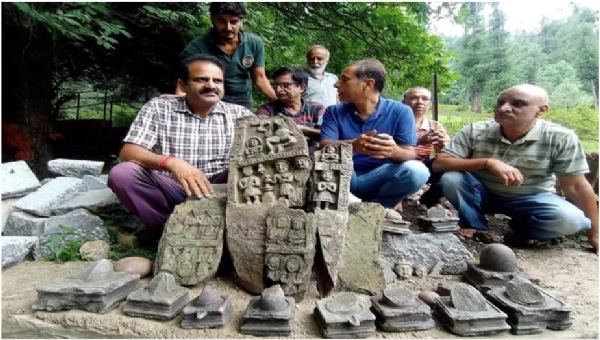
Archaeological authorities believe these findings may be associated with the Karkota dynasty (625–855 CE), a ruling house of Kashmir that was firmly rooted in Sanatan Dharma and shaped much of northern India’s cultural, spiritual, and political landscape.
Kashmir and the Karkota Legacy
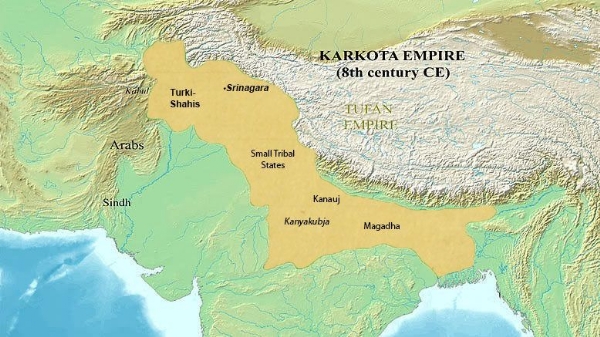
The Karkota dynasty represents a golden age in Kashmir’s history. Founded by King Durlabhavardhana, the dynasty reached its peak under the reign of Lalitaditya Muktapida (c. 724–760 CE), remembered as one of Bharat’s most powerful emperors. His dominion extended from the Gangetic plains to Central Asia, and from Bengal to parts of southern India. So expansive was his influence that he was described as “Kashmir’s Alexander.”
Chinese pilgrim Xuanzang mentioned the Karkota rulers in his travel records, and Kalhana’s Rajatarangini also documents their contributions to politics, art, and religion. Lalitaditya is credited with constructing the grand Martand Sun Temple, whose ruins even today testify to Kashmir’s architectural and spiritual grandeur.
The idols unearthed in Anantnag stand as archaeological witnesses to this period. They reaffirm that Shaivism and Hindu dharma were not just practiced but deeply embedded in the cultural identity of Kashmir.
Anantnag: A Sacred Shaiva Landscape
The discovery of 11 Shivalingas is significant in understanding Kashmir’s place as a center of Shaiva tradition. The region has long been associated with Shaiv Darshan, one of the most profound philosophical streams of Hindu thought. The annual Amarnath Yatra continues to embody this living tradition, where lakhs of devotees undertake a spiritual journey that is as much about self-discovery as devotion.
The fact that these Shivalingas were found at Karukoot Nag further deepens their symbolic importance. The word Karukoot is derived from Karkotaka in Sanskrit, tying the site’s nomenclature itself to the Karkota lineage. In Sanatan traditions, Nagas (serpent deities) and water bodies have held sacred associations, representing fertility, protection, and divine guardianship of nature’s sources. Anantnag itself is dotted with sacred springs and Nag shrines, with Papaharan Nag and Karukoot Nag temples being central to Kashmiri Pandit traditions.
Civilizational and Cultural Continuity
The idols are not just stone relics but reminders of the cultural and spiritual continuity of Kashmir, a land that for centuries was known as Sharada Peeth or Sharada Desh—a hub of knowledge and dharma. For nearly seven centuries (7th–13th CE), Kashmir led India intellectually and spiritually, producing great philosophers like Abhinavagupta and Anandavardhana.
This excavation adds another chapter to that legacy. The very presence of multiple Shivalingas together signifies the vibrancy of Shaiva worship in the region. It reinforces that Hindu dharma was not imported into Kashmir but is indigenous to its soil, water, and mountains.
A Ray of Hope for Kashmiri Pandits
For the Kashmiri Pandit community, displaced from their ancestral homeland in the late 20th century, such findings carry profound emotional weight. These idols symbolize not just religious heritage but also a cultural anchor that ties the community to its roots. They are living proof of an unbroken link to the land and its dharmic traditions, despite centuries of upheavals and displacements.
The Broader Geopolitical Context
At a time when expansionist powers like China attempt to rewrite history by making false cultural claims over border regions like Ladakh and Aksai Chin, discoveries such as the Anantnag idols serve as a civilizational counterclaim. The spread and influence of the Karkota dynasty across Central Asia, Afghanistan, and even into Tibet remind us that Bharat’s cultural reach was historically far deeper than what modern borders depict.
The idols unearthed in Kashmir thus not only reaffirm the valley’s Hindu roots but also stand as silent witnesses against narratives that seek to erase or distort India’s civilizational heritage.
The excavation at Anantnag is more than just an archaeological discovery. It is a rediscovery of Kashmir’s essence—a land of Shiva, of sacred springs, of temples and philosophy, of dynasties that upheld Sanatan Dharma while shaping India’s destiny. The Shivalingas and idols unearthed from the soil remind us that no matter how much time passes, the civilizational memory of Bharat continues to emerge, reaffirming its timeless legacy.
--