The Deep State Formula to Kill Democracy: Congress Lies, CSDS-Lokniti Flawed Data and Dollars From Abroad
21 Aug 2025 12:48:27
In recent months, one allegation after another by the Congress party and Rahul Gandhi regarding India’s electoral system has crumbled under scrutiny. The most recent flashpoint came when Sanjay Kumar, senior psephologist at the Centre for the Study of Developing Societies (CSDS) and co-director of its Lokniti programme, apologised after posting misleading claims about massive discrepancies in Maharashtra’s electoral rolls.
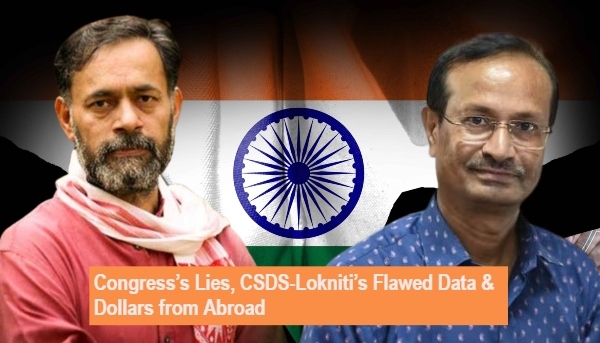
Kumar had alleged that constituencies like Ramtek and Devlali had mysteriously lost over a third of their voters, while Nashik West and Hingna showed improbable surges of over 40%. Congress leaders including Pawan Khera swiftly weaponised these claims as “proof” of electoral fraud, providing fuel for the party’s “vote chori” campaign against the Election Commission of India (ECI). Within hours, the claims were amplified across social media, lending legitimacy to Congress’s ongoing campaign of "vote theft" that India’s elections were being manipulated.
Yet, within two days, it was collapsed. Kumar admitted that his team had “misread the data” and issued a public apology. But by then, the damage was done. Congress refused to retract its accusations, with spokesperson Sujata Paul dismissing Kumar’s apology as “his problem, not ours.” The BJP launched a counter-offensive, accusing both Kumar and Congress of running a coordinated disinformation campaign.
The most serious response came from the Indian Council of Social Science Research (ICSSR), the apex government body under the Ministry of Education, which has been CSDS’s primary funder. It declared the incident a “gross violation of Grant-in-Aid rules” and issued a show-cause notice to CSDS. This was not merely an academic embarrassment; it was an institutional crisis. Between 2020–21 and 2023–24, CSDS received nearly ₹140 crore in grants from ICSSR, raising a legitimate question: why is taxpayers’ money being funnelled into an institution whose errors—convenient or otherwise—are repeatedly weaponised to attack democratic institutions?
Source: Education.Gov.In
To understand the weight Kumar’s claims carried, one must examine the stature CSDS has carefully cultivated. Founded in 1963 by Rajni Kothari, it was projected as a hub for alternative social science research outside Western frameworks. But over the decades, it evolved into a political actor disguised as a research institute.
Its influence is derived from the Lokniti programme (1997), which has become synonymous with psephology in India. Lokniti’s National Election Studies (NES), revived by Yogendra Yadav, created a vast archive of electoral data. More importantly, Lokniti tied itself to media partnerships with outlets such as The Hindu, ensuring that every election cycle, CSDS’s interpretations dominated headlines. Instead of remaining neutral, CSDS became an agenda-setter in political discourse, shaping how results were explained to the public.

Source: Lokniti


Across their publications, Hindu voters are fragmented into endless caste categories, while Muslims are portrayed as a unified “vote bank.” This selective framing fuels narratives of division, reinforcing Congress’s electoral strategies.
The ideological DNA of Lokniti cannot be separated from its architect, Yogendra Yadav. As founder-director, Yadav revived election studies and pioneered the practice of funding surveys through media sponsorships. But his journey did not end in academia. He transitioned into politics—co-founding the Aam Aadmi Party, later founding Swaraj India, and eventually aligning himself with Congress’s Bharat Jodo Yatra and Bharat Jodo Abhiyaan.
Since 2014, Yadav has relentlessly attacked the Election Commission, branding it “political,” “untrustworthy,” and guilty of holding the “most shameful” press conference in its history. He has repeatedly echoed Rahul Gandhi’s charges of voter list manipulation. Significantly, such rhetoric was absent before 2014, raising doubts about whether Yadav’s positions are objective academic critiques or thinly veiled political strategies.
Yadav’s worldview—that the BJP’s rise is a “threat to democracy”—shaped Lokniti’s analytical lens. Sanjay Kumar, often described as Yadav’s protégé, inherited this intellectual framework, ensuring continuity in CSDS’s ideological trajectory.

CSDS’s clout is not built on scholarship alone. Its financial scaffolding reveals heavy dependence on foreign funding. While ICSSR has provided steady government grants, international donors have shaped much of its agenda.
Ford Foundation: Gave CSDS a major endowment in 2000 and at least $739,500 in project-specific grants, targeting caste divisions, Muslim identity politics, rural crises, and democratization debates. One grant of $200,000 in 2008 was explicitly “to facilitate civil society engagement with mainstream media.”

Source: Ford Foundation
International Development Research Centre (IDRC, Canada): Supported CSDS under the Think Tank Initiative (2009–2019) to promote “inclusive governance.”
Other Alleged Funders: Reports suggest involvement of the Gates Foundation, NORAD (Norway), Hewlett Foundation, and Dutch agencies.
These funders emphasise “inequality,” “social justice,” and “minority rights.” CSDS’s research mirrors these themes almost exactly. Far from being a neutral think tank, CSDS functions as a node in a global network that exports Western identity politics into India’s democratic discourse.
Hindu voters: Broken down into upper castes, OBCs, Dalits, Adivasis, even sub-castes within SC groups—projecting Hindus as divided and conflicted.
Muslim voters: Treated as a single bloc, despite internal divisions (Ashraf vs. Pasmanda). Public-facing reports repeatedly describe a “consolidated Muslim vote.”
This asymmetry is not accidental. It perpetuates a narrative where Hindus are fragmented while minorities are unified, conveniently serving the opposition’s electoral strategies. In effect, CSDS transforms social science into narrative engineering, subsidised by foreign grants.
The August 2025 controversy was not merely an academic slip. It exposed the machinery of narrative warfare:
This is not merely flawed research. It is foreign-funded propaganda, designed to delegitimise India’s institutions and weaken the democratic fabric of the world’s largest democracy.
Kumar had alleged that constituencies like Ramtek and Devlali had mysteriously lost over a third of their voters, while Nashik West and Hingna showed improbable surges of over 40%. Congress leaders including Pawan Khera swiftly weaponised these claims as “proof” of electoral fraud, providing fuel for the party’s “vote chori” campaign against the Election Commission of India (ECI). Within hours, the claims were amplified across social media, lending legitimacy to Congress’s ongoing campaign of "vote theft" that India’s elections were being manipulated.
Yet, within two days, it was collapsed. Kumar admitted that his team had “misread the data” and issued a public apology. But by then, the damage was done. Congress refused to retract its accusations, with spokesperson Sujata Paul dismissing Kumar’s apology as “his problem, not ours.” The BJP launched a counter-offensive, accusing both Kumar and Congress of running a coordinated disinformation campaign.
The most serious response came from the Indian Council of Social Science Research (ICSSR), the apex government body under the Ministry of Education, which has been CSDS’s primary funder. It declared the incident a “gross violation of Grant-in-Aid rules” and issued a show-cause notice to CSDS. This was not merely an academic embarrassment; it was an institutional crisis. Between 2020–21 and 2023–24, CSDS received nearly ₹140 crore in grants from ICSSR, raising a legitimate question: why is taxpayers’ money being funnelled into an institution whose errors—convenient or otherwise—are repeatedly weaponised to attack democratic institutions?

Source: Education.Gov.In
CSDS and the Making of Influence
To understand the weight Kumar’s claims carried, one must examine the stature CSDS has carefully cultivated. Founded in 1963 by Rajni Kothari, it was projected as a hub for alternative social science research outside Western frameworks. But over the decades, it evolved into a political actor disguised as a research institute.
Its influence is derived from the Lokniti programme (1997), which has become synonymous with psephology in India. Lokniti’s National Election Studies (NES), revived by Yogendra Yadav, created a vast archive of electoral data. More importantly, Lokniti tied itself to media partnerships with outlets such as The Hindu, ensuring that every election cycle, CSDS’s interpretations dominated headlines. Instead of remaining neutral, CSDS became an agenda-setter in political discourse, shaping how results were explained to the public.
Faculty and the Politics of Division
A deeper look into Lokniti’s faculty shows a consistent pattern: an obsession with caste and minority politics.- Mohd. Sanjeer Alam: Focuses on Muslim exclusion, affirmative action, and socio-spatial disadvantages of minorities.
- Hilal Ahmed: Centres his work on Muslim identity, caste within Islam, and political Islam, with writings such as Allah Naam ki Siyasat.
- Sanjay Kumar: The most visible face of Lokniti, regularly interprets elections through caste coalitions and Hindu fragmentation, while presenting Muslims as a consolidated bloc.
- V. B. Singh: A veteran, concentrated his scholarship on caste-based political mobilisation and ethnic politics.
Source: Lokniti
Across their publications, Hindu voters are fragmented into endless caste categories, while Muslims are portrayed as a unified “vote bank.” This selective framing fuels narratives of division, reinforcing Congress’s electoral strategies.
The Yogendra Yadav Legacy
The ideological DNA of Lokniti cannot be separated from its architect, Yogendra Yadav. As founder-director, Yadav revived election studies and pioneered the practice of funding surveys through media sponsorships. But his journey did not end in academia. He transitioned into politics—co-founding the Aam Aadmi Party, later founding Swaraj India, and eventually aligning himself with Congress’s Bharat Jodo Yatra and Bharat Jodo Abhiyaan.
Since 2014, Yadav has relentlessly attacked the Election Commission, branding it “political,” “untrustworthy,” and guilty of holding the “most shameful” press conference in its history. He has repeatedly echoed Rahul Gandhi’s charges of voter list manipulation. Significantly, such rhetoric was absent before 2014, raising doubts about whether Yadav’s positions are objective academic critiques or thinly veiled political strategies.
Yadav’s worldview—that the BJP’s rise is a “threat to democracy”—shaped Lokniti’s analytical lens. Sanjay Kumar, often described as Yadav’s protégé, inherited this intellectual framework, ensuring continuity in CSDS’s ideological trajectory.

The Money Trail: Foreign Influence
CSDS’s clout is not built on scholarship alone. Its financial scaffolding reveals heavy dependence on foreign funding. While ICSSR has provided steady government grants, international donors have shaped much of its agenda.
Ford Foundation: Gave CSDS a major endowment in 2000 and at least $739,500 in project-specific grants, targeting caste divisions, Muslim identity politics, rural crises, and democratization debates. One grant of $200,000 in 2008 was explicitly “to facilitate civil society engagement with mainstream media.”
Source: Ford Foundation
International Development Research Centre (IDRC, Canada): Supported CSDS under the Think Tank Initiative (2009–2019) to promote “inclusive governance.”
Other Alleged Funders: Reports suggest involvement of the Gates Foundation, NORAD (Norway), Hewlett Foundation, and Dutch agencies.
These funders emphasise “inequality,” “social justice,” and “minority rights.” CSDS’s research mirrors these themes almost exactly. Far from being a neutral think tank, CSDS functions as a node in a global network that exports Western identity politics into India’s democratic discourse.
Methodology as Political Activism
The most damning critique of CSDS lies in its methodology. While it gathers data rigorously, its analysis is politically selective.Hindu voters: Broken down into upper castes, OBCs, Dalits, Adivasis, even sub-castes within SC groups—projecting Hindus as divided and conflicted.
Muslim voters: Treated as a single bloc, despite internal divisions (Ashraf vs. Pasmanda). Public-facing reports repeatedly describe a “consolidated Muslim vote.”
This asymmetry is not accidental. It perpetuates a narrative where Hindus are fragmented while minorities are unified, conveniently serving the opposition’s electoral strategies. In effect, CSDS transforms social science into narrative engineering, subsidised by foreign grants.
The August 2025 controversy was not merely an academic slip. It exposed the machinery of narrative warfare:
- Foreign donors supply funds to institutions such as CSDS.
- CSDS-Lokniti frames research to magnify caste divisions and minority victimhood.
- Congress politicians weaponise this research to attack the Election Commission and the BJP.
- Sympathetic media outlets amplify these claims as “neutral scholarship.”
This is not merely flawed research. It is foreign-funded propaganda, designed to delegitimise India’s institutions and weaken the democratic fabric of the world’s largest democracy.