More than a language, Sanskrit covers cosmos to computation
Total Views |


Sanskrit is often celebrated as the language of the Vedas. However, it would be wrong to limit it only to rituals or scriptures, as that ignores its vast richness. It is a tool of knowledge, a structure of logic, and a system of sound that has informed human inquiry for millennia. From the chanting of mantras to the formulation of algorithms, Sanskrit has served as a bridge between the spiritual and the scientific, between the wisdom of the ancients and the explorations of the modern age.
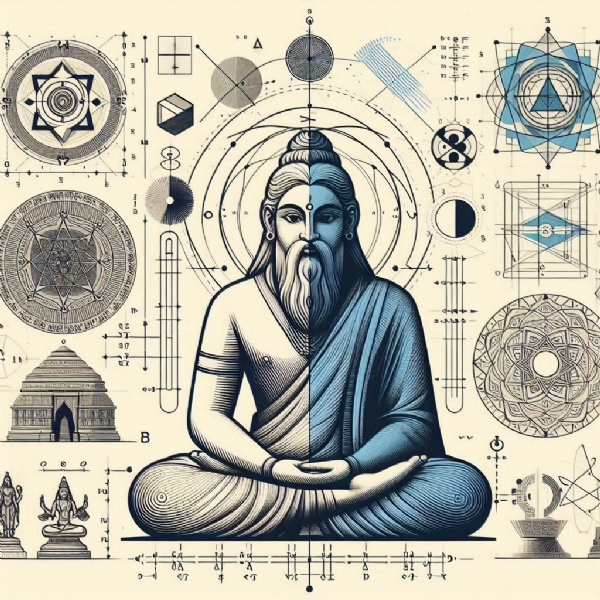
Where most languages evolved organically with ambiguity, Sanskrit was deliberately codified. This deliberate design gave it a reach that extended into mathematics, cosmology, medicine, and today, even artificial intelligence.
Sanskrit lies in its phonetic system, which is perhaps the most methodical in human history. Unlike arbitrary sound clusters in other languages, Sanskrit aligns each phoneme with a distinct organ of speech — throat, palate, tongue, teeth, and lips. The classification is anatomical, not abstract. This is why when a student learns Sanskrit sounds, he learns simultaneously how his body produces them.
Such precision was not merely academic. Mantras, central to Vedic practice, were crafted as sequences of vibrations that resonate with breath and articulation. Their effectiveness, traditionally said to influence consciousness, rests in part on this physiological harmony. Far from being mystical chants alone, mantras can be understood as engineered patterns of sound that align mind, body, and breath in one rhythmic flow — a science of vibration long before modern phonetics or speech therapy formalised the connection.
Sanskrit also proved to be an unparalleled vessel for mathematics. Aryabhata in the 6th century encoded numbers into syllables, allowing vast values to be composed within verse. By assigning digits to consonants and vowels, entire astronomical calculations could be preserved in compact poetic form.
Brahmagupta took this tradition further, formalising the use of zero as a number with operational rules — a leap that changed mathematics forever. Unlike ordinary languages, where expressing such abstractions requires cumbersome explanations, Sanskrit’s tight grammar and symbolic flexibility made it ideal for encoding large magnitudes and minute fractions alike. In effect, Sanskrit was not only a medium of poetry but also of numerical logic, foreshadowing the compact symbolic systems of modern computation.
Cosmology too found in Sanskrit a voice of precision and metaphor. The Upanishads described creation as emerging step by step from an undifferentiated reality — space, air, fire, water, and earth unfolding in order. This layered vision of emergence mirrors the explanatory frameworks of physics, where complexity arises from simplicity.
When modern cosmology speaks of the Big Bang expanding from a singularity, one cannot help but hear echoes of the Sanskritic imagination, which linked linguistic order with universal order. Sanskrit thus did not merely describe rituals of worship; it articulated a vision of the cosmos, bridging spiritual intuition with rational inquiry.
Sanskrit’s descriptive power extended into medicine. In texts like the Suśruta and Charaka Saṃhitās, anatomical terms were chosen with semantic transparency. Words such as hṛdaya (heart, “to receive and to give”) or yakṛt (liver, signifying transformation) conveyed not just location but function. The language itself taught physiology.
This economy of meaning ensured that students of Ayurveda were not memorising arbitrary names but internalising a logic of the body. The skull as kapāla (a bowl), the gall bladder as pittāśaya (“seat of bile”) — each word was an instruction as well as a label. It made Sanskrit a teaching tool as much as a descriptive one, a language where etymology became anatomy.
Nowhere is Sanskrit’s scientific genius more evident than in its grammar. Panini’s Aṣṭādhyāyī is a system of nearly 4,000 rules that generate the entire language with algorithmic precision. Each rule operates deterministically, interacting with others in a self-contained logical structure.
This is why modern computer scientists have seen in Panini’s grammar an early model of formal languages and compilers. Where today’s programming depends on unambiguous syntax and rule-based generation, Panini anticipated the principle over two thousand years ago. Recent work in artificial intelligence has revisited Sanskrit’s grammar as a framework for semantic clarity in machine translation and natural language processing. What was once designed to preserve sacred hymns now serves as inspiration for computational models of human language.
Sanskrit’s genius is not locked in the past. It lives in every sphere where structure, clarity, and precision matter. It shaped the chants of the ritual fire, the calculations of astronomy, the healing principles of Ayurveda, and now the architectures of artificial intelligence.
It is at once the sound of devotion and the code of science. Its roots are ancient, yet its branches reach into the future. In Sanskrit, the human quest for meaning, order, and discovery has found a timeless companion — a language that remains not only classical but eternal, not only spiritual but scientific, not only ancient but futuristic.
Source: Vayuveg
Where most languages evolved organically with ambiguity, Sanskrit was deliberately codified. This deliberate design gave it a reach that extended into mathematics, cosmology, medicine, and today, even artificial intelligence.
The Science of Sound
Sanskrit lies in its phonetic system, which is perhaps the most methodical in human history. Unlike arbitrary sound clusters in other languages, Sanskrit aligns each phoneme with a distinct organ of speech — throat, palate, tongue, teeth, and lips. The classification is anatomical, not abstract. This is why when a student learns Sanskrit sounds, he learns simultaneously how his body produces them.
Such precision was not merely academic. Mantras, central to Vedic practice, were crafted as sequences of vibrations that resonate with breath and articulation. Their effectiveness, traditionally said to influence consciousness, rests in part on this physiological harmony. Far from being mystical chants alone, mantras can be understood as engineered patterns of sound that align mind, body, and breath in one rhythmic flow — a science of vibration long before modern phonetics or speech therapy formalised the connection.
Numbers in Verse
Sanskrit also proved to be an unparalleled vessel for mathematics. Aryabhata in the 6th century encoded numbers into syllables, allowing vast values to be composed within verse. By assigning digits to consonants and vowels, entire astronomical calculations could be preserved in compact poetic form.
Brahmagupta took this tradition further, formalising the use of zero as a number with operational rules — a leap that changed mathematics forever. Unlike ordinary languages, where expressing such abstractions requires cumbersome explanations, Sanskrit’s tight grammar and symbolic flexibility made it ideal for encoding large magnitudes and minute fractions alike. In effect, Sanskrit was not only a medium of poetry but also of numerical logic, foreshadowing the compact symbolic systems of modern computation.
Mapping the Cosmos
Cosmology too found in Sanskrit a voice of precision and metaphor. The Upanishads described creation as emerging step by step from an undifferentiated reality — space, air, fire, water, and earth unfolding in order. This layered vision of emergence mirrors the explanatory frameworks of physics, where complexity arises from simplicity.
When modern cosmology speaks of the Big Bang expanding from a singularity, one cannot help but hear echoes of the Sanskritic imagination, which linked linguistic order with universal order. Sanskrit thus did not merely describe rituals of worship; it articulated a vision of the cosmos, bridging spiritual intuition with rational inquiry.
The Anatomy of Words
Sanskrit’s descriptive power extended into medicine. In texts like the Suśruta and Charaka Saṃhitās, anatomical terms were chosen with semantic transparency. Words such as hṛdaya (heart, “to receive and to give”) or yakṛt (liver, signifying transformation) conveyed not just location but function. The language itself taught physiology.
This economy of meaning ensured that students of Ayurveda were not memorising arbitrary names but internalising a logic of the body. The skull as kapāla (a bowl), the gall bladder as pittāśaya (“seat of bile”) — each word was an instruction as well as a label. It made Sanskrit a teaching tool as much as a descriptive one, a language where etymology became anatomy.
Grammar as Algorithm
Nowhere is Sanskrit’s scientific genius more evident than in its grammar. Panini’s Aṣṭādhyāyī is a system of nearly 4,000 rules that generate the entire language with algorithmic precision. Each rule operates deterministically, interacting with others in a self-contained logical structure.
This is why modern computer scientists have seen in Panini’s grammar an early model of formal languages and compilers. Where today’s programming depends on unambiguous syntax and rule-based generation, Panini anticipated the principle over two thousand years ago. Recent work in artificial intelligence has revisited Sanskrit’s grammar as a framework for semantic clarity in machine translation and natural language processing. What was once designed to preserve sacred hymns now serves as inspiration for computational models of human language.
A Timeless Relevance
Sanskrit’s genius is not locked in the past. It lives in every sphere where structure, clarity, and precision matter. It shaped the chants of the ritual fire, the calculations of astronomy, the healing principles of Ayurveda, and now the architectures of artificial intelligence.
It is at once the sound of devotion and the code of science. Its roots are ancient, yet its branches reach into the future. In Sanskrit, the human quest for meaning, order, and discovery has found a timeless companion — a language that remains not only classical but eternal, not only spiritual but scientific, not only ancient but futuristic.
Source: Vayuveg