Modi at Gangaikonda Cholapuram: Reclaiming Rajendra Chola's Legacy from Separatist Narratives
04 Aug 2025 15:47:02
During his recent visit to Tamil Nadu, Prime Minister Narendra Modi visited the ancient city of Gangaikonda Cholapuram and paid homage to Rajendra Chola I, on his birth anniversary. At the same time, the Prime Minister set the narrative straight that no separatist agenda will be tolerated encroaching over the legacy of national heroes. While he was clad in traditional Tamil attire and addressing the gathering in Tamil, Modi retraced the footsteps of Rajendra Chola I, as a bold assertion of Bharat’s cultural unity. What did he do that was more than merely a political gesture, let’s see;
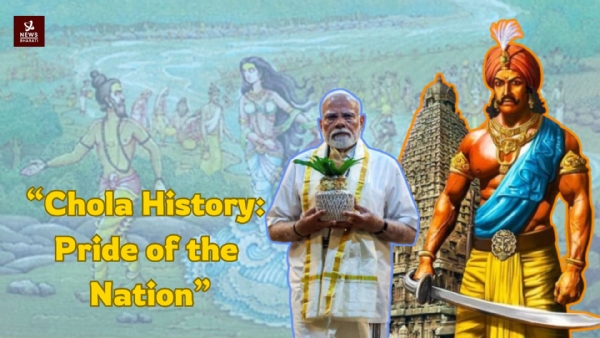
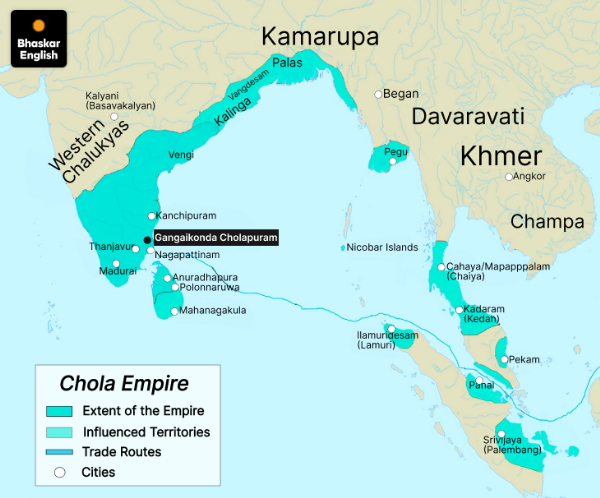
Firstly & most importantly, Rajendra Chola I, one of the greatest emperors of the Chola dynasty, was not a regional monarch restricted to the regional boundaries of Tamil speaking areas. A fact that even the Prime Minister kept on subtly highlighting through his words and actions, during the visit. His reign between 1014 and 1044 CE marked a civilisational expansion rooted in Dharma, conquest, and spiritual synthesis. His legendary Gangetic expedition from Tamil Nadu to Bengal between 1019–1021 CE was a military expedition rooted in his pan-Indian civilisational vision. By bringing back the sacred waters of the Ganga and founding the city of Gangaikonda Cholapuram, Rajendra Chola embedded the spiritual heart of North India into the cultural and administrative core of the South.
The Gangaikondacholisvarar Temple, modeled after the Peria Koil of Thanjavur but more intricate in sculpture and subtle in architecture, became the crowning jewel of his capital. Alongside it, the creation of the Chola Gangam lake, a 17 km manmade reservoir, was a marvel of ecological foresight. Its advanced water management system showcased a blend of dharmic duty and scientific genius, echoing the civilisational ethos that balanced power with sustainability.
While invoking Rajendra Chola’s memory, PM Modi reminded the nation of the same balance; between expansion and ethics, tradition and transformation. It was not coincidental that he chose to mark the Chola king’s birth anniversary by visiting the same land where Ganga was ritually poured into Tamil soil. It was a symbolic act of reclamation, drawing a straight line from a Chola emperor’s integrated vision to a modern Indian state asserting its civilisational continuity.
This visit also served as a subtle ideological rebuttal to narratives that have for decades tried to isolate Tamil history from Indian civilisational identity. The Dravidianist discourse, especially led by the DMK, has long promoted a "Tamil-first" identity positioned in opposition to a so-called "Aryan" or "North Indian" cultural influence. Ironically, Rajendra Chola himself defies this binary. He was a Tamil king who conquered the north, claimed the Ganga, and celebrated his victories by spiritual integration, not separatism.
Therefore, even though PM Modi’s tribute may seem as an act of historical nostalgia, it was actually a civilisational statement: Tamil pride is not antithetical to Bharatiya identity but it is foundational to it. The Chola empire was not isolationist but expansive in scope and deeply dharmic in worldview. By acknowledging this, the Prime Minister challenged the ideological monopoly of Dravidian parties that have historically presented Tamil Nadu as a cultural outlier.
Since 2021, the DMK has attempted to rebrand itself by organizing temple festivals, renovating shrines, and promoting spiritual tourism. But these measures often appear as reactionary optics, spurred by growing public pressure and nationalist critique. The same party that once dismissed temple rituals now seeks political mileage through temple events—while continuing to subtly uphold separatist cultural narratives.
In contrast, the BJP’s approach has been to root Tamil pride within India’s civilisational fabric. From restoring stolen Chola-era artifacts to referencing the Sengol, and organizing cultural exchanges like Kashi-Tamil Sangamam, the Modi government has sought to dismantle the North-South divide fabricated by colonial and Marxist historians.
PM Modi wasn’t exaggerating when he said that Rajendra Chola was a leader who “balanced conquest with sustainability”. Rajendra Chola I built temples and at the same time also developed ecosystems, both material and moral. His Chola Gangam lake was a model of environmental wisdom. It featured sediment traps and silt-releasing mechanisms that enriched surrounding paddy fields. This was happening centuries before “sustainability” became a global buzzword.
This alignment of civilisational symbolism with modern development is what Modi encapsulates in his philosophy of “Vikas bhi, Virasat bhi”. India’s path to becoming a Viksit Bharat must rise from its roots, not abandon them.
Rajendra Chola I was hailed as ‘Trisamudreshwar’ (God of three oceans). Today, as India pursues the Act East policy, strengthens its naval power, and builds maritime alliances in the Indo-Pacific, the legacy of this dharmic sea conqueror becomes even more relevant. Modi’s homage is therefore even strategic, tying together national identity, maritime vision, cultural resurgence, and geopolitical assertion.
Gangaikonda Cholapuram, once the spiritual-political center of the Chola might, is now contributing as a civilisational bridge between North and South, the divide that was created and is being nurtured even today, for political gains. By walking the same path Rajendra Chola I did a millennium ago, Prime Minister Modi has signaled that India’s greatness lies not just in its ancient glory, but in its ability to carry that legacy forward and that too as the nation stands united, and sided with dharma.
-- The article has referred research provided by Vayuveg
--