Relative Happiness- Urban Vs Rural
06 Aug 2025 16:55:52
According to some estimates India has 6 lakh 40 thousand plus villages, housing a major portion of our population. Around seven metros and several large Tier one and two cities cover majority of urban land scape.
We the urban people of India live in our own cozy comfort zone – sometimes not cozy at all. We the so called elite have amenities which are supposed to be available to every citizen on this earth irrespective of the class or country. For instance, every house hold must have electricity, toilette facility, potable water to bathe and drink, green energy to cook and road connectivity.
We in India for the last several decades have been coining funny slogans like ‘Roti, Kapada aur Makan’ which means ‘food, clothing and a decent home as shelter’. These are the bare necessities of ‘jungle book’ level. Picturized on a huge cute bear singing a song to this tune.
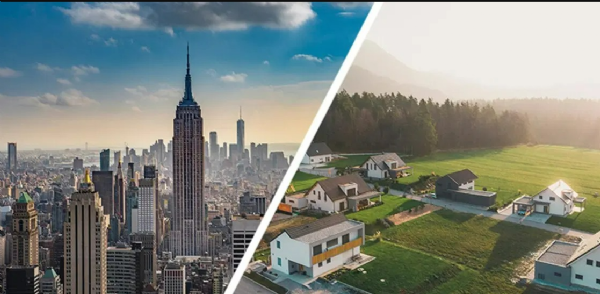
Now the fifth largest economy. Can we still be struggling for bear necessities? No sane mind will agree to this. But that has been the fact.
The Urban life style
It is life but not necessarily a stylish one for all. People in towns or large cities have access to tap water, electricity, and several toilettes. Which are required for survival- without this also we survived. Electricity and water connections were available, yet not very efficient to anyone’s liking.
For the first two decades after independence we didn’t have clean energy for cooking. Everyone was cooking food on stoves powered by Kerosene oil! Rural India was on coal or wood. From Kashmir to Kanyakumari passing through Delhi our national capital the story was the same.
Indian Oil provided cleaner fuels from the time it started marketing Liquefied Petroleum Gas (LPG) in 1965. The first ‘Indane’ LPG connection was released on 22nd October 1965 in Kolkata.
It was a luxury to say the least. Very few got it and it was always in short supply for decades on. One required high connections to get a gas connection. Some big towns were struggling too to get tap connections and access to clean water. Very patchy progress.
Of late happiness bar has been raised- mostly in the urban elite- circle. The rich, are very rich and ‘Richie Rich’ are fighting for most expensive bathroom sanitary brands like VILLEROY & BOCH, Maison Valentina or Dornbracht to answer nature’s call and at the same time people in villages- men and women- both were ducking behind trees and bushes to do the same thing in open fields! These expensive brands are crazily priced and a set of bath room fittings could buy a 600 sq. feet tenement in a village for a family of six.
Yet the Urban elite crib and cry- evade and avoid taxes where possible- and they manage it. They cry horse on GST labeled (Gabbar Singh Tax). The ‘crap’ brand conscious curse the tax authority – aka government. For taxing them even for every day crap.
Happiness quotient of the poor
Einstein’s theory of relativity couldn’t be explained better or used in a better way than this. While some clamor for a bathroom fitting costing hundreds of thousands of Rupees (Now let us drop the dollar out of the equation for a change) the poor don’t have a bath room with a commode. No tapped water, no electricity (Chandeliers galore in the urban elite homes) with a 100% power backup even for air conditioners.
Change is the only constant But change does not happen on its own. Someone has to make that happen. It is not easy. First it is the thought or ‘soach’ for a change that must become a reality. Then there is inertia to resist this change.
Yet if there is a will to do it- it can be done.
Someone now realized that it should be done and it could be done and then it was done.
Work in progress
Well begun is half done has been oft repeated right from the time we were in school?
The reason not to begin was- we are too many. Population of 1.4 billion is no joke.
‘Nobody cares how much you know, until they know how much you care.’ Theodore Roosevelt
In this case well begun is almost done!
109 Million Toilets Build in Rural India since Launch of Swachh Bharat In Oct 2014. 95.2% Rural Population now has toilet access.
This has had a positive impact on the life, health, wealth and dignity of rural communities. Amplifying these benefits is the impact on the market economy and, in particular, on job creation, which is significant by itself. The massive improvement in India’s sanitation coverage has resulted in direct employment opportunities for masons, laborers and industries involved in supplying sanitary ware, and indirect opportunities for related sectors. One toilet needs on an average one mason and two laborers to work for three days, meaning the construction of one toilet requires an average of nine person-days of work. Construction of 10 crore toilets has resulted in, an estimated 90 crore person-days (Man days) of employment generated. Assuming that one person-year of work comprises 200 working days, these totals to well over 45 lakh person-years of work! I always say management and strategy is nothing but common sense- but is not very common- this action confirms this hypothesis.
Published by Statista Research Department, Feb 16, 2023- Approximately 90 percent of villages in India were estimated to be electrified in 2019. Rural areas and country sides are also known as villages in India.
Piped water was a pipe dream for people living in villages. Ministry of Jal Shakti reported in March 23 that 11.49 Crore (59%) Rural Households have been Provided Tap Water Connections.
Digital revolution.
While writing a book on agro-entrepreneurs I had to speak to several farmers in India. Firstly to be able to speak and get information for my research itself was a proof that connectivity to remote areas is now a reality- several could send me e mails and whats app messages too! Some promoted their achievements by uploading short videos on Youtube. If some of us have not really understood the meaning of ‘empowerment’- this is empowerment!
Buoyed by 5G push and a high installed base, the India smartphone market is projected to grow 10 per cent in 2023 to reach 175 million units.
Yeh dil mangey more
People living in metros and tier I or II cities cannot appreciate the joy of having a roof on top of their head as they already have it- it is taken for granted. A gas connection today is no big deal for the urban middle class- most kept two connections and two cylinders as a backup- today things have improved. Tap water and electricity is a big given (yes there are not flawless but they are there).
Ask a soldier in Siachin glacier how difficult it is to fetch water and survive on hurricane lanterns, make tea on a stove- in a snow tent?
He too knows the value of these basics and urban elite will never. For them glass is always only half full. And those with empty glasses get very happy with glass even half empty.
India is happy if rural India is happy- and that is what counts and that is what will count in future. They are the ones who are grateful and they are the ones who decide who to elect.
This reminds me of a quote, often attributed to Albert Einstein: “Everything that can be counted does not necessarily count; everything that counts cannot necessarily be counted.”
On technology front we are going all guns blazing.