When Science Meets Spirituality: Vivekananda’s Vision for India and the World
13 Sep 2025 17:01:21
When Swami Vivekananda addressed the Parliament of Religions in Chicago in 1893, the world saw him as a representative of India’s spiritual heritage. Yet, behind his message of vishwabandhutva, there was also a deeper philosophical proposition. The one that connected the wisdom of India’s ancient traditions with the emerging language of contemporary science. For Vivekananda, the essence of Hindutva was not religious exclusivity but the civilizational spirit of India: a way of thinking that sought unity amidst diversity, questioned with reason, and upheld ethics as the foundation of all knowledge.
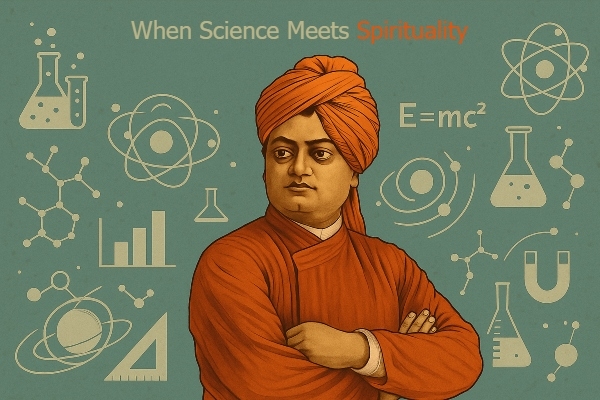
This broader definition of Hindutva reveals why it aligns so well with the scientific outlook. Science itself is an endless pursuit of patterns, principles, and unity underlying the multiplicity of the universe. Indian philosophy had long articulated this quest through its insistence that all phenomena — material or mental, physical or spiritual — are expressions of an underlying oneness.
Science as the Pursuit of Unity
Swami Vivekananda, in his paper on Hinduism, said that “Science is nothing but the finding of unity.” He commented on the fact that the ultimate purpose of science was not merely technological innovation but the discovery of harmony in the workings of nature. This idea becomes even more striking when placed in the context of modern scientific milestones.
The late 19th century saw the discovery of the electron by J. J. Thomson in 1897, which effectively divided physics into two domains: the microscopic world, later studied through quantum mechanics, and the macroscopic world, explored through cosmology and astrophysics. Gravity governed the vastness of galaxies, while electromagnetism and nuclear forces explained the subatomic realm. Albert Einstein sought to bridge this gap with his dream of a Grand Unified Theory, attempting to show that these forces could be understood as expressions of a single principle. Though he did not succeed in his lifetime, the aspiration itself marked a turning point. Stephen Hawking later carried forward this vision, coining the phrase “Theory of Everything” to describe a framework that could unify the laws of the cosmos.
Placed alongside these efforts, Vivekananda’s insight from 1893 acquires a prophetic dimension. Long before theoretical physics articulated the dream of unification, he had expressed the same aspiration in philosophical terms: that knowledge, whether scientific or spiritual, must ultimately converge upon unity.
Beyond Darwin: The Evolution of Consciousness
During Vivekananda’s lifetime, Darwin’s theory of evolution had shaken the foundations of Christian theology in Europe. Vivekananda admired Darwin’s achievement, yet he also pointed out its limitations. Darwin explained the evolution of the body, he argued, but not the growth of the mind and consciousness.
In his lecture on “The Evolution of Man” in London (1896), Swami Vivekananda noted that the human organism could be traced to simpler forms of life, but insisted that the soul was not subject to evolution. The inner faculties — thought, reason, intuition, and awareness — had their own path of development, one already mapped by India’s Yoga Sutras and Upanishadic traditions.
This perspective resonates strongly today. Contemporary science is increasingly engaging with the mysteries of consciousness, and even global institutions like the World Health Organisation recognise spirituality as a vital dimension of well-being alongside the physical, mental, and social. Vivekananda thus anticipated a debate that science continues to wrestle with more than a century later.
Dialogues with the West: Bridging Two Worlds
Vivekananda’s years in America and Europe gave him exposure to some of the brightest scientific minds of his era. His conversations with Harvard philosopher and psychologist William James left a deep impression. James reportedly described him as “the paragon of Vedantists,” recognising in him a thinker who could hold his own in the intellectual debates of the West.
Even more remarkable were his interactions with the inventor Nikola Tesla. Vivekananda discussed with Tesla the Indian philosophical views about the ultimate oneness of matter and energy. Nicola Tesla, intrigued by this idea, attempted to capture this oneness mathematically, which can be reduced to potential energy. Although he could not fully formalize it, their dialogue foreshadowed the later scientific realization of mass-energy equivalence expressed in Einstein’s famous equation, E = mc².
Whether through such personal encounters or through the shared intellectual climate of the time, Vivekananda demonstrated a rare ability: to articulate metaphysical insights in terms that resonated with scientists. This was not religion masked as science, but an insightful guideline for the world — showing that both stand as complementary paths converging on the same truth.
Science and Nation-Building: From Tata to Bose
Swami Vivekananda’s influence extended beyond lectures and debates. His vision directly shaped the building of India’s scientific institutions. When Jamsetji Tata met Swami Vivekananda on a ship bound for Chicago, their conversation turned to India’s future. Vivekananda emphasised that true progress would not come from merely importing machines but from cultivating the scientific spirit that created them. Inspired by this exchange, Tata later envisioned a great research institute for India — a vision that materialised as the Indian Institute of Science in Bengaluru, still fondly remembered as the ‘Tata Institute’.
After Vivekananda’s passing, his disciple Sister Nivedita continued this mission. She encouraged Acharya Jagadish Chandra Bose, one of India’s pioneering scientists, to patent his groundbreaking research in plant physiology and wireless communication. For her, Bose’s discoveries were not just scientific achievements but also expressions of India’s philosophical insight that consciousness pervades all life.
Together, these initiatives reflected Vivekananda’s conviction that science and spirituality were twin forces in building a modern, self-reliant India.
Towards a Civilizational Synthesis
What makes Vivekananda’s reflections so enduring is their balance. He neither glorified spirituality at the cost of science nor compromised philosophy under the pressure of technology. Instead, he argued for a samanvaya — a synthesis. As he put it, ‘We must have a new order of sannyasins, with Vedanta as the basis and modern science as the limbs.’ Monks, he urged, should study Western science alongside scriptures so that religion could be expressed in a language intelligible to the modern mind. At the same time, he cautioned that science without ethics leads to ruin: ‘Knowledge must have a purpose — to help mankind. If it is used for selfish ends, it brings destruction.’ For Vivekananda, the harmony of science and spirituality was not optional but essential — ensuring that discovery was always guided by compassion and the welfare of humanity.
This balance remains profoundly relevant today. Our world faces unprecedented technological revolutions — from artificial intelligence to biotechnology — yet also wrestles with crises of inequality, climate change, and ethical responsibility. Vivekananda’s message offers a guiding framework: progress must be scientific in method, but spiritual in purpose.
Swami Vivekananda’s lasting contribution was to demonstrate that India’s civilizational ethos is deeply compatible with scientific inquiry. He saw it not as a closed tradition but as an open framework — one capable of embracing doubt, dialogue, discovery, and ethical responsibility.
When we reflect on his words alongside the dreams of Einstein or Hawking, we see more than coincidence. We see a continuity of vision: the recognition that the destiny of science, like that of spirituality, lies in uncovering the unity that underpins all existence.
As India aspires to its role as Vishwaguru in the 21st century, this synthesis of knowledge is its greatest offering to the world. Our laboratories and research centers must not only pursue innovation but also embody the civilizational wisdom that Vivekananda articulated — that science, guided by compassion and righteousness, can become a force for the upliftment of humanity.
Source: Vayuveg
This broader definition of Hindutva reveals why it aligns so well with the scientific outlook. Science itself is an endless pursuit of patterns, principles, and unity underlying the multiplicity of the universe. Indian philosophy had long articulated this quest through its insistence that all phenomena — material or mental, physical or spiritual — are expressions of an underlying oneness.
Science as the Pursuit of Unity
Swami Vivekananda, in his paper on Hinduism, said that “Science is nothing but the finding of unity.” He commented on the fact that the ultimate purpose of science was not merely technological innovation but the discovery of harmony in the workings of nature. This idea becomes even more striking when placed in the context of modern scientific milestones.
The late 19th century saw the discovery of the electron by J. J. Thomson in 1897, which effectively divided physics into two domains: the microscopic world, later studied through quantum mechanics, and the macroscopic world, explored through cosmology and astrophysics. Gravity governed the vastness of galaxies, while electromagnetism and nuclear forces explained the subatomic realm. Albert Einstein sought to bridge this gap with his dream of a Grand Unified Theory, attempting to show that these forces could be understood as expressions of a single principle. Though he did not succeed in his lifetime, the aspiration itself marked a turning point. Stephen Hawking later carried forward this vision, coining the phrase “Theory of Everything” to describe a framework that could unify the laws of the cosmos.
Placed alongside these efforts, Vivekananda’s insight from 1893 acquires a prophetic dimension. Long before theoretical physics articulated the dream of unification, he had expressed the same aspiration in philosophical terms: that knowledge, whether scientific or spiritual, must ultimately converge upon unity.
Beyond Darwin: The Evolution of Consciousness
During Vivekananda’s lifetime, Darwin’s theory of evolution had shaken the foundations of Christian theology in Europe. Vivekananda admired Darwin’s achievement, yet he also pointed out its limitations. Darwin explained the evolution of the body, he argued, but not the growth of the mind and consciousness.
In his lecture on “The Evolution of Man” in London (1896), Swami Vivekananda noted that the human organism could be traced to simpler forms of life, but insisted that the soul was not subject to evolution. The inner faculties — thought, reason, intuition, and awareness — had their own path of development, one already mapped by India’s Yoga Sutras and Upanishadic traditions.
This perspective resonates strongly today. Contemporary science is increasingly engaging with the mysteries of consciousness, and even global institutions like the World Health Organisation recognise spirituality as a vital dimension of well-being alongside the physical, mental, and social. Vivekananda thus anticipated a debate that science continues to wrestle with more than a century later.
Dialogues with the West: Bridging Two Worlds
Vivekananda’s years in America and Europe gave him exposure to some of the brightest scientific minds of his era. His conversations with Harvard philosopher and psychologist William James left a deep impression. James reportedly described him as “the paragon of Vedantists,” recognising in him a thinker who could hold his own in the intellectual debates of the West.
Even more remarkable were his interactions with the inventor Nikola Tesla. Vivekananda discussed with Tesla the Indian philosophical views about the ultimate oneness of matter and energy. Nicola Tesla, intrigued by this idea, attempted to capture this oneness mathematically, which can be reduced to potential energy. Although he could not fully formalize it, their dialogue foreshadowed the later scientific realization of mass-energy equivalence expressed in Einstein’s famous equation, E = mc².
Whether through such personal encounters or through the shared intellectual climate of the time, Vivekananda demonstrated a rare ability: to articulate metaphysical insights in terms that resonated with scientists. This was not religion masked as science, but an insightful guideline for the world — showing that both stand as complementary paths converging on the same truth.
Science and Nation-Building: From Tata to Bose
Swami Vivekananda’s influence extended beyond lectures and debates. His vision directly shaped the building of India’s scientific institutions. When Jamsetji Tata met Swami Vivekananda on a ship bound for Chicago, their conversation turned to India’s future. Vivekananda emphasised that true progress would not come from merely importing machines but from cultivating the scientific spirit that created them. Inspired by this exchange, Tata later envisioned a great research institute for India — a vision that materialised as the Indian Institute of Science in Bengaluru, still fondly remembered as the ‘Tata Institute’.
After Vivekananda’s passing, his disciple Sister Nivedita continued this mission. She encouraged Acharya Jagadish Chandra Bose, one of India’s pioneering scientists, to patent his groundbreaking research in plant physiology and wireless communication. For her, Bose’s discoveries were not just scientific achievements but also expressions of India’s philosophical insight that consciousness pervades all life.
Together, these initiatives reflected Vivekananda’s conviction that science and spirituality were twin forces in building a modern, self-reliant India.
Towards a Civilizational Synthesis
What makes Vivekananda’s reflections so enduring is their balance. He neither glorified spirituality at the cost of science nor compromised philosophy under the pressure of technology. Instead, he argued for a samanvaya — a synthesis. As he put it, ‘We must have a new order of sannyasins, with Vedanta as the basis and modern science as the limbs.’ Monks, he urged, should study Western science alongside scriptures so that religion could be expressed in a language intelligible to the modern mind. At the same time, he cautioned that science without ethics leads to ruin: ‘Knowledge must have a purpose — to help mankind. If it is used for selfish ends, it brings destruction.’ For Vivekananda, the harmony of science and spirituality was not optional but essential — ensuring that discovery was always guided by compassion and the welfare of humanity.
This balance remains profoundly relevant today. Our world faces unprecedented technological revolutions — from artificial intelligence to biotechnology — yet also wrestles with crises of inequality, climate change, and ethical responsibility. Vivekananda’s message offers a guiding framework: progress must be scientific in method, but spiritual in purpose.
Swami Vivekananda’s lasting contribution was to demonstrate that India’s civilizational ethos is deeply compatible with scientific inquiry. He saw it not as a closed tradition but as an open framework — one capable of embracing doubt, dialogue, discovery, and ethical responsibility.
When we reflect on his words alongside the dreams of Einstein or Hawking, we see more than coincidence. We see a continuity of vision: the recognition that the destiny of science, like that of spirituality, lies in uncovering the unity that underpins all existence.
As India aspires to its role as Vishwaguru in the 21st century, this synthesis of knowledge is its greatest offering to the world. Our laboratories and research centers must not only pursue innovation but also embody the civilizational wisdom that Vivekananda articulated — that science, guided by compassion and righteousness, can become a force for the upliftment of humanity.
Source: Vayuveg