Police Crackdown on Sanitation Workers Sparks Statewide Outrage in Tamil Nadu
Total Views |


A peaceful demonstration by sanitation workers demanding secure livelihoods turned into a flashpoint of public anger after a sudden police crackdown across Tamil Nadu. The DMK government, once known for its slogan “We stand for workers,” is now being accused of betraying that very commitment.
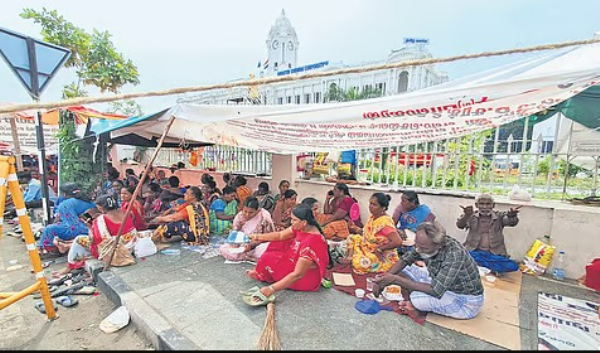
Acting on a recent court directive, police detained hundreds of protesters without prior warning. Among those forcibly removed were women, senior workers, and long-serving daily wagers. Heart-wrenching visuals of exhausted workers collapsing on the streets or being dragged away by the authorities have gone viral, prompting widespread condemnation.
From Promises to Disappointment
The DMK’s 2021 election manifesto assured sanitation workers of permanent employment, fair pay, and safe working conditions. Three years later, these pledges remain largely unfulfilled:
What began as a hope for stability has turned into a period of deepening uncertainty for many sanitation workers.
Accusations of Hypocrisy
AIADMK leader Edappadi K. Palaniswami accused the ruling party of “wearing two faces” — one before elections and another after coming to power.
“When in opposition, the DMK would protest even for small causes. Now, instead of dialogue, it uses force against genuine demands,” he said.
Despite the 13-day protest, the government failed to initiate talks with workers, further fueling the criticism of its approach.
Welfare Announcements: Solution or Diversion?
Following the backlash, the government unveiled a set of welfare measures, including free breakfast schemes, housing benefits, and insurance coverage. However, the key demand for permanent government jobs was absent, leading unions to dismiss the announcement as a mere diversion.
“Such schemes may look good on paper, but they do not solve our fundamental problem — job security,” a union leader remarked.
Chennai’s Civic Decline Under Scrutiny
The episode has also reignited concerns about Chennai’s deteriorating civic management. Once among India’s cleanest metros, the city slipped to 38th place in the 2024–25 Swachh Survekshan rankings.
The city produces 6,500 tonnes of waste daily, yet door-to-door collection reaches only about half its households. Operational public toilets have fallen from 77% to 33%, and in localities like Nungambakkam, garbage often remains uncleared until late afternoon.
While Indore has secured a 7-star cleanliness rating, Chennai failed to earn even one. Mayor Priya defended the heavy reliance on private contractors, saying it was “the only practical way to maintain citywide cleanliness.” Yet, 10 out of the city’s 15 zones under privatised waste management have seen falling wages, job losses, and declining civic standards. Workers who once earned ₹23,000 now make only ₹15,000.
Once celebrated as the “Detroit of India,” Chennai now finds itself grappling with uncollected waste, broken promises, and eroding public trust.
Acting on a recent court directive, police detained hundreds of protesters without prior warning. Among those forcibly removed were women, senior workers, and long-serving daily wagers. Heart-wrenching visuals of exhausted workers collapsing on the streets or being dragged away by the authorities have gone viral, prompting widespread condemnation.
From Promises to Disappointment
The DMK’s 2021 election manifesto assured sanitation workers of permanent employment, fair pay, and safe working conditions. Three years later, these pledges remain largely unfulfilled:
- Stalled Regularisation: Permanent job approvals remain locked in legal battles, with workers’ petitions languishing unresolved.
- Rising Privatisation: Despite promises to curb outsourcing, a large share of civic services continues to be handled by private contractors, undermining job security.
- Unpaid and Underpaid: Minimum wage directives are often bypassed, leaving thousands struggling to make ends meet.
What began as a hope for stability has turned into a period of deepening uncertainty for many sanitation workers.
Accusations of Hypocrisy
AIADMK leader Edappadi K. Palaniswami accused the ruling party of “wearing two faces” — one before elections and another after coming to power.
“When in opposition, the DMK would protest even for small causes. Now, instead of dialogue, it uses force against genuine demands,” he said.
Despite the 13-day protest, the government failed to initiate talks with workers, further fueling the criticism of its approach.
Welfare Announcements: Solution or Diversion?
Following the backlash, the government unveiled a set of welfare measures, including free breakfast schemes, housing benefits, and insurance coverage. However, the key demand for permanent government jobs was absent, leading unions to dismiss the announcement as a mere diversion.
“Such schemes may look good on paper, but they do not solve our fundamental problem — job security,” a union leader remarked.
Chennai’s Civic Decline Under Scrutiny
The episode has also reignited concerns about Chennai’s deteriorating civic management. Once among India’s cleanest metros, the city slipped to 38th place in the 2024–25 Swachh Survekshan rankings.
The city produces 6,500 tonnes of waste daily, yet door-to-door collection reaches only about half its households. Operational public toilets have fallen from 77% to 33%, and in localities like Nungambakkam, garbage often remains uncleared until late afternoon.
While Indore has secured a 7-star cleanliness rating, Chennai failed to earn even one. Mayor Priya defended the heavy reliance on private contractors, saying it was “the only practical way to maintain citywide cleanliness.” Yet, 10 out of the city’s 15 zones under privatised waste management have seen falling wages, job losses, and declining civic standards. Workers who once earned ₹23,000 now make only ₹15,000.
Once celebrated as the “Detroit of India,” Chennai now finds itself grappling with uncollected waste, broken promises, and eroding public trust.