East-West Link Roads Redefining Mumbai's Mobility
13 Jan 2026 12:40:21
Mumbai’s transport challenges are deeply rooted in its history and geography. The city evolved in a linear north-south manner, with commercial and business activities concentrated in the Island City in the south. At the same time, residential development steadily moved northwards along the western and eastern suburbs. Mumbai’s transport corridors also followed this pattern, resulting in strong north-south routes but very few east–west connections.
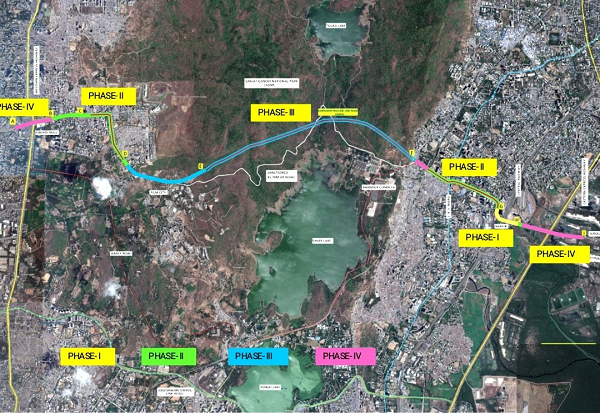
Alignment of GMLR and its tunnels
As the eastern and western suburbs expanded rapidly over the past few decades, this imbalance has become increasingly visible. Commuters were forced to take long detours, traffic congestion worsened and travel time and costs rose sharply. The need to strengthen east–west road connectivity was identified and it was stressed that without strong east–west corridors, congestion would only intensify despite improvements elsewhere.
In response, MMRDA rolled out a series of projects under the Mumbai Urban Transport Project and the Mumbai Urban Infrastructure Project, placing east–west link roads among the highest priorities. Three major corridors: the Santacruz–Chembur Link Road, Andheri-Ghatkopar Link Road and Jogeshwari-Vikhroli Link Road were developed to connect the Western and Eastern Express Highways. These roads changed suburban mobility and cut travel times.
However, success brought its own challenges. With rising population, vehicle growth, and economic activity, all three corridors are now operating close to their saturation limits, especially during peak hours. This made it clear that Mumbai needed not just maintenance, but capacity expansion and new east–west corridors.
It is in this context that Mumbai’s east–west connectivity has received a decisive boost under the leadership of Devendra Fadnavis. Projects that were once delayed or treated cautiously have been revived, redesigned and fast-tracked with a corridor-based approach rather than piecemeal fixes.
Among the most significant is the Goregaon–Mulund Link Road (GMLR), the fourth and most critical east–west corridor. Envisioned as a direct connection between the Western Express Highway at Goregaon and the Eastern Express Highway at Mulund, GMLR has the potential to decongest large parts of suburban Mumbai. While portions of the road already exist on both sides, the central stretch remained incomplete as it passes through the Sanjay Gandhi National Park. Today, with tunnel-based solutions and modern engineering, this long-pending “missing link” is finally being addressed.
The other significant projects such as the Santacruz–Chembur Link Road extension and the Kurla–Ghatkopar elevated road, have eased pressure on ground-level roads and improved travel efficiency across dense residential and commercial zones. Targeted interventions such as the underpass at Goregaon–Vikhroli Link Road further eliminate bottlenecks and improve junction-level traffic flow.
Looking at the larger metropolitan region, the Thane–Borivali twin tunnels and the Orange Gate–Marine Drive tunnel reflect a broader vision. It is the one that connects east and west, not just within Mumbai, but across the wider urban and economic landscape.
Together, these projects mark a shift from fragmented planning to strategic connectivity-led development. By strengthening east–west linkages, Mumbai is easing traffic congestion and correcting a historical imbalance in its urban growth. Under Devendra Fadnavis’s leadership, the city is finally being stitched together - lane by lane, tunnel by tunnel - into a more efficient, accessible, and future-ready metropolis.
Alignment of GMLR and its tunnels
As the eastern and western suburbs expanded rapidly over the past few decades, this imbalance has become increasingly visible. Commuters were forced to take long detours, traffic congestion worsened and travel time and costs rose sharply. The need to strengthen east–west road connectivity was identified and it was stressed that without strong east–west corridors, congestion would only intensify despite improvements elsewhere.
In response, MMRDA rolled out a series of projects under the Mumbai Urban Transport Project and the Mumbai Urban Infrastructure Project, placing east–west link roads among the highest priorities. Three major corridors: the Santacruz–Chembur Link Road, Andheri-Ghatkopar Link Road and Jogeshwari-Vikhroli Link Road were developed to connect the Western and Eastern Express Highways. These roads changed suburban mobility and cut travel times.
However, success brought its own challenges. With rising population, vehicle growth, and economic activity, all three corridors are now operating close to their saturation limits, especially during peak hours. This made it clear that Mumbai needed not just maintenance, but capacity expansion and new east–west corridors.
It is in this context that Mumbai’s east–west connectivity has received a decisive boost under the leadership of Devendra Fadnavis. Projects that were once delayed or treated cautiously have been revived, redesigned and fast-tracked with a corridor-based approach rather than piecemeal fixes.
Among the most significant is the Goregaon–Mulund Link Road (GMLR), the fourth and most critical east–west corridor. Envisioned as a direct connection between the Western Express Highway at Goregaon and the Eastern Express Highway at Mulund, GMLR has the potential to decongest large parts of suburban Mumbai. While portions of the road already exist on both sides, the central stretch remained incomplete as it passes through the Sanjay Gandhi National Park. Today, with tunnel-based solutions and modern engineering, this long-pending “missing link” is finally being addressed.
The other significant projects such as the Santacruz–Chembur Link Road extension and the Kurla–Ghatkopar elevated road, have eased pressure on ground-level roads and improved travel efficiency across dense residential and commercial zones. Targeted interventions such as the underpass at Goregaon–Vikhroli Link Road further eliminate bottlenecks and improve junction-level traffic flow.
Looking at the larger metropolitan region, the Thane–Borivali twin tunnels and the Orange Gate–Marine Drive tunnel reflect a broader vision. It is the one that connects east and west, not just within Mumbai, but across the wider urban and economic landscape.
Together, these projects mark a shift from fragmented planning to strategic connectivity-led development. By strengthening east–west linkages, Mumbai is easing traffic congestion and correcting a historical imbalance in its urban growth. Under Devendra Fadnavis’s leadership, the city is finally being stitched together - lane by lane, tunnel by tunnel - into a more efficient, accessible, and future-ready metropolis.