DMK just promises, but does not deliver, at least for its own workforce
Total Views |


The DMK government has hit headlines, and again this time, it is for the wrong reasons. They are not only creating ruckus in the state over hurting Hindu sentiments, but also now for government employees. At least the numbers say so.
Chief Minister MK Stalin had pledged a "golden era" for Tamil Nadu's government employees after it came to power in May 2021. Four-and-a-half years later, as the state enters 2026, that promise is still on paper. The scale and frequency of protests across Tamil Nadu speak high volumes of a deep and widening trust deficit between the state government and its own workforce.
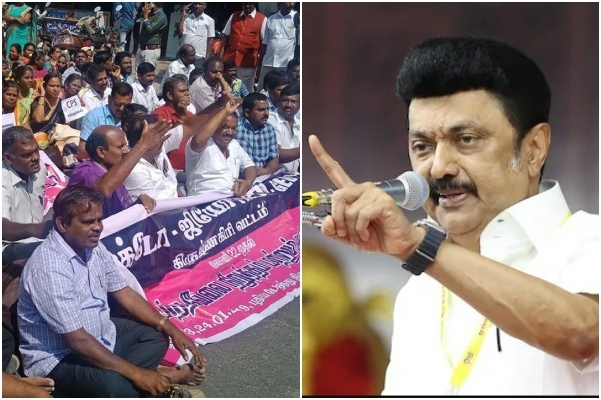
Employees have received no meaningful salary revision beyond periodic dearness allowance (DA) announcements. Even these DA hikes have been delayed, with arrears pending for 18 to 24 months in many cases. For teachers, healthcare workers and temporary staff, salary delays have become routine, severely impacting household finances. The Pongal bonus - traditionally seen as a morale booster - has also drawn sharp criticism, with employees calling the ₹3,000 payout an "insult" when compared to benefits in earlier years.
Govt jobs - The DMK's manifesto promised the creation of 10 lakh jobs annually and the filling of three lakh government vacancies. Reality tells a very different story. In 2021, barely 2,000 positions were filled. In 2023, the Tamil Nadu Public Service Commission recruited only 1,752 candidates. Today, an estimated 2.5 lakh government posts remain vacant, including nearly 70,000 teachers and 30,000 police personnel. This chronic understaffing has not only burdened existing employees but also weakened public service delivery across sectors.
Pension - The DMK had promised to restore the Old Pension Scheme (OPS) within a year of assuming office. Instead, by the end of 2025, the government introduced the Tamil Nadu Assured Pension Scheme (TAPS), a model closely resembling the Centre's New Pension Scheme. Employee unions have denounced TAPS as a betrayal, accusing the government of playing with semantics while abandoning its core promise. For thousands of employees nearing retirement, the move has triggered anxiety and resentment.
Contract Work, Outsourcing and Job Insecurity: Another major flashpoint is the unchecked rise of outsourcing and contract employment in government departments. This practice undermines permanent posts, weakens the reservation system and exposes workers to exploitation. Temporary staff in education, health and transport departments continue to work without job security or benefits, while long-standing demands for regularisation of Anganwadi and midday meal workers remain ignored. Compassionate appointments, once capped at 25%, have been slashed to a mere 5%, leaving families of deceased employees in distress.
Allegations of Harassment and Repression: The anger is not just limited to jobs, pension, etc. It has also extended to harassment. In 2025, a video from Tindivanam showing a Scheduled Caste government employee allegedly being forced to fall at the feet of a DMK councillor sparked statewide outrage.
For a government that came to power pledging dignity, security and justice for its workforce, the anger on the streets tells a different, far harsher story.
Chief Minister MK Stalin had pledged a "golden era" for Tamil Nadu's government employees after it came to power in May 2021. Four-and-a-half years later, as the state enters 2026, that promise is still on paper. The scale and frequency of protests across Tamil Nadu speak high volumes of a deep and widening trust deficit between the state government and its own workforce.
Employees have received no meaningful salary revision beyond periodic dearness allowance (DA) announcements. Even these DA hikes have been delayed, with arrears pending for 18 to 24 months in many cases. For teachers, healthcare workers and temporary staff, salary delays have become routine, severely impacting household finances. The Pongal bonus - traditionally seen as a morale booster - has also drawn sharp criticism, with employees calling the ₹3,000 payout an "insult" when compared to benefits in earlier years.
Govt jobs - The DMK's manifesto promised the creation of 10 lakh jobs annually and the filling of three lakh government vacancies. Reality tells a very different story. In 2021, barely 2,000 positions were filled. In 2023, the Tamil Nadu Public Service Commission recruited only 1,752 candidates. Today, an estimated 2.5 lakh government posts remain vacant, including nearly 70,000 teachers and 30,000 police personnel. This chronic understaffing has not only burdened existing employees but also weakened public service delivery across sectors.
Pension - The DMK had promised to restore the Old Pension Scheme (OPS) within a year of assuming office. Instead, by the end of 2025, the government introduced the Tamil Nadu Assured Pension Scheme (TAPS), a model closely resembling the Centre's New Pension Scheme. Employee unions have denounced TAPS as a betrayal, accusing the government of playing with semantics while abandoning its core promise. For thousands of employees nearing retirement, the move has triggered anxiety and resentment.
Contract Work, Outsourcing and Job Insecurity: Another major flashpoint is the unchecked rise of outsourcing and contract employment in government departments. This practice undermines permanent posts, weakens the reservation system and exposes workers to exploitation. Temporary staff in education, health and transport departments continue to work without job security or benefits, while long-standing demands for regularisation of Anganwadi and midday meal workers remain ignored. Compassionate appointments, once capped at 25%, have been slashed to a mere 5%, leaving families of deceased employees in distress.
Allegations of Harassment and Repression: The anger is not just limited to jobs, pension, etc. It has also extended to harassment. In 2025, a video from Tindivanam showing a Scheduled Caste government employee allegedly being forced to fall at the feet of a DMK councillor sparked statewide outrage.
For a government that came to power pledging dignity, security and justice for its workforce, the anger on the streets tells a different, far harsher story.