India’s Geopolitical Checkmate: How Africa Became the Key to Europe’s “Mother of All Deals”
NewsBharati 31-Jan-2026 14:48:35 PM
Total Views |


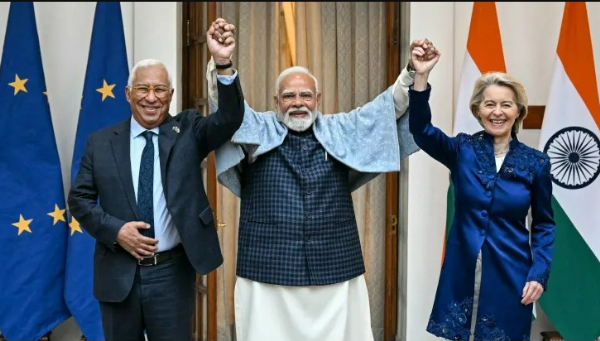
For nearly two decades, negotiations between India and the European Union over a free trade agreement remained stalled. Europe, often dismissive of India’s demands, seemed unwilling to compromise. Yet in 2025, the deal was suddenly signed in New Delhi, hailed by European leaders themselves as the “Mother of All Deals.” What changed?
The answer lies not in Brussels or Delhi, but in Africa. Over the past decade, India quietly rewrote the rules of engagement, building influence across the African continent and reshaping global power dynamics.
The Africa Pivot
The turning point came in 2015, when Prime Minister Narendra Modi hosted the India–Africa Forum Summit in New Delhi. Far from a routine diplomatic gathering, it was a psychological reset. Modi emphasized shared colonial scars and struggles, positioning India as a partner rather than a patron. Scholarships replaced soldiers; partnerships replaced exploitation.
Thousands of African students studied in Indian universities, many returning home to become ministers, diplomats, even presidents. They carried with them not just degrees, but fluency in Hindi and a deep affinity for India. In effect, India created a pro India deep state in Africa, built not through coercion but through education and respect.
Strategic Investments and Defense Partnerships
India’s outreach was not limited to cultural diplomacy. Over $80 billion in investments flowed into African infrastructure projects. Unlike Western or Chinese models, India offered fair market prices and joint development rather than debt traps.
Defense cooperation followed. African military chiefs attended Indian air shows, and Indian-made jets, drones, and missiles began replacing Western imports. In Morocco, India established a defense manufacturing hub in partnership with Tata, producing armored vehicles and linking African supply chains directly to India’s economy.
Digital Integration
India also exported its digital revolution. Through UPI integration, African economies began linking with India’s payment systems, embedding Indian technology into everyday transactions. Infrastructure, defense, and digital platforms created a fortress of “Made in India, Made with India” across Africa.
Europe’s Resource Shock
The impact on Europe was profound. For decades, Europe had relied on Africa as a free tap for raw materials, often paying pennies for resources worth far more. India disrupted this model by offering fair prices and joint ventures. Suddenly, Europe’s supply chains dried up.
By the time European leaders realized Africa was slipping away, India had already built a fortress of influence. Europe’s lifeline was cut. Faced with resource insecurity, Europe had little choice but to return to the negotiating table in Delhi.
The West’s Alienation from America
Another factor that weakened Europe’s position was its growing alienation from the United States. Traditionally, Europe relied on Washington as its strategic partner. But under Donald Trump, America’s posture became increasingly unstable, bullish, and domineering. His unpredictable diplomacy, transactional approach to alliances, and disregard for multilateral norms eroded trust among European leaders. Instead of providing reassurance, Trump’s behavior deepened divisions, leaving Europe isolated and searching for new partners. This vacuum made India’s steady, respectful engagement with Africa and the Global South even more attractive, further tilting the balance of power away from the traditional transatlantic axis.
The Geopolitical Checkmate
Foreign Minister S. Jaishankar and National Security Advisor Ajit Doval orchestrated this strategy with relentless trips and quiet diplomacy. Modi’s role was to deliver the final checkmate: Europe, weakened and resource-starved, signed the trade deal not as a concession to India’s demands, but as an act of surrender to geopolitical reality.
The EU–India trade deal was not merely an economic agreement. It was the culmination of a decade-long master plan that leveraged Africa as the pivot point of global power. By offering respect, education, fair trade, and partnership, India transformed Africa’s perception of global alliances.
Europe’s “Mother of All Deals” was, in truth, the product of India’s geopolitical checkmate — a strategy that combined diplomacy, defense, and digital integration to reshape the balance of power.
The answer lies not in Brussels or Delhi, but in Africa. Over the past decade, India quietly rewrote the rules of engagement, building influence across the African continent and reshaping global power dynamics.
The Africa Pivot
The turning point came in 2015, when Prime Minister Narendra Modi hosted the India–Africa Forum Summit in New Delhi. Far from a routine diplomatic gathering, it was a psychological reset. Modi emphasized shared colonial scars and struggles, positioning India as a partner rather than a patron. Scholarships replaced soldiers; partnerships replaced exploitation.
Thousands of African students studied in Indian universities, many returning home to become ministers, diplomats, even presidents. They carried with them not just degrees, but fluency in Hindi and a deep affinity for India. In effect, India created a pro India deep state in Africa, built not through coercion but through education and respect.
Strategic Investments and Defense Partnerships
India’s outreach was not limited to cultural diplomacy. Over $80 billion in investments flowed into African infrastructure projects. Unlike Western or Chinese models, India offered fair market prices and joint development rather than debt traps.
Defense cooperation followed. African military chiefs attended Indian air shows, and Indian-made jets, drones, and missiles began replacing Western imports. In Morocco, India established a defense manufacturing hub in partnership with Tata, producing armored vehicles and linking African supply chains directly to India’s economy.
Digital Integration
India also exported its digital revolution. Through UPI integration, African economies began linking with India’s payment systems, embedding Indian technology into everyday transactions. Infrastructure, defense, and digital platforms created a fortress of “Made in India, Made with India” across Africa.
Europe’s Resource Shock
The impact on Europe was profound. For decades, Europe had relied on Africa as a free tap for raw materials, often paying pennies for resources worth far more. India disrupted this model by offering fair prices and joint ventures. Suddenly, Europe’s supply chains dried up.
By the time European leaders realized Africa was slipping away, India had already built a fortress of influence. Europe’s lifeline was cut. Faced with resource insecurity, Europe had little choice but to return to the negotiating table in Delhi.
The West’s Alienation from America
Another factor that weakened Europe’s position was its growing alienation from the United States. Traditionally, Europe relied on Washington as its strategic partner. But under Donald Trump, America’s posture became increasingly unstable, bullish, and domineering. His unpredictable diplomacy, transactional approach to alliances, and disregard for multilateral norms eroded trust among European leaders. Instead of providing reassurance, Trump’s behavior deepened divisions, leaving Europe isolated and searching for new partners. This vacuum made India’s steady, respectful engagement with Africa and the Global South even more attractive, further tilting the balance of power away from the traditional transatlantic axis.
The Geopolitical Checkmate
Foreign Minister S. Jaishankar and National Security Advisor Ajit Doval orchestrated this strategy with relentless trips and quiet diplomacy. Modi’s role was to deliver the final checkmate: Europe, weakened and resource-starved, signed the trade deal not as a concession to India’s demands, but as an act of surrender to geopolitical reality.
The EU–India trade deal was not merely an economic agreement. It was the culmination of a decade-long master plan that leveraged Africa as the pivot point of global power. By offering respect, education, fair trade, and partnership, India transformed Africa’s perception of global alliances.
Europe’s “Mother of All Deals” was, in truth, the product of India’s geopolitical checkmate — a strategy that combined diplomacy, defense, and digital integration to reshape the balance of power.

Chintan Mokashi
Chintan Mokashi is a Pune-based writer, journalist, and researcher. He specialises in cinema, world history, human rights, and corporate fraud examination. With a PG Diploma in Journalism from KC College, Mumbai and extensive experience in writing across diverse subjects, his work blends analytical depth with cultural insight. Fluent in Marathi and English, Chintan’s writing bridges historical context with contemporary relevance, offering readers a thoughtful and engaging perspective.