China’s Dam, Congress’s Politics
National security demands scrutiny, not political sabotage.
NewsBharati 27-Oct-2026 12:39:58 PM
Total Views |


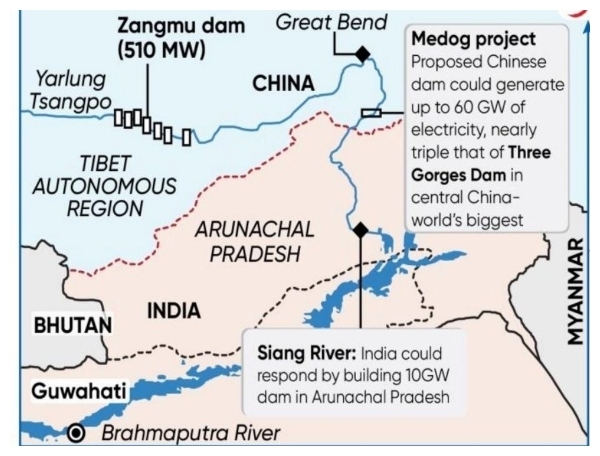
China’s proposed 60,000-MW Medog hydropower project in Tibet has transformed the Siang River in Arunachal Pradesh into a matter of strategic urgency for India. But at a time when Beijing is expanding its capacity to influence the waters flowing into India, the Congress party has chosen to challenge the government’s approach to the proposed Siang Upper Multipurpose Project (SUMP), demanding a halt to preliminary surveys. Pawan Khera has questioned the project’s justification, arguing that national security cannot be used to override the rights of indigenous communities.
The question is not whether the concerns of Arunachal Pradesh’s indigenous communities deserve attention.The question is whether a national political party can reduce a strategic infrastructure debate to an opportunity to attack the government, undermine public confidence and obstruct the very investigations needed to determine how India should prepare for China’s expanding capabilities.
China’s dam is not an ordinary infrastructure project.The Medog project, planned on the Yarlung Tsangpo in Tibet, is expected to have a generating capacity of approximately 60,000 MW. The river enters India as the Siang in Arunachal Pradesh and subsequently becomes part of the Brahmaputra system. China’s position upstream gives its decisions on river development direct implications for downstream countries. India has legitimate reasons to demand transparency, reliable hydrological information and safeguards against unilateral actions by Beijing.
The concern extends beyond electricity generation. A project of this scale raises questions about seasonal water availability, the possibility of altered river flows, emergency releases and the consequences of an accident or natural disaster. China has said its project will not harm downstream countries, but assurances from Beijing cannot substitute for independent assessment and effective safeguards.
The actual consequences would depend on the dam’s design, operating procedures, reservoir conditions and hydrological circumstances. Nevertheless, the possibility of a strategic disadvantage arising from China's upstream position cannot be dismissed merely because the worst-case scenario is uncertain. Strategic planning exists precisely because governments must prepare for risks before they become disasters. India cannot afford to discover its vulnerabilities after a crisis has begun.
The proposed Siang project, with a planned capacity of around 11,200 MW, is being examined as a potential means of strengthening India's water security, regulating river flows and responding to the strategic implications of China's upstream dam. Crucially, it remains at the pre-feasibility stage. The surveys are intended to establish whether the project is technically viable; they are not a final decision to construct the dam.
This distinction matters. Why should Congress demand that preliminary investigations stop before the country has established the project's feasibility, risks and potential benefits? If the project is unsuitable, the assessment should establish that. If it is necessary, India must understand the costs of delay. Refusing to investigate is not an alternative to informed decision-making.
A strategic project must be evaluated through engineering, environmental science, disaster modelling and national security assessments. Political slogans cannot replace any of these. At the same time, the concerns of the people cannot simply be brushed aside. Their land, livelihoods, ancestral connections and cultural heritage deserve meaningful consultation and legally sound safeguards. The government must establish the project's actual risks transparently, explain its potential benefits and ensure that affected communities are heard.
But consultation must not become an indefinite veto over the gathering of technical information. Nor should opposition to a preliminary survey automatically determine the fate of a project of national significance. The responsible course is to complete the necessary assessments while maintaining dialogue, protecting local rights and avoiding unnecessary confrontation.
Congress cannot discuss national security as though its own history were beyond scrutiny. The 1962 war with China remains one of the most painful chapters in independent India's strategic history. Under Jawaharlal Nehru, India suffered a devastating military defeat, exposing serious weaknesses in its preparedness and assessment of Chinese intentions. The circumstances of that war were complex, but the lesson was unmistakable -diplomatic confidence cannot substitute for military preparedness, and wishful thinking cannot neutralise a strategic adversary.
Decades later, the Congress-led UPA government continued to face the challenge of inadequate border infrastructure. In November 2011, the Defence Ministry reported that only 15 of the 61 strategic border roads entrusted to the Border Roads Organisation had been completed. A 2017 performance audit by the Comptroller and Auditor General subsequently documented substantial delays in the execution of these roads, originally targeted for completion by 2012. These figures demonstrate the consequences of failing to translate strategic priorities into timely infrastructure.
Congress must therefore explain why it now treats a project presented as a potential response to China's upstream advantage primarily as a controversy over the government's handling of protests. What is not legitimate is allowing political opposition to overshadow the strategic question that India cannot afford to ignore. Pawan Khera has questioned the government's handling of the unrest and demanded a halt to surveys. The Arunachal Pradesh Congress Committee has also established a fact-finding panel and called for greater consultation and a temporary suspension of survey activities.
Congress is entitled to demand accountability. But accountability cannot mean examining only the government's actions while ignoring the strategic consequences of suspending the work.Where is Congress's comprehensive alternative? If it believes the proposed Siang project is unnecessary or dangerous, will it publish an alternative assessment of the Medog dam's potential impact? What measures does it propose to protect downstream communities against extreme floods, altered water flows or other contingencies? How does it propose to strengthen India's bargaining position with Beijing?
These are the questions a serious national opposition must answer. It is equally important not to confuse political criticism with proven complicity in foreign interests. No evidence presented here establishes that Congress is acting on behalf of China or that it has funded or instigated the protests. Such allegations require evidence. The criticism of Congress must rest on its public positions and their potential consequences, not on unsubstantiated accusations. That distinction does not weaken the argument. It makes it stronger.
The Siang controversy presents Congress with an opportunity to demonstrate that it can rise above partisan calculations. It could press for rigorous environmental scrutiny, credible rehabilitation guarantees, transparent public consultation and a national assessment of China's upstream hydropower strategy all while insisting that India develop the capacity to protect its interests. Instead, demanding that surveys stop risks putting the political demand before the strategic assessment.
India must not repeat the historical mistake of treating the absence of immediate danger as proof that preparation is unnecessary. China is investing in infrastructure that could have consequences far beyond electricity generation. India needs independent scientific assessments, reliable data-sharing arrangements, diplomatic pressure on Beijing and suitable infrastructure of its own.
The Siang project may ultimately require modifications or even rejection if the evidence establishes that its risks outweigh its benefits. National security is not a licence to ignore environmental science or the rights of indigenous citizens. But neither can environmental concerns be used to avoid examining a serious strategic challenge.
Congress must decide whether it wants to be an opposition that merely obstructs or one that helps prepare India for the challenges ahead. Its record from 1962 to the prolonged delays in strategic border infrastructure should make it especially conscious of the price of inadequate preparedness.
China will not postpone its strategic ambitions because Indian political parties disagree. The Brahmaputra will not wait for a political consensus to emerge. And India's security cannot depend on whether a proposed defence measure is convenient for the opposition.
The government must listen to the people of Arunachal Pradesh, establish the facts and proceed on the basis of evidence. Congress, for its part, must stop treating every national security initiative as another opportunity for political confrontation.
India's sovereignty is not a bargaining chip. National security is not a party manifesto. And the defence of the nation must never become collateral damage in the pursuit of political mileage

Editor's Desk
Editor's Desk