“The genocide was a deep-rooted conspiracy carefully planned by the Congress Party”: Former IAS H. P. S. Saran at Symposium on the 1984 Sikh Genocide
Addressing the gathering, former IAS officer H. P. S. Saran compared Congress-led 1984 Sikh Genocide with the anti-Jewish violence perpetrated by the Nazis in 1938.
Total Views |


New Delhi, Nov 2: Centre for Socio-Cultural Studies, Delhi, organised a “1984 Sikh Genocide Remembrance Seminar” to remember those who lost their lives in the anti-Sikh political violence that took place in Delhi in 1984. The programme was held on Sunday, 25 October 2026, at the Department of Political Science, University of Delhi. Distinguished civil servants, senior journalists, lawyers, social activists and people from various sections of society attended the event.
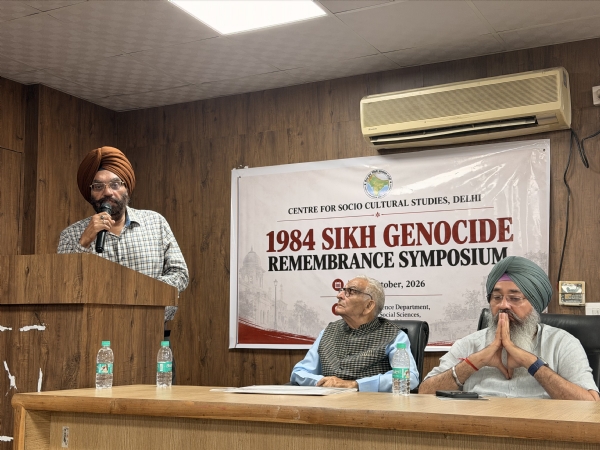
Opening the seminar, Professor Ravinder Singh of the Department of Punjabi said that the Congress Party had gained political mileage by describing the 1984 genocide as Hindu-Sikh riots. “Riots are always two-sided, but this was a one-sided genocide,” he said. He further stated, “I am an eyewitness myself. Sajjan Kumar used to roam around in an open jeep, instigating people and planning violence.” He added that the document titled ‘Who Are the Guilty?’, which named individual leaders and presented evidence against them, was systematically ignored.
Emphasizing the path forward after more than four decades, he remarked that true closure can only begin with the official acceptance of the tragedy as an act of genocide by the government of the day. Furthermore, he highlighted that there must be widespread recognition of the brave individuals and groups who risked their lives to shelter and protect victims during those dark days, many of whom have remained silent ever since. Acknowledging their courage and humanity, he noted, is vital to healing past wounds and strengthening the enduring bond between the two brethren communities.
Senior advocate Harvinder Singh Phoolka, who made significant contributions towards securing punishment for Congress leaders such as Jagdish Tytler and Sajjan Kumar for their roles in the violence, conveyed his best wishes to the organizers through an online message. The booklet titled “1984 Sikh Genocide Remembrance Symposium” was also released during the programme.
1 November 1984
— Dilpreet Grewal ☬ (@DpreetG) November 1, 2026
Sikhs will never forget the massacre of thousands of innocent people. Their homes were burned, families destroyed, and justice denied for decades. Congress cannot escape its responsibility for this dark chapter of India's history.
1984 is not forgotten.… pic.twitter.com/tGV6itmjYR
Advocate Gurlad Singh Kahlon, who has been associated with court cases related to the violence, said that the Congress Party had committed the heinous act of declaring a patriotic community traitors and carrying out their genocide. He stated that when the Emergency was challenged, Indira Gandhi conspired to ensure that Punjab could not rise again. He said that although the punishment of Sajjan Kumar and others might amount to only symbolic justice, even this symbolic justice would not have been possible had the BJP government not come to power in 2014. Gurlad Singh also appealed to the public to express solidarity with the victims by lighting “One Lamp, One November” (Ek Diya, Ek November).
Several citizens who helped the victims of the violence were honoured at the seminar. Social workers Harbhajan Lal and Rakesh Rikhi, among those who helped save lives, were felicitated.
Recalling those days, Harbhajan Lal said that in 1984, the Congress Party inflicted unprecedented atrocities not only upon Sikhs but upon Indian society as a whole. He explained how several citizens risked their lives to protect a gurdwara and the sacred saroop of Sri Guru Granth Sahib from being burnt in the Sarvodaya Enclave area. Former IPS officer Shiv Sahai and social activist Vagish Issar, who were present at the seminar, also shared their experiences.
Addressing the gathering, former IAS officer H. P. S. Saran compared the violence of 1984 with the anti-Jewish violence perpetrated by the Nazis in 1938. He pointed out that the use of inflammatory expressions such as “killer Sikhs”, “backlash” and “Khoon ka Badla Khoon” clearly indicated that the violence was carefully planned and that the Congress Party was merely waiting for a “go-ahead.” He also described the systematic disregard of these facts and pieces of evidence as a “mockery of law”.
The seminar provided an opportunity for families of the victims to share their experiences and for participants to discuss openly the questions surrounding the tragedy. The event proved meaningful in encouraging future generations to understand history and remain aware of the dangers of violence.