Savitribai Phule's was a voice of "renewal" in a time of "social distortion"
On her death anniversary, the most meaningful tribute to Savitribai Phule is to reclaim her legacy from selective historiography and ideological appropriation.
NewsBharati 09-Mar-2026 18:48:01 PM
Total Views |


Every year, the death anniversary of Savitribai Phule offers an opportunity to remember one of the most remarkable figures in India’s social reform movement. Yet the way her legacy is presented in public discourse often reflects the politics of historiography more than the reality of her life and work.
Sections of Marxist historiography have attempted to frame Savitribai Phule as a symbol of rupture, someone who supposedly liberated Indian society from an inherently regressive Hindu past. This interpretation oversimplifies history, with an aim to deliberately distort the intellectual and civilizational context in which her work unfolded. Honoring Savitribai Phule truly requires recognizing her not as a product of Western ideological influence, but as a reformer rooted deeply within India’s own moral and social traditions.
Often how it is portrayed, her life didn't represent a rejection of the Indian civilization. In fact, it is a powerful example of its internal capacity for self-correction and renewal.
Politics of Selective Historiography
In contemporary academic and political discourse, historical figures are often selectively interpreted to suit ideological narratives. Unfortunately, Savitribai Phule has not been immune to this trend.
Certain strands of Marxist historiography portray her educational efforts as an outright rebellion against a supposedly monolithic and oppressive Hindu social order. In doing so, they attempt to frame the 19th-century reform movements as products of colonial modernity rather than indigenous moral awakening.
Such a portrayal ignores the complexity of Indian social history. Indian civilization has historically witnessed continuous phases of introspection and reform. From the Bhakti movement to various regional reform traditions, voices questioning social distortions have emerged from within society itself. The 19th century was no exception.
Savitribai Phule must be understood within this long continuum of internal reform rather than as a civilizational rupture.
Indigenous Roots of Women’s Education
Another distortion arises from the assumption that women’s education in India began only in the 19th century under colonial influence. Historical evidence suggests otherwise.
Classical Indian texts offer numerous references to women’s learning and intellectual participation. In the grammatical treatises of Panini, for example, specific terms such as Upadhyayi (female teacher) and Chhatri (female student) appear in linguistic usage. The very presence of such terms indicates that female education was a recognized social reality.
Ancient Indian literature and philosophical traditions also preserve the intellectual contributions of women scholars and seekers. These strands collectively demonstrate that women’s participation in learning was historically embedded within Indian civilization, even if it later experienced phases of decline.
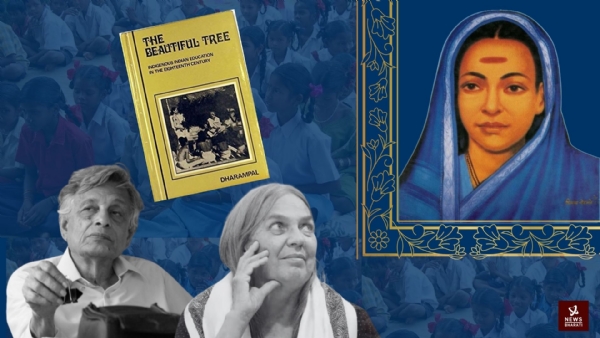
Further evidence of India’s indigenous educational ecosystem can be found in the work of Gandhian thinker Dharampal. Through meticulous analysis of British administrative surveys conducted in regions such as Madras, Bengal, and Punjab, Dharampal documented the existence of thousands of village schools operating across India prior to the consolidation of colonial rule.
These institutions were often sustained by community support and local revenue structures, forming what Dharampal famously described as the “Beautiful Tree” of indigenous education. While this system had its limitations, it reflected a deeply rooted tradition of community-driven learning.
Within this broader context, the 19th century should be seen not as the beginning of women’s education in India, but as a revival during a period of social decline.
Savitribai Phule: A Revolutionary Within Her Time
It was within this complex historical moment that Savitribai Phule emerged as one of the pioneers of women’s education in India. Along with her husband, Jyotirao Phule, she played a crucial role in establishing schools for girls in Pune at a time when entrenched prejudices denied them access to learning.
Savitribai saw education as a moral necessity arising from lived social realities of widowhood, denial of literacy, and the social exclusion faced by women. The schools she helped establish were not colonial outposts designed to dismantle Indian society. Rather, they functioned within the existing social fabric, engaging communities directly and challenging discriminatory practices through ethical persuasion and example.
In this sense, her movement represented an internal churning. It demonstrated that society itself possessed the ethical resources necessary to confront and correct its distortions. Savitribai Phule’s work, therefore, can be understood as the vanguard of a restorative movement, one that sought to revive the moral principles of dignity, knowledge, and compassion embedded within Indian civilization.
A Voice of Renewal in a Time of Social Distortion
The significance of Savitribai’s work lies in the moral vision that guided her actions. She believed in a society where dignity and knowledge were accessible to all. Guided by the belief that every human being was a child of one divine source, she envisioned a moral community grounded in equality and compassion.
Her life ultimately embodied these values in the most profound manner. During the plague epidemic in Pune, Savitribai personally worked to serve the affected, carrying patients to treatment centers and providing care irrespective of caste or social background. She eventually succumbed to the disease while serving plague victims.
This final act of service reflects the ethos of universal humanitarian that defined her life.
Political Appropriation in Contemporary Discourse
In modern political discourse, however, Savitribai Phule is often invoked primarily as a symbol of caste antagonism. While her struggle against social discrimination was real and courageous, reducing her legacy to a tool for contemporary identity politics risks diminishing the broader vision she embodied.
Savitribai’s work was not about deepening social divisions but about healing them, the exact opposite of how she is portrayed. Her commitment to education, compassion, and social dignity aimed at building a more just society rather than perpetuating antagonism. Reducing her to a narrow political symbol ignores the universality of her mission.
On her death anniversary, the most meaningful tribute to Savitribai Phule is to reclaim her legacy from selective historiography and ideological appropriation. More than being a rebel against tradition, she was a reformer rooted within it, someone who recognized both the strengths and the distortions within society and worked tirelessly to restore its moral balance.
By understanding Savitribai Phule as part of India’s long tradition of internal reform and ethical renewal, we honour her not only as a pioneer of women’s education but also as a guardian of the civilizational values that continue to shape India’s social conscience.
--

Himali Nalawade
Himali Nalawade is associated with News Bharati as an Author since a considerable period. She is mostly linked with researched articles from the areas of Defence, Defence Infrastructure and Culture-Religion. Along with her Masters in Mass Communication and Journalism after her graduation in History, she has also studied Diploma in Underwater Archaeology and Diploma in Indology.