Mauli Takalkar: The gentle ‘ṭāḷ’ in Bhimsen Joshi's abhangs falls silent
With passing of Mauli Takalkar, Maharashtra has lost one of the last living bridges between devotion, simplicity, and the golden age of Hindustani music.
Total Views |


There are some rhythms that become part of collective memory itself. For generations in Pune, one such sight felt eternal: Bhimsen Joshi seated before a sea of listeners, voice rising into an abhanga of Tukaram or Namdev and beside him sat Mauli Takalkar with his ṭāḷ (टाळ) in hand. As Panditji’s voice soared, the tender metallic rhythm of Mauli’s cymbals quietly blended in the atmosphere.
Today, that rhythm has fallen silent.
 Born as Dnyaneshwar on April 11, 1927, into a deeply rooted Warkari family, he came to be lovingly known as “Mauli” – a name associated with Sant Dnyaneshwar Maharaj. His relationship with music was rooted not in ambition, but bhakti. Though trained in pakhawaj and ṭāḷ under Mahadev Buva Sukale and skilled in mridang, tabla, and vocal music, his soul found its permanent home in the humble pair of cymbals that became an extension of his being.
His life resembled one of the old stories Pune lovingly preserves across generations.
_202605172157301317_H@@IGHT_400_W@@IDTH_600.jpg "mauli takalkar")
Yet his name became inseparably intertwined with Bhimsen Joshi. Across more than four decades and over 2,500 Santvani concerts, Mauli became part of Panditji’s inner musical universe. He often recalled with emotion how Bhimsen Joshi treated him not as an accompanist, but as family.
“Panditji was such a great man, he would take me to America for a whole month just to perform one abhanga,” Mauli once said with characteristic humility.
Classical vocalist Shubhada Mulgund recalled that Mauli eventually became part of the family itself. “Taal and Mauli were inseparable,” she said. “From the early Santvani programmes to foreign tours and even daily walks with Panditji, Mauli was always with us.” Remembering what drew Bhimsen Joshi towards him, she said it was his extraordinary command over laya and his deep immersion in the abhang tradition. His instinctive command over timing, rhythm, and pacing was flawless. “That is what caught Panditji’s eyes and ears,” she said.
In an age obsessed with spotlight and celebrity, Mauli Takalkar represented another tradition – artists who considered supporting greatness itself to be sacred work. His ṭāḷ never sought attention. It quietly strengthened the soul of the performance with complete surrender.
Even as honours came his way, Mauli remained deeply grounded in the Warkari ethos. He continued participating in the Pandharpur wari, performing bhajans through Harihar Bhajan Mandal and guiding younger musicians, including his son Anand and grandson Prathamesh.
Somewhere, in the memory of an early winter Sawai morning, Bhimsen Joshi’s voice still rises in an abhanga.
And beside him, smiling gently, Mauli Takalkar still keeps the ṭāḷ.
Today, that rhythm has fallen silent.
With the passing of Mauli Takalkar on Sunday (May 17), just after entering his hundredth year, Maharashtra has lost one of the last living bridges between devotion, simplicity, and the golden age of Hindustani music. For thousands who attended Sawai Gandharva Mahotsav, Santvani programmes, and Warkari gatherings over the last five decades, Mauli was never merely an accompanist in the background. He was part of the memory itself.
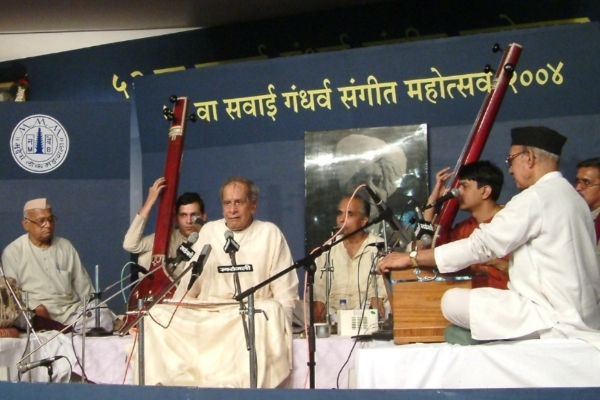
Mauli Takalkar (left) accompanying Pandit Bhimsen Joshi during Sawai Gandharva Sangeet Mahotsava in 2004. Pic courtesy: Arya Sangeet Prasarak Mandal
His life resembled one of the old stories Pune lovingly preserves across generations.
Long before the world knew him as Bhimsen Joshi’s trusted companion, Mauli worked at a shop in Mahatma Phule Mandai. Amid the noise of vegetable traders and crowded lanes, destiny arrived one day in the form of Bal Gandharva. At a banana stall belonging to Madhavrao Shinde, a disciple from the tradition of Master Krishnarao Phulambrikar, Bal Gandharva was requested to sing a bhajan. A young Mauli was asked to accompany him on the taal. That brief moment became a turning point in his life.
Mauli Takalkar (Pic courtesy: Amit Deshpande)
From the crowded lanes of Mandai to the grand stages of India and the world, Mauli’s journey unfolded through quiet dedication. He went on to accompany stalwarts like Kishori Amonkar and later shared the stage with admired vocalists including Shaunak Abhisheki, Anand Bhate, Jayateerth Mevundi, Raghunandan Panshikar, and even youngsters like Aarya Ambekar.
Yet his name became inseparably intertwined with Bhimsen Joshi. Across more than four decades and over 2,500 Santvani concerts, Mauli became part of Panditji’s inner musical universe. He often recalled with emotion how Bhimsen Joshi treated him not as an accompanist, but as family.
“Panditji was such a great man, he would take me to America for a whole month just to perform one abhanga,” Mauli once said with characteristic humility.
Classical vocalist Shubhada Mulgund recalled that Mauli eventually became part of the family itself. “Taal and Mauli were inseparable,” she said. “From the early Santvani programmes to foreign tours and even daily walks with Panditji, Mauli was always with us.” Remembering what drew Bhimsen Joshi towards him, she said it was his extraordinary command over laya and his deep immersion in the abhang tradition. His instinctive command over timing, rhythm, and pacing was flawless. “That is what caught Panditji’s eyes and ears,” she said.
In an age obsessed with spotlight and celebrity, Mauli Takalkar represented another tradition – artists who considered supporting greatness itself to be sacred work. His ṭāḷ never sought attention. It quietly strengthened the soul of the performance with complete surrender.
Even as honours came his way, Mauli remained deeply grounded in the Warkari ethos. He continued participating in the Pandharpur wari, performing bhajans through Harihar Bhajan Mandal and guiding younger musicians, including his son Anand and grandson Prathamesh.
Somewhere, in the memory of an early winter Sawai morning, Bhimsen Joshi’s voice still rises in an abhanga.
And beside him, smiling gently, Mauli Takalkar still keeps the ṭāḷ.