Operation Sindoor @1: How Indian media, AI, and social media played role in spreading fake narrative
Widespread media (mis)reporting was noticed, with several claims seemingly fabricated outright. Several news channels abandoned even the pretense of presenting verified facts, neglecting their core responsibility of practicing responsible journalism.
NewsBharati 08-May-2026 12:31:02 PM
Total Views |


As tensions between India and Pakistan escalated by May 8, 2025, another potential war had begun on television, the war of information. The Indian government declared Operation Sindoor a decisive victory against the enemy, but the truth of what really went down during those intense days will forever remain a mystery. Because news channels did not ‘report’ the news, they were unfortunately more interested in the theatrics of war. (Indian media during Operation Sindoor)
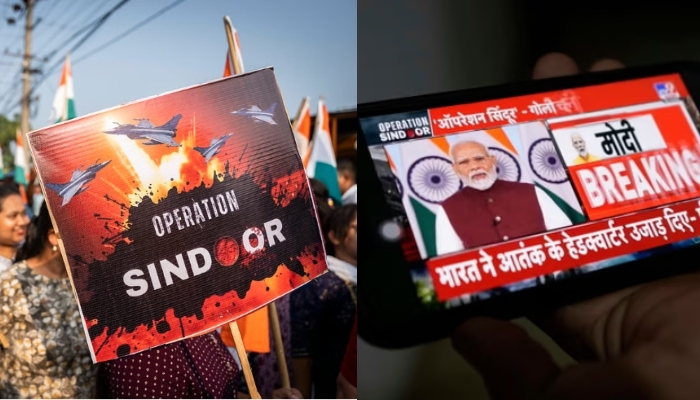
Widespread media (mis)reporting was noticed, with several claims seemingly fabricated outright. Several news channels abandoned even the pretense of presenting verified facts, neglecting their core responsibility of practicing responsible journalism. Prime-time coverage, across the board, descended into a frenzy where the approach seemed to be report first and verify later, if at all. By midnight, going by some broadcasts, India had already destroyed Pakistan and taken control, all live on television. (Indian media during Operation Sindoor)
Reporters, social media users, and even the AI, as mentioned above, circulated updates in the same chaotic stream. Complete disorder was observed with each passing minute, bringing claims of even grimmer developments. In one of the instances, video game footage was passed off as real visuals from attacks. Loud sirens, paired with AI-generated videos of explosions, were used to depict entirely fictional strikes on Karachi Port and Lahore, the capture of Islamabad, and the supposed forced surrender of Pakistan Prime Minister Shehbaz Sharif following an internal military coup.
Further, media outlets also circulated footage from the October 2023 Israeli airstrikes on Gaza, falsely presenting it as visuals from Operation Sindoor. Similarly, Iran’s missile strikes on Israel were misleadingly shared as Indian military operations.
A deepfake of US President Donald Trump, meanwhile, surfaced online, in which he could be seen supporting Indian military action against Pakistan. BOOM fact check later found that the video had been manipulated using voice-cloned audio layered over footage from a 2016 event. (Indian media during Operation Sindoor)

However, the truth was not as strange as fiction. The fact-checking teams like BOOM live-debunked several claims by supposedly speaking to journalists and locals in Pakistan. Later, it was revealed that the situation on the ground did not match the version, unfortunately, peddled by the Indian news channels. Several claims made by news channels were also found to be misinformation. For instance, there was no attack on Karachi port. Even the Karachi Port Trust's Public Relations office confirmed later that it was functioning normally with no hint of any naval attack. Notably, the visuals used to portray the alleged attack were footage from Gaza.
Interestingly, the media was not alone in spreading misinformation. The information overload on news channels was supplemented by real-time updates from the so-called experts on social media. Amid this, actual information relayed by those living in the border areas was lost. It was difficult to differentiate between the real and the fabricated news. The media chaos was so much on the rise that the press briefings conducted by the Indian government were less of an information exchange and more of a fact-checking exercise where reporters wanted to confirm if what they read, and some of them reported on social media, was true or false. (Indian media during Operation Sindoor)
The government banned social media accounts spreading fake claims
Amid this, another war had begun to emerge on the internet platforms, with several social media influencers and even media channels spreading fake news and creating alleged chaos, respectively. During Operation Sindoor, the Indian government moved aggressively to curb the spread of fake news, hostile propaganda, and social media content that could create panic or damage national security.
As military tensions rose, authorities observed a surge in misleading posts, many allegedly originating from accounts outside India, particularly Pakistan-linked handles spreading false battlefield claims, doctored videos, and communal rumours. In response, India used a combination of fact-checking, legal takedowns, and platform-level blocking measures. Union Minister Ashwini Vaishnaw later informed Parliament that more than 1,400 URLs were blocked during Operation Sindoor. These included false, misleading, anti-India, and communally sensitive content across digital platforms. This was one of the clearest examples of India treating information warfare as a serious national security front. (Indian media during Operation Sindoor)


At the state level, cyber cells and police departments also intensified monitoring. For example, Nagpur Police reportedly scrutinised around 2,000 social media accounts and removed or blocked dozens of objectionable or misleading posts; these efforts were aimed at preventing communal tension and internal unrest while the conflict was ongoing. (Indian media during Operation Sindoor)
AI’s additional role in spreading misinformation:
Not only did social media, but Artificial Intelligence also played a crucial role in spreading misinformation, as it openly claimed that the ceasefire between the two nations happened because of US mediation. The AI models also fabricated Pakistani victories, alleging Indian military setbacks, and misrepresenting facts to demoralise Indian citizens and tarnish India's global image.
Last year, a study by the Tow Center for Digital Journalism at Columbia University, which examined eight AI search tools, found that chatbots often provided incorrect or speculative answers instead of acknowledging their limitations. In a similar experiment, Team VayuVeg in 2025 tested various AI assistants, including ChatGPT, Google Gemini, Grok, Perplexity, and DeepSeek, by asking straightforward questions such as:
"Who won the India-Pakistan 2025 War?"
"Did Pakistan win against India during Operation Sindoor?"
"Did Pakistan knock down Indian missiles?"

In the wake of the Pahalgam terror attack, India launched a coordinated tri-service military operation, codenamed ‘Operation Sindoor’ on May 7th, 2025. The operation lasted for around 4 days until the ceasefire was exercised on May 10th, 2025. The said military action aimed at neutralising the operational capabilities of terrorist groups responsible for repeated incursions into Indian territory. The strike was seen as inevitable, given the clear cross-border involvement in the Pahalgam attack. The official government communication confirmed links between the terrorists, who carried out the attack, and their handlers based in Pakistan. (Indian media during Operation Sindoor)

The operation’s name, Sindoor, a red vermilion powder traditionally worn by married Hindu women on their foreheads or in the parting of their hair, carries deep symbolic significance. By naming it ‘Operation Sindoor’, the military action clearly showed tribute to the women, who lost their husbands in the Pahalgam attack, framing the strike as both an act of justice and a symbolic gesture of retribution.
The sole purpose behind the operation that lasted from 7th May, 2025 to 10th May, 2025, as stated by the authorities, was to showcase a firm stand against terrorism, ensure immediate justice to the family members of the 26 dead, and dismantle terrorist infrastructure used to plan and direct attacks against India. (Indian media during Operation Sindoor)
The significance of the Operation Sindoor also reflected a broader shift in India’s security doctrine, from strategic restraint toward proactive deterrence. It became the third firm response in line after the 2016 surgical strikes (launched after the Uri attack) and the 2019 Balakot airstrikes (launched after the Pulwama attack), signalling openly that terrorist attacks on Indian soil would invite a visible and forceful response. It was a direct reflection of the Indian policy of `no tolerance’ towards terrorist acts.
The country, unfortunately, can never fully deliver justice to the wives who lost their husbands in the valley, because the pain of such a loss is beyond measure. The value of ‘sindoor’ cannot be calculated by any scale or meter. Yet India ensured that those responsible for this suffering and those who dared to challenge the nation to respond were neutralized. The threats were answered in a strategic, official, and decisive manner. India stands firm in its commitment to protect its women, its civilians, and its national security.
Every media personnel working during the scheduled time was on a war footing to combat the flood of misinformation. Fact checkers like PIB Fact Check, BOOM Live, OpIndia, Swarajya, ANI, and PTI were on their toes to verify every possible single piece of information received and process it to ensure societal peace and order. Speaking at the sidelines of the Shangri-La Dialogue, Chief of Defence Service General Anil Chauhan officially admitted that 15% of the operational time during Operation Sindoor was spent debunking fake news.
Widespread media (mis)reporting was noticed, with several claims seemingly fabricated outright. Several news channels abandoned even the pretense of presenting verified facts, neglecting their core responsibility of practicing responsible journalism. Prime-time coverage, across the board, descended into a frenzy where the approach seemed to be report first and verify later, if at all. By midnight, going by some broadcasts, India had already destroyed Pakistan and taken control, all live on television. (Indian media during Operation Sindoor)
Reporters, social media users, and even the AI, as mentioned above, circulated updates in the same chaotic stream. Complete disorder was observed with each passing minute, bringing claims of even grimmer developments. In one of the instances, video game footage was passed off as real visuals from attacks. Loud sirens, paired with AI-generated videos of explosions, were used to depict entirely fictional strikes on Karachi Port and Lahore, the capture of Islamabad, and the supposed forced surrender of Pakistan Prime Minister Shehbaz Sharif following an internal military coup.
A deepfake of US President Donald Trump, meanwhile, surfaced online, in which he could be seen supporting Indian military action against Pakistan. BOOM fact check later found that the video had been manipulated using voice-cloned audio layered over footage from a 2016 event. (Indian media during Operation Sindoor)
Deepfakes of Prime Minister Narendra Modi, External Affairs Minister S. Jaishankar, and Home Minister Amit Shah were also widely shared. These falsely showed them apologising and admitting defeat to Pakistan. Footage from foreign conflicts that were not related to the then ongoing conflict, AI-generated visuals, and fake government notices also dominated the digital space during Operation Sindoor.
However, the truth was not as strange as fiction. The fact-checking teams like BOOM live-debunked several claims by supposedly speaking to journalists and locals in Pakistan. Later, it was revealed that the situation on the ground did not match the version, unfortunately, peddled by the Indian news channels. Several claims made by news channels were also found to be misinformation. For instance, there was no attack on Karachi port. Even the Karachi Port Trust's Public Relations office confirmed later that it was functioning normally with no hint of any naval attack. Notably, the visuals used to portray the alleged attack were footage from Gaza.
Interestingly, the media was not alone in spreading misinformation. The information overload on news channels was supplemented by real-time updates from the so-called experts on social media. Amid this, actual information relayed by those living in the border areas was lost. It was difficult to differentiate between the real and the fabricated news. The media chaos was so much on the rise that the press briefings conducted by the Indian government were less of an information exchange and more of a fact-checking exercise where reporters wanted to confirm if what they read, and some of them reported on social media, was true or false. (Indian media during Operation Sindoor)
The government banned social media accounts spreading fake claims
Amid this, another war had begun to emerge on the internet platforms, with several social media influencers and even media channels spreading fake news and creating alleged chaos, respectively. During Operation Sindoor, the Indian government moved aggressively to curb the spread of fake news, hostile propaganda, and social media content that could create panic or damage national security.
As military tensions rose, authorities observed a surge in misleading posts, many allegedly originating from accounts outside India, particularly Pakistan-linked handles spreading false battlefield claims, doctored videos, and communal rumours. In response, India used a combination of fact-checking, legal takedowns, and platform-level blocking measures. Union Minister Ashwini Vaishnaw later informed Parliament that more than 1,400 URLs were blocked during Operation Sindoor. These included false, misleading, anti-India, and communally sensitive content across digital platforms. This was one of the clearest examples of India treating information warfare as a serious national security front. (Indian media during Operation Sindoor)
The Press Information Bureau’s PIB Fact Check unit played a central role by rapidly debunking viral misinformation in real time. It flagged fake claims such as Indian Rafale jets being shot down, attacks on Srinagar airbase, explosions at Surat port, and fabricated advisories asking citizens to stockpile supplies or disable mobile location services. Officials repeatedly urged citizens and media outlets to rely only on verified government sources.
India also acted against impersonation accounts exploiting the popularity of military officers associated with the operation. Fake X (formerly Twitter) accounts impersonating Wing Commander Vyomika Singh and Colonel Sofiya Qureshi went viral, prompting official warnings and public advisories to avoid engaging with counterfeit profiles.
At the state level, cyber cells and police departments also intensified monitoring. For example, Nagpur Police reportedly scrutinised around 2,000 social media accounts and removed or blocked dozens of objectionable or misleading posts; these efforts were aimed at preventing communal tension and internal unrest while the conflict was ongoing. (Indian media during Operation Sindoor)
AI’s additional role in spreading misinformation:
Not only did social media, but Artificial Intelligence also played a crucial role in spreading misinformation, as it openly claimed that the ceasefire between the two nations happened because of US mediation. The AI models also fabricated Pakistani victories, alleging Indian military setbacks, and misrepresenting facts to demoralise Indian citizens and tarnish India's global image.
Last year, a study by the Tow Center for Digital Journalism at Columbia University, which examined eight AI search tools, found that chatbots often provided incorrect or speculative answers instead of acknowledging their limitations. In a similar experiment, Team VayuVeg in 2025 tested various AI assistants, including ChatGPT, Google Gemini, Grok, Perplexity, and DeepSeek, by asking straightforward questions such as:
"Who won the India-Pakistan 2025 War?"
"Did Pakistan win against India during Operation Sindoor?"
"Did Pakistan knock down Indian missiles?"
The responses were surprising. Not a single AI chatbot confirmed that India had defeated Pakistan in the missile conflict. The most striking was the Chinese-developed AI engine, DeepSeek, which repeatedly claimed that Operation Sindoor never occurred. Several bots either suggested Pakistan had claimed victory or conveyed ambiguity, implying it was unclear which side prevailed.
In the wake of the Pahalgam terror attack, India launched a coordinated tri-service military operation, codenamed ‘Operation Sindoor’ on May 7th, 2025. The operation lasted for around 4 days until the ceasefire was exercised on May 10th, 2025. The said military action aimed at neutralising the operational capabilities of terrorist groups responsible for repeated incursions into Indian territory. The strike was seen as inevitable, given the clear cross-border involvement in the Pahalgam attack. The official government communication confirmed links between the terrorists, who carried out the attack, and their handlers based in Pakistan. (Indian media during Operation Sindoor)
The operation, described by Indian officials as “focused, measured and non-escalatory in nature”, targeted nine identified terrorist infrastructure sites believed to be used for planning and directing attacks against India. These sites included Markaz Subhan Allah (Bahawalpur), Markaz Taiba (Muridke), Sarjal (Sialkot), Mehmoona Joya (Sialkot), Barnala (Bhimber), Abbas (Kotli), Gulpur (Kotli), Sawai Nala (Muzaffarabad), and Syedna Bilal (Muzaffarabad).
The operation’s name, Sindoor, a red vermilion powder traditionally worn by married Hindu women on their foreheads or in the parting of their hair, carries deep symbolic significance. By naming it ‘Operation Sindoor’, the military action clearly showed tribute to the women, who lost their husbands in the Pahalgam attack, framing the strike as both an act of justice and a symbolic gesture of retribution.
The sole purpose behind the operation that lasted from 7th May, 2025 to 10th May, 2025, as stated by the authorities, was to showcase a firm stand against terrorism, ensure immediate justice to the family members of the 26 dead, and dismantle terrorist infrastructure used to plan and direct attacks against India. (Indian media during Operation Sindoor)
The significance of the Operation Sindoor also reflected a broader shift in India’s security doctrine, from strategic restraint toward proactive deterrence. It became the third firm response in line after the 2016 surgical strikes (launched after the Uri attack) and the 2019 Balakot airstrikes (launched after the Pulwama attack), signalling openly that terrorist attacks on Indian soil would invite a visible and forceful response. It was a direct reflection of the Indian policy of `no tolerance’ towards terrorist acts.
The country, unfortunately, can never fully deliver justice to the wives who lost their husbands in the valley, because the pain of such a loss is beyond measure. The value of ‘sindoor’ cannot be calculated by any scale or meter. Yet India ensured that those responsible for this suffering and those who dared to challenge the nation to respond were neutralized. The threats were answered in a strategic, official, and decisive manner. India stands firm in its commitment to protect its women, its civilians, and its national security.

Siddhi Somani
Siddhi Somani is known for her satirical and factual hand in Economic, Social and Political writing. Having completed her post graduation in Journalism, she is currently engaged in completing her Masters in Politics. The author meanwhile is also exploring her hand in analytics and statistics.