Amit Shah’s Drug-Free India: Why the Drug War Is a National Security Battle
NewsBharati 07-Sep-2026 14:14:26 PM
Total Views |


For decades, India has spoken about the drug menace as though it were principally a problem of policing, addiction and rehabilitation. Amit Shah has now changed the vocabulary. His declaration that India will become “Drug-Free” by 2029 places narcotics where they increasingly belong at the centre of the national-security discourse.
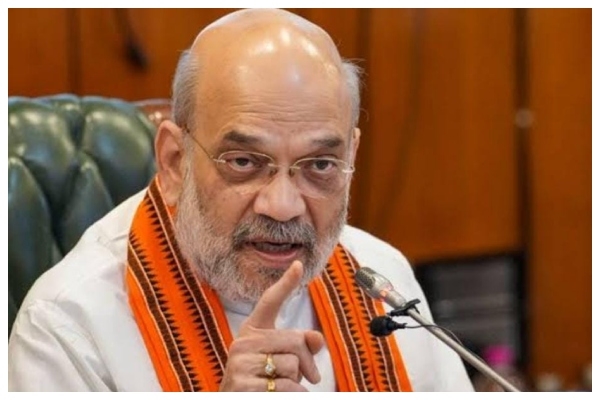
That is the significance of the three-year roadmap announced by the Union Home Minister on September 6. The government’s strategy is not confined to catching peddlers on street corners. It aims at dismantling the entire narcotics ecosystem trafficking networks, clandestine laboratories, precursor chemicals, financing chains, international fugitives and the demand that sustains the market. The roadmap rests on intelligence-led enforcement, control of precursor and synthetic drugs, demand and harm reduction, and institutional coordination.
This is not merely about saving young people from addiction. It is about protecting the Indian State from an enemy that does not always arrive wearing the uniform of an enemy.
The most dangerous aspect of the narcotics trade is the money behind it. A drug empire generates enormous quantities of unaccounted cash. That money can finance organised crime, corruption, illegal arms networks and, ultimately, terrorism. Shah has explicitly warned that narcotics-generated “dirty money” is used to fund terrorism and can produce narco-terror modules. The geography makes the threat even more serious.
India sits close to two notorious narcotics-producing and trafficking regions the so-called Golden Crescent to the west and Golden Triangle to the east. The country can therefore become not merely a consumer market but a transit corridor, distribution hub and financial ecosystem for international criminal networks. Shah has specifically spoken of the need to stop trafficking through these routes.
A young addict is a victim. A street-level peddler is a criminal. But the financier, international trafficker, clandestine laboratory operator and terrorist organisation exploiting the narcotics economy belong to an entirely different category. They constitute an ecosystem of hostile power. A nation that allows that ecosystem to grow is not merely losing its youth. It is permitting an alternative underground economy to acquire power.
Article 370 was described for decades as politically untouchable. The Modi government removed the special constitutional arrangement in 2019. The Supreme Court subsequently upheld the constitutional validity of the move. Naxalism was another problem that had survived governments, operations and development packages for generations. Shah repeatedly imposed deadlines and demanded a coordinated security response. By 2026, the government declared the country Naxalism-free after the culmination of an intensified campaign.The Northeast, too, was once routinely discussed through the vocabulary of insurgency, ethnic conflict and instability. The security architecture has increasingly shifted towards peace, connectivity and development.

The lesson is not that every government target automatically becomes reality. The lesson is more important - problems that Indian politics once learned to manage can, under determined political leadership, be attacked with the objective of ending them. That is Shah’s governing philosophy. Do not administer the problem indefinitely. Identify the network. Attack its infrastructure. Break its financing. Coordinate the agencies. Set a deadline. Measure results. That is precisely what makes the 2029 narcotics target interesting.
The old anti-drug model often concentrated on the visible end of the chain. Catch the courier. Seize the consignment. Arrest the peddler. File the case. That is necessary but insufficient. The real war has to travel upwards. Who manufactures the drug? Who supplies precursor chemicals? Who finances the operation? Who controls the transport corridor? Who launders the money? Who provides protection? Who operates across state or international borders? Who converts narcotics profits into terror financing? Unless those questions are answered, the war merely replaces one peddler with another. The new roadmap reportedly sets concrete targets, including dismantling 100 international or interstate drug networks, destroying 100 clandestine laboratories and bringing back 100 narcotics fugitives. That is the correct direction.
But enforcement alone will not produce a Drug-Free India. There is another battlefield: the mind. A country aspiring to become Viksit Bharat in 2047 cannot afford a generation weakened by addiction, synthetic drugs and chemical dependence. Shah has explicitly linked drug-free youth power with the larger national objective of Viksit Bharat. This is where families, schools, universities, religious and community institutions, civil society and the medical system have to become part of the national campaign. The June 2026 Vision Document on Narcotics Control already placed supply reduction, demand reduction and rehabilitation within the same framework. The addict must not be treated merely as a criminal statistic. He must be rescued. But those who manufacture, finance and distribute poison cannot hide behind the language of victimhood. Compassion for the victim must coexist with zero tolerance for the predator.
Article 370 was supposed to be politically untouchable. Naxalism was supposed to be an endless security problem. Terrorism was supposed to be managed rather than defeated. The Northeast was supposed to remain trapped in cycles of insurgency and instability.The larger lesson of the Modi-Shah era is not that every promise is easy. It is that political impossibility is often sustained by political hesitation.
The narcotics challenge will be harder because unlike a territorial or insurgent enemy, drugs have no single battlefield. The enemy is dispersed across borders, cities, villages, financial systems, cyberspace and social networks. But that is precisely why the national-security approach is necessary.
India cannot become a developed power while allowing a parallel narcotics economy to recruit its young, corrupt its institutions and finance organised crime and terrorism. The 2029 deadline should therefore not be dismissed as another government slogan. It should be treated as a national mission.
The war on narcotics is ultimately a war over who owns India’s future the nation or the criminal networks that seek to poison it.
And if Amit Shah’s record teaches one lesson, it is this: India should stop asking whether a seemingly impossible problem can be solved. It should ask what political will, institutional coordination and national resolve are required to solve it.
This version keeps the “make the impossible possible” theme central without turning the editorial into a simple praise piece. It also makes the national-security argument the intellectual backbone rather than an afterthought.

Editor's Desk
Editor's Desk