Breaking the symbols of Slavery and Mass Murder
India believes that real revolution is the improvement of the character and so the real revolutionists are parents, teachers, yoga masters, sages & saints
NewsBharati 24-Nov-2022 15:07:02 PM
Total Views |


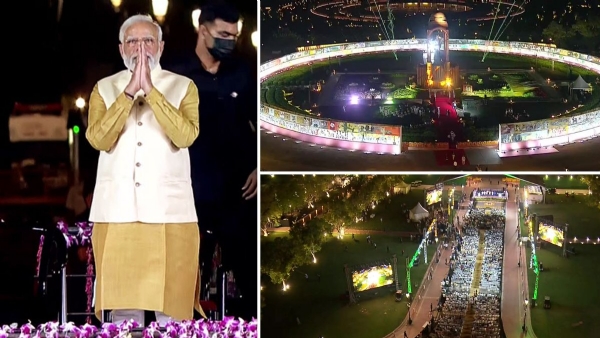
While inaugurating Kartavya Path at India Gate in September 2022, PM Modi said the symbol of colonialism, 'Kingsway' or Rajpath, will be a history and a new era has begun.
Babri Masjid, meaning Mosque of Babur, was a controversial structure in Ayodhya, India, at a site believed by many Hindus to be the birthplace of the Hindu deity Rama. Mir Baqi, a general of the Mughal emperor Babur, destroyed the Hindu temple in 1528 CE and built a structure on its site. Archaeological Survey of India conducted an excavation and found during excavation many things which suggest the presence of a Hindu structure beneath. The High Court noted that the Babri structure was not built on vacant land and the excavated underneath structure was not Islamic in nature. The structure, a symbol of slavery, was demolished in 1992.
India believes that real revolution is the improvement of character and so the real revolutionists are parents, teachers, yoga masters, sages & saints. West always considered mass murderers like Lenin, Stalin, and Mao Zedong as revolutionary leaders. The demolition of monuments to Russian Communist leader, Vladimir Lenin in modern Ukraine, Poland, and other countries started during the fall of the Soviet Union in the 1990s. The demolition of Lenin's monuments in Ukraine happened in four stages.
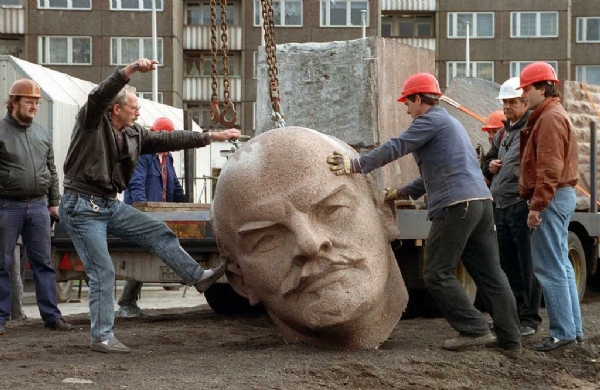
i. During the 1990s more than 2,000 Lenin monuments were demolished in Galicia and Volyn,
ii. at the turn of the 1990-the 2000s, more than 600 Lenin monuments were removed in western and central areas,
iii. in 2005-2008 more than 600 were demolished mainly in central areas, and
iv. in 2013-2014 552 monuments were demolished.
No statues of the former Soviet leader Vladimir Lenin have been left across Ukraine, the head of the Ukrainian Institute of National Memory, Vladimir Vyatrovich, said in an interview with Liga.
The same thing has also happened in Poland where over 2,000 Communist-era monuments have been removed since 1979. In 2014 Polish town of Nowa Huta erected a statue of a urinating Lenin in bright green color.
Young men in Ethiopia dismantled the statue of the Russian Bolshevik revolutionary leader Vladimir Lenin in Addis Ababa on May 23, 1991, two days after the exiled departure of Ethiopia's pro-Communist strongman Mengistu Haile Mariam.
Also Read: Sanatana Dharma in the 21st Century
Lenin came to power after the October Revolution in 1917 and was responsible for the mass murder of millions of people before his death in 1924. In May 1922, Lenin issued a decree calling for the execution of anti-Bolshevik priests, causing between 14,000 and 20,000 deaths. A decree in April 1919 resulted in the establishment of concentration camps, which were entrusted to the Cheka, later administered by a new government agency, Gulag. By the end of 1920, 84 camps had been established across Soviet Russia, holding about 50,000 prisoners; by October 1923, this had grown to 315 camps and about 70,000 inmates. Those who interned in the camps were used as slave labor. From July 1922, intellectuals deemed to be opposing the Bolshevik government were exiled to inhospitable regions or deported from Russia altogether; Lenin personally scrutinized the lists of those to be dealt with in this manner.
During the Russian Famine of 1921, the government exported large quantities of food grains, letting Five million people starve and die. People view a huge head of a statue of Joseph Stalin in the middle of downtown Budapest, Hungary. Christopher Columbus claimed Central and South America for Spain during the 1400s. This resulted in the genocide and extinction of several Native American Tribes. In Caracas, Venezuela, the statue of Christopher Columbus was toppled in 2004. It was replaced by a likeness of Guaicaipuro, an indigenous chief who resisted Spanish conquerors.
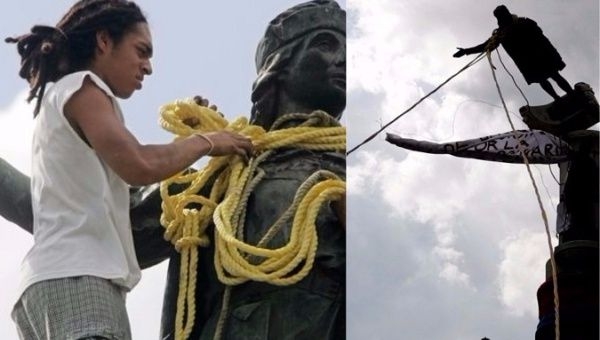
Venezuelan demonstrators place a rope to take down a Christopher Columbus statue in Caracas, on Oct. 12, 2004
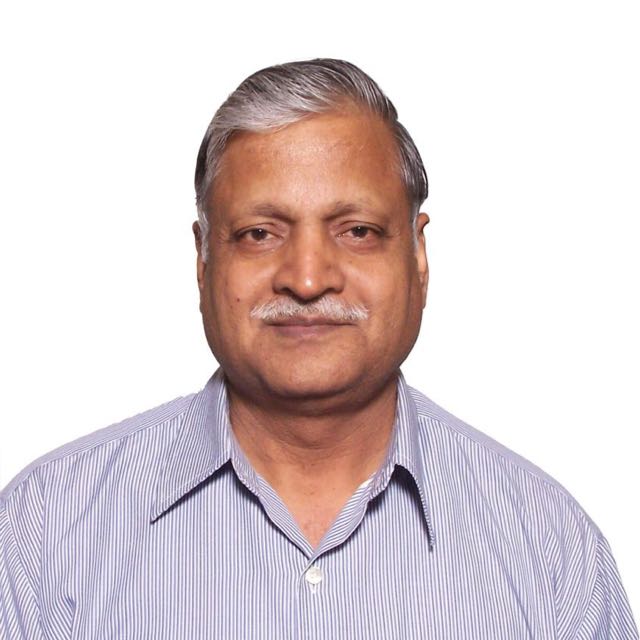
Ravi Aiyyar
Ravi Kumar is a member of All India Sampark Toli of RSS. His headquarters is in Mumbai.
Ravi Kumar completed engineering from the prestigious Madras Institute of Technology, Chennai in 1970. During his college days, he was All India General Secretary of Akhil Bharatiya Vidyarthi Parishad (1969-70). ABVP is considered the largest student organization in the world. He served as Project Engineer for five years and left his job with M/S Larsen & Toubro in 1975 to serve society as an RSS Pracharak. He worked among the youth of Gujarat and the tribals of Maharashtra.
For 36 years from 1982 to 2018, Ravi Kumar travelled regularly to 45 countries to serve the Indian society under Sewa International. During this period his headquarters were in Hong Kong, Bangkok, and Sydney, Australia.
He has conducted more than 300 Yoga camps and more than 500 workshops on Vedic Mathematics in over 40 countries in many universities and socio-cultural institutions.