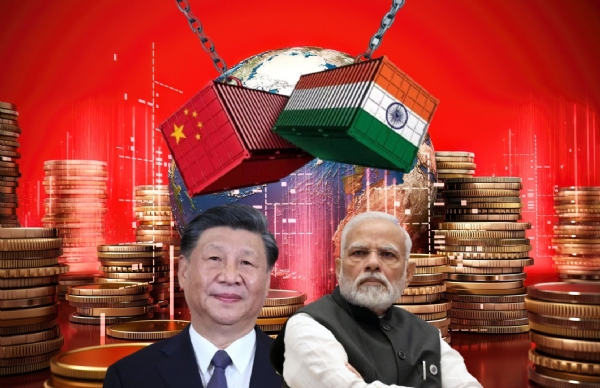
China has initiated economic warfare against India through various means, aiming to slow down India's economic growth and prevent it from emerging as a major economic and geopolitical competitor. Beijing's policies leverage China's economic dominance and India's reliance on China. These include supply chain disruptions, trade restrictions, investment leverage, currency manipulation, illicit trade, and information warfare.
In response, India has focused on strengthening domestic manufacturing through policies like "Make in India" and "Atmanirbhar Bharat," diversifying supply chains, scrutinizing Chinese investments, and imposing trade barriers. Despite these efforts, India's economic dependence on China remains significant, necessitating further strategic de-risking and resilience building in the future.
Geopolitical and Economic Context of India-China Rivalry
The relationship between China and India is complex, characterized by economic cooperation alongside frequent border disputes and underlying tensions. China's primary objective is to prevent India from emerging as a competitor. Beijing's policies are designed to exert pressure on India's economy by limiting the supply of critical components, imposing trade restrictions on specific Indian exports, and leveraging investments in Indian startups.
Historically, China has been India's largest trading partner between 2008 and 2021. India justified its reliance on China in the name of "importing efficiency" due to cheaper goods and loans, particularly in sectors like thermal power and startups. However, this has led to a significant and destabilizing trade deficit for India with China. The bilateral relationship deteriorated significantly after the 2020 Galwan Valley clash, leading to a hardening of Indian economic policies towards China and increased militarization along the Line of Actual Control (LAC). These actions by China aim to threaten India's economic sovereignty and hinder its growth.
China's Multidimensional Economic Coercion and Infiltration Tactics
China employs a range of tactics to impede India's economic growth and prevent its emergence as a strong competitor. These tactics are not solely economic but also encompass geopolitical and information warfare elements, creating a complex challenge for India.
A. Economic Infiltration and "Mind Subversion"
China has invested in Indian startups and technology companies, particularly between 2015 and 2020, contributing to the growth of India's tech sector. While these investments have fuelled India's development, they are now viewed as strategic vulnerabilities. China could potentially use these investments to exert pressure on India's economy and influence its foreign policy decisions.
Following the Galwan conflict, India has imposed stricter scrutiny on Chinese investments. However, some prominent Indian corporations, such as the Confederation of Indian Industry (CII) and the Adani group, have advocated for easing restrictions on Chinese investments. They argue that this would reduce costs and enhance their competitiveness. This situation suggests that economic interests can inadvertently create internal pressure groups that align with Chinese objectives. China's economic infiltration creates an environment within the Indian corporate sector where easing ties with China is advocated for economic gain, subtly influencing India's strategic stance. While not direct psychological manipulation, it is a form of indirectly influencing policy decisions through economic incentives.
B. Trade and Market Manipulation
Artificial Valuation of Chinese Yuan (Currency Manipulation) and its Impact on Indian Trade: China has historically intervened in foreign exchange markets to keep its currency (Renminbi/Yuan) undervalued. A devalued Yuan makes Chinese exports cheaper and more competitive globally. For instance, the 2015 devaluation led to a surge in demand for the dollar, weakening the Indian Rupee and increasing volatility in Indian bond markets. This directly impacts Indian exporters, especially in competitive sectors like textiles, apparel, chemicals, and metals, leading to reduced profit margins and increased dumping of Chinese goods in the Indian market. While China claims to be moving towards a more market-oriented economy, concerns about transparency persist.
Under-Invoicing in Indian Imports: Mechanism, Scale, and Impact on Domestic Industries: Under-invoicing of imports is a common practice to evade customs duties and GST, and to avoid regulatory requirements for imports above a certain value. India has noted a large number of instances of trade mis-invoicing in imports from China. This practice can be used to move untaxed money out of the country or to undermine the competitiveness of domestic producers by artificially lowering import prices and facilitating dumping, thereby hindering local growth. A discrepancy of $11 billion between Chinese export data and Indian import data is partly attributed to under-invoicing.
Dumping of Cheap and Substandard Chinese Goods: Targeted Sectors and Consequences: India regularly accuses China of dumping in several strategic sectors, such as APIs (Active Pharmaceutical Ingredients), steel, textiles, and solar panels. China's low production costs, often enabled by government subsidies, allow Chinese goods to enter the market at cheaper rates, threatening domestic industries. India has responded by imposing anti-dumping duties on various products, including plastic processing machines (27-63%) and herbicide raw material PEDA, pharmaceutical input Acetonitrile, Vitamin A Palmitate, Insoluble Sulphur, Potassium Tertiary Butoxide, and décor paper. This aims to protect local businesses and ensure fair market competition.
The artificial valuation of the Chinese Yuan directly enhances the competitiveness of Chinese exports, making it easier for Chinese producers to dump goods into the Indian market. This creates a vicious cycle where India's trade deficit widens , and domestic industries face unfair competition, hindering their growth and self-reliance objectives. This illustrates how China's multiple tactics converge to achieve the objective of slowing India's economic growth.
C. Supply Chain Dominance and Disruptions
Control over Critical Raw Materials (e.g., Rare Earths, APIs) and Export Restrictions: India is heavily reliant on China for critical inputs, including 70-80% of Active Pharmaceutical Ingredients (APIs) and nearly 60% of semiconductors. This dependence is exacerbated by the green transition, as India relies on China for photovoltaic cells, wafers, lithium-ion batteries, and strategic resources like lithium, rare earths, and graphite, essential for solar panel manufacturing. China has weaponized this control, as seen in its export restrictions on gallium and germanium in late 2023. As of April 2024, China has tightened export licensing rules for rare earth elements like terbium and dysprosium, disrupting global supply chains and impacting India's auto and electronics sectors.
Disruptions in Key Supply Chains and Limitations on Exports of Critical Components to India: Beijing can leverage its dominant position to disrupt or limit exports of critical components to India, potentially crippling sectors like electronics manufacturing or pharmaceutical production. This has been evident in recent moves to prevent high-tech manufacturing from relocating from China to India.
Restrictions or Withdrawal of Skilled Manpower and Technology Transfer: China has actively taken steps to curb technology transfers and equipment exports to India and other Asian countries. A notable example is the withdrawal of over 300 Chinese engineers from Foxconn's iPhone manufacturing facilities in India in July 2025. This was a deliberate attempt to block the transfer of technical know-how and hinder India's growth in electronics manufacturing. This action disrupts ongoing training and delays the implementation of high-end manufacturing processes, posing a significant challenge to India's manufacturing ambitions.
India's heavy reliance on Chinese inputs creates a serious strategic vulnerability. China's control over rare earths and APIs means it can impose a "silent blockade" , significantly impacting Indian industries without a direct trade war and slowing down India's industrialization. China's actions aim to "cripple" Indian sectors and block technology transfer , directly hindering India's manufacturing ambitions and its ability to achieve self-reliance in strategic sectors like electronics. This indicates a deliberate strategy by China to actively impede India's development to maintain its lead in technology and manufacturing.
D. Illicit Smuggling and Trade
Illicit Smuggling and Trade via Nepal, Sri Lanka, Bangladesh, and Southeast Asia: Illicit trade, including smuggling and grey market operations, involves trading goods outside authorized distribution channels, often to evade duties or exploit price differences. It thrives in regions with porous borders and regulatory gaps. Chinese goods are extensively smuggled into India via neighboring countries like Nepal and Bangladesh. For example, banned Chinese lighters are smuggled into India via Nepal.
Impact on Indian Domestic Markets and Revenue: Smuggling introduces cheaper, often untaxed goods into the market, threatening domestic industries. It also results in significant losses in government revenue. Illicit trade fuels organized crime, corruption, and money laundering, posing risks to public health (e.g., illicit pharmaceuticals) and national security.
China's economic influence in neighboring countries (e.g., BRI projects in Nepal, Sri Lanka, Bangladesh ), combined with porous borders , creates a conducive environment for illicit trade. This provides alternative routes for Chinese goods to enter India, destabilizing India's border regions and undermining its economic policies. It allows Chinese goods to bypass Indian duties and regulations , threatening India's domestic industries and revenue collection. Furthermore, it creates a "grey market" that further distorts fair competition in the market. This is a subtle way to circumvent India's trade protections.
E. Strategic Influence and Undermining Indian Brands
Leveraging the Belt and Road Initiative (BRI) and "Debt Trap" Concerns in Neighboring Countries: China's BRI has expanded its influence in India's neighboring countries, including Pakistan, Bangladesh, Sri Lanka, and the Maldives. While offering economic benefits, BRI projects have raised concerns about "debt trap diplomacy," where nations become indebted to China, risking their sovereignty and providing China with strategic footholds. India has chosen to stay away from BRI. Increased Chinese military presence and economic activities in these regions are viewed as a strategy to encircle India.
Undermining and Neutralizing Indian Brands like BHEL, C-DAC: While there is no direct evidence of China explicitly "discrediting" or "neutralizing" specific Indian brands like BHEL or C-DAC, it is implicit in China's broader strategy to undermine India's economic and industrial progress. This includes:
Supply Chain Blockades: China has imposed a "silent blockade" on India for critical materials like fertilizers and rare earth magnets, impacting Indian industries. This indirectly affects the operational efficiency and reputation of Indian public sector undertakings and brands reliant on these inputs.
Information Warfare and Propaganda: Chinese state media and online nationalists actively spread narratives portraying India's capabilities as "inferior" and claiming "China has defeated India." Undermining India's capabilities and national ethos can indirectly erode confidence in Indian brands and industries, including public sector enterprises.
Intellectual Property Theft: China has a long history of state-organized intellectual property (IP) theft , which allows Chinese firms to bypass R&D costs and undercut global competitors. While not specific to BHEL or C-DAC, such practices inherently reduce the competitive edge and innovation of any legitimate brand, creating an unfair playing field.
China's objective is to undermine India's economic power. The BRI creates strategic dependencies and potential "debt traps" in neighboring countries , forming a geopolitical encirclement that diverts India's attention and resources. The "silent blockade" on critical inputs directly hinders India's industrial output, affecting major players like BHEL (in the power sector) and C-DAC (in electronics/IT, which relies on components). This is a practical way to "neutralize" or impede their operations. Propaganda aims to erode confidence in India's capabilities, indirectly impacting brand image and investor trust in Indian industries. General IP theft diminishes the competitive edge of Indian innovations, including those by entities like C-DAC (known for supercomputing). Thus, China employs various economic and information warfare tactics that collectively work to diminish the growth and competitiveness of key Indian brands and public sector undertakings.
F. Covert Influence Operations
Cyberattacks Targeting India's Critical Infrastructure and Data: China has conducted state-sponsored cyberattacks on India's critical infrastructure, including power grids (e.g., Ladakh, Mumbai, and Telangana), media organizations, and sensitive government databases (e.g., Aadhaar, Finance, External Affairs, Home Ministry, EPFO). These attacks aim to steal sensitive data, shape narratives, and potentially disrupt essential services.
Information Warfare and Narrative Manipulation: China actively conducts propaganda campaigns against India, including providing assistance to separatist groups in Northeast India. Chinese state media and online platforms engage in disinformation campaigns, amplifying anti-India narratives, downplaying Chinese casualties in border conflicts, and even echoing Pakistani misinformation. The objective is to undermine India's credibility and sow confusion.
Interference in Education under the Guise of Environmental Issues and Use of Activists to Block Indian Industries: While there is no direct evidence in the snippets of China directly using environmental issues or activists to halt industries, China's methods of "shaping narratives" and "influencing voter choices" suggest a readiness to exploit any internal points of contention to impede India's development or create instability. Local protests in Ladakh against planned mining and industrial projects due to environmental concerns are noted, which, while domestic, could potentially be amplified or exploited by external actors as part of a broader influence strategy. A direct Chinese link is not provided in the snippets for this specific point, but it could be a logical extension of China's "Three Warfares" strategy.
--