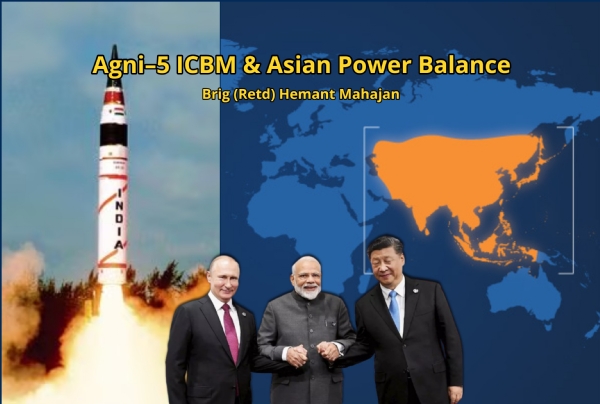
India’s successful test of the Agni–5 Intercontinental Ballistic Missile (ICBM) has fundamentally strengthened its deterrence posture in Asia. With a range of 5,500–8,000 km, the missile can cover the entirety of China, Pakistan, and parts of Europe, placing India in the elite club of six nations with proven ICBM capabilities.
Equipped with MIRV (Multiple Independently Targetable Re-entry Vehicle) technology, the Agni–5 can deliver multiple nuclear warheads against separate targets, enhancing survivability and credibility of India’s second-strike capability. This breakthrough alters the India–China–Pakistan security equation, bolsters India’s nuclear doctrine, and signals India’s readiness to uphold stability in the Indo-Pacific.
Indian Environment Most Volatile In The World
India’s security environment remains one of the most volatile in the world, surrounded by two nuclear-armed neighbours—China and Pakistan, both of which maintain aggressive postures. China’s increasing military assertiveness in the Indo-Pacific, coupled with Pakistan’s continued proxy warfare, has necessitated India’s pursuit of credible deterrence.
The Agni missile series has been the backbone of India’s land-based strategic forces. The test of Agni–5, carried out from Dr. APJ Abdul Kalam Island, Odisha, represents a strategic leap—not just technologically but also politically. With this, India demonstrates both technological self-reliance and strategic confidence.
Technical Features of Agni–5
Range: 5,500–8,000 km → Brings all of China within strike range.
Payload: 1.5 tons (nuclear or conventional).
MIRV Capability: 3–6 warheads, each targeting different locations.
Propulsion: 3-stage, solid-fuel rocket (faster launch readiness, less vulnerable to pre-emptive strikes).
Speed: Mach 24 (approx. 29,000 km/h).
Guidance System: Ring Laser Gyroscope (RLG) & Micro Navigation System (MINS) with CEP < 10 m.
MIRV Technology: 3–6 independently targetable warheads.
Nuclear Doctrine Impact: Strengthens India’s No First Use (NFU) policy by ensuring devastating retaliation.
Geopolitical Implication: Balances Chinese hegemony in Asia and enhances India’s bargaining power in multilateral forums.
Diplomatic Message: India is a responsible, self-reliant, and decisive nuclear power.
Why Agni–5 Matters for India
Strategic Depth: Ensures that Chinese command centres, industrial hubs, and military bases are within range.
Credible Deterrence: Strengthens India’s second-strike capacity.
Global Standing: Positions India among the world’s top six ICBM powers.
Missile Defence Penetration: MIRVs complicate interception attempts by Chinese/US missile defence systems.
Symbol of Self-Reliance: Developed under the DRDO’s indigenous program, showcasing India’s R&D capability.
MIRV Technology – A Game Changer
MIRV allows a single missile to deploy multiple warheads, each capable of striking different targets. This transforms deterrence by:
Maximizing Destruction: One missile = 3–6 strikes.
Evasion of Defences: Overwhelms enemy missile shields.
Resource Efficiency: Fewer missiles required for assured retaliation.
India’s adoption of MIRV places it alongside the US, Russia, and China, significantly raising its strategic credibility.
India–China Strategic Dynamics
China’s nuclear arsenal includes DF–31 and DF–41 ICBMs, with ranges up to 12,000–14,000 km. While India’s Agni–5 has a shorter range, it adequately covers all Chinese assets relevant to India’s security.
Implications:
Neutralizes China’s “nuclear coercion” tactics.
Provides leverage during border tensions (e.g., Doklam 2017, Galwan 2020).
Strengthens India’s role in QUAD & Indo-Pacific security frameworks.
Evolution of the Agni Missile Family
Missile
Range (km)
Role
Agni–1
700–900
Pakistan-focused tactical deterrent
Agni–2
2,000–3,500
Covers entire Pakistan, parts of China
Agni–3
3,500–4,000
Wider Asian coverage
Agni–4
4,000–4,500
China’s border provinces
Agni–5
5,500–8,000
True ICBM, covers entire China
Counter-Value vs Counter-Force Missions
Counter-Value: Strikes against cities & industrial hubs (e.g., Shanghai, Islamabad).
Counter-Force: Strikes against missile silos, airbases, naval bases.
With Agni–5’s precision and MIRV, India can pursue both strategies, enhancing flexibility and deterrence credibility.
Doctrinal Impact – India’s No First Use (NFU)
India’s NFU doctrine (2003) commits to never initiating nuclear strike, but promises massive retaliation. Agni–5 makes this promise credible:
Guarantees second-strike capability.
Prevents enemy miscalculation.
Strengthens India’s minimum credible deterrence posture.
India’s nuclear triad – Land (Agni series), Sea (Arihant-class SSBN), Air (Mirage-2000/Rafale with nuclear bombs)]
Global & Diplomatic Implications
For Pakistan: Raises threshold for miscalculation, as escalation risks annihilation.
For China: Demonstrates India’s willingness to ensure parity.
For the US & Russia: Positions India as a strategic partner, not junior ally.
For Multilateral Forums: Strengthens India’s case for UNSC permanent membership and nuclear supplier group (NSG).
Statistical Snapshot – India’s Strategic Posture
India’s nuclear arsenal: ~164 warheads (SIPRI estimate).
China’s nuclear arsenal: ~410 warheads.
Pakistan’s nuclear arsenal: ~170 warheads.
Global ICBM powers: US, Russia, China, UK, France, India.
Recommendations
The Agni–5 ICBM represents more than a missile—it is a strategic equalizer. By integrating MIRV technology, India has enhanced both its deterrence credibility and regional influence. Few recommendations are as under:-
Accelerate deployment of Agni–5 into the Strategic Forces Command.
Expand MIRV capability across the Agni series.
Invest in hypersonic missile development to maintain long-term edge.
Strengthen command-and-control systems for secure, survivable deterrence.
Leverage Agni–5 for diplomatic influence in Asia-Pacific security frameworks.
Agni–5 ensures that India’s voice in global strategic affairs will be heard, respected, and factored into any future security architecture.
Two other Important Strategic Land Marks
India successfully tests maiden flight of Integrated Air Defence Weapon Multi-layered shield': Msn Sudarshan Chakra
The Defence Research and Development Organisation (DRDO) on Sunday successfully conducted the maiden flight tests of the Integrated Air Defence Weapon System (IADWS), a multi-layered air defence platform. The trials were carried out on Saturday afternoon off the Odisha coast. The system integrates three indigenous components — the Quick Reaction Surface-to Air Missile (QRSAM), the advanced Very Short Range Air Defence System (VSHORADS) missiles, and a high-power laser-based Directed Energy Weapon (DEW).
A ₹70,000-crore agreement with Germany; six high-tech submarines to be built”
Government of India has approved negotiations under Project-75 India for acquiring six advanced submarines—to be built in India in collaboration with Germany’s ThyssenKrupp Marine Systems. The Defence Ministry and Mazagon Dockyards (MDL) have been authorized to begin discussions by the end of this month. These submarines will be equipped with Air-Independent Propulsion (AIP) systems, enabling them to remain submerged for up to three weeks.
Clearance has been granted for negotiations to begin—MDL and Germany’s ThyssenKrupp Marine Systems are now the sole contenders for the deal .Negotiations are expected to start by the end of August 2025, with hopes to finalize the contract within six months.
--