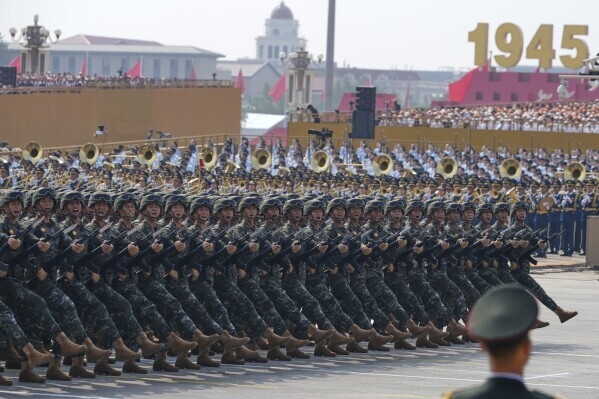
China showed the world its growing power by holding a grand military parade to mark the 80th anniversary of the end of World War II. This parade was not just a display of military might, but a diplomatic effort to send a clear message to the United States and its allies.
China put on a very well-planned display with an impressive list of guests to showcase its strength. Xi Jinping led the largest military parade in China's history. The event came just a few days after a major conference of "Global South" leaders in Tianjin, making it a diplomatically significant week for Xi Jinping.
This article analyzes the strategic aspects of China's military parades, examining their role as a tool of statecraft and a showcase of military might. It further discusses the implications of this growing military prowess for regional stability, with a particular focus on India and Taiwan, and outlines India's strategic response measures.
Outline:
- A New Axis: The Formation of an Authoritarian Alliance
- A Showcase of Power: Display of State-of-the-Art Military Technology
- Regional Repercussions: Impact on India and Taiwan
- India's Counter-Strategy: Response Measures to Chinese Military Might
- Modernizing the Force: An Examination of the Ministry of Defence's 15-Year Armed Forces Modernization Plan
A New Alliance of Authoritarian Nations
The presence of Russian President Vladimir Putin and North Korean leader Kim Jong Un alongside Xi Jinping was particularly noteworthy. The sight of these three authoritarian leaders walking together on the red carpet was a direct challenge to Western nations. Leaders from non-Western countries like Belarus, Iran, Indonesia, and Myanmar were also at the event.
U.S. President Donald Trump reacted immediately to the parade, posting on his Truth Social account, "Please give my warmest regards to Vladimir Putin and Kim Jong Un while you conspire against the United States of America."
Leaders from the U.S., Western Europe, Japan, India, and South Korea were not at the event. Among Chinese officials, few significant figures were absent. For those who monitor China, the absence of certain Chinese Communist Party (CCP) officials reveals who has fallen out of favor with Xi Jinping. Former Chinese leaders Hu Jintao and former Premier Zhu Rongji were not seen. Both are elderly, and Hu has only been seen in public once since being escorted out of the 20th Party Congress in 2022.
Display of State-of-the-Art Military Technology
The main purpose of the parade was to send a direct message to the U.S. and Europe: "America, Europe, and China's neighboring nations should not consider challenging China's national ambitions.
In the 70-minute parade, China showcased many advanced weapons, including tanks, drones, long-range and nuclear-capable missiles, and stealth aircraft. This display showed the progress of the People's Liberation Army (PLA) in weaponry and technology. Notably, China revealed some of its secret weapons to the public for the first time.
A key takeaway was the increasing emphasis on anti-drone systems and airborne early warning aircraft. "These changes have come from the lessons of the Russia-Ukraine war, where we have seen the widespread use of drones."
J15-DT aircraft: China's new, carrier-based electronic warfare aircraft was shown. This is a 'flying support system' and a 'decoy for fighter jets.' The aircraft helps fighter jets track moving targets and keeps them away from attacks.
Submarine-launched Intercontinental Ballistic Missile (ICBM): The world took notice of a new submarine-launched ICBM. This shows China's progress in creating a "triad" of nuclear missile systems with launch capabilities from land, air, and sea.
It's important to "separate" real capabilities from China's information warfare campaigns. "There is always a great deal of deception associated with parades, exercises, or displays." But we should not underestimate China's capabilities—their military strength is significant.
China's Growing Global Role
The parade, coming soon after the conference of "Global South" leaders in China, made for a diplomatically significant week for Xi Jinping. The weapons China displayed in its grand parade have a major impact on global, Indian, and Taiwanese security, showing China's growing power and aspiration for global dominance.
Impact on India and Taiwan
China's military display will have the most direct impact on the U.S., India, and Taiwan. The impact on USA is not considered in this article as it is a subject for a separate article.
Pressure on Taiwan: China considers Taiwan an integral part of its territory. The advanced weapons shown in this parade, especially those related to naval warfare technology, are a direct warning to Taiwan that while China speaks of peaceful unification, the option of using force is always open.
Security Challenge for India: China's rising military spending and modernization are a major concern for India. China's arsenal is almost three times that of India's. China is trying to create a "security ring" around India by supplying weapons to neighboring countries (e.g., Pakistan). As a result, India must prepare to face a joint threat from both China and Pakistan. India also must make China and Pakistan fight a three-front war.
India's Response Measures
To counter China's growing military power, India needs to take action on multiple levels.
Increase Defence Capability: India must increase its defence budget and modernize its weapons. It's especially important to develop subterranean warfare technology and advanced air defence systems (like the S-400 missile systems).
Promote Indigenous Technology: India needs to reduce its reliance on foreign weapons and become self-reliant in defence production. Under the 'Atmanirbhar Bharat' (Self-Reliant India) initiative, domestic research and development (R&D) and production must be increased.
Strengthen Ties with Asian Allies: To counter China's expansionist policies, India needs to strengthen strategic partnerships with countries like Japan, Australia, Vietnam, Taiwan, and the U.S. Groups like the 'Quad' can provide a strong alternative to China's growing influence.
Develop Infrastructure: It's vital for India to develop infrastructure like roads, tunnels, and airstrips along the Line of Actual Control (LAC) to speed up the movement of troops and weapons.
Increase Cyber and Electronic Warfare Capabilities: China's display of its cyber and electronic warfare units gives an idea of its progress in this area. India must urgently increase its cyber security and electronic warfare capabilities to face these threats.
Ministry of Defence's 15-Year Armed Forces Modernization Plan
In response to China's grand military parade, India's Defence Minister has introduced an important and comprehensive 15-year plan for the modernization of weapons. This plan is not limited to upgrading India's military power but also aims to strengthen the country's defence system, self-reliance, technological progress, and global power standing.
The plan includes the modernization of the army, air force, navy, cyber and space defence, and the role of industry and the private sector.
If this plan is successfully implemented, India will become a country with a self-reliant and modern military force. It will emerge as a major exporter in the global defence market. It will be able to take a more capable stance against neighboring countries like China and Pakistan. It will also give a significant boost to domestic employment, technology, and the industrial revolution.
India has the world's second-largest military force. Given its geopolitical location, border challenges, terrorism, and maritime security, the modernization of its defense sector is imperative. For a long time, India was dependent on imports; however, under the "Self-Reliant India" policy, priority is now given to indigenous technology, arms manufacturing, and research. Against this backdrop, the 15-year plan introduced by the Defence Minister is extremely important.
Background
Historically, India's defense forces have relied heavily on foreign arms and equipment. The United States, Russia, France, and Israel were the main suppliers. However, with rapid technological changes, it has become essential for India to make its military more network-centric, technologically advanced, and self-reliant. In response to this objective, a long-term policy has been formulated that considers the significant participation of research institutions—DRDO, HAL, BEL, BDL—as well as the private sector.
Objectives of the Plan
Some key objectives of the 15-year modernization plan are as follows:
Increase Indigenous Arms Manufacturing: Reduce dependence on foreign weapons by manufacturing under the Make in India initiative.
Technological Development: Focus on cyber and space defense, artificial intelligence, drone systems, and robotics.
Coordinated Modernization of All Three Armed Forces: Create synergy and joint operational procedures among the army, navy, and air force.
Increase Research and Development Capability: Provide more autonomy and funding to DRDO and Indian industries.
Enhance International Strategic Cooperation: Exchange high-level technology with friendly nations like the United States, France, Australia, and Japan.
Army Modernization
India's army is one of the largest in the world. The plan for this force focuses on the following:
Developing modern combat tanks (Arjun Mk1A and a future Light Tank).
Equipping infantry with advanced rifles, body armor, and night-vision devices.
Indigenously manufacturing artillery and missile systems like the Dhanush, K9 Vajra, and Pinaka.
Extensive use of drone technology for mapping and intelligence gathering in border areas.
Air Force Modernization
- This plan is crucial for the Indian Air Force due to the growing aerial threats from China and Pakistan.
- Developing indigenous fighter aircraft (LCA Tejas Mk-2, AMCA – Advanced Medium Combat Aircraft).
- Upgrading existing aircraft like the Rafale and Su-30MKI.
- Enhancing cyber and electronic warfare capabilities.
- Ballistic and cruise missile systems that can strike with precision from long distances.
- Developing secure air-to-air refueling systems and high-tech AWACS aircraft.
Navy Modernization
Maritime security is linked to India's energy security. Considering China's increasing presence in the Indian Ocean region, the naval plan is as follows:
- Manufacturing nuclear submarines (INS Arihant series).
- Building aircraft carriers (INS Vikrant, future Indigenous Aircraft Carrier-II).
- Indigenous projects for warships and destroyers.
- Manufacturing drones and underwater autonomous vehicles for the navy.
- Satellite networks to enhance maritime intelligence gathering and security.
Cyber and Space Defence
- In the digital age, battles are not limited to borders or seas but also take place in cyberspace and space. The plan is also significant in this regard.
- Establishing a Cyber Security Command.
- Securing the networks of defense institutions and the armed forces.
- Developing anti-satellite weapons systems for space defense.
- Improving indigenous technology for GPS and communication satellites.
Role of Industry and the Private Sector
- Government institutions alone are not enough for this 15-year plan. The private sector, startups, and international cooperation are essential.
- Setting up Defence Industrial Corridors (in Uttar Pradesh and Tamil Nadu).
- Giving more responsibility to private companies to increase indigenous production capacity.
- Creating export-ready defense equipment to make India a defense manufacturing hub.
Implementation Challenges
- Despite being comprehensive, the plan faces some challenges:
- Coping with rapid technological changes.
- Securing the necessary funding for research and production.
- Delays caused by bureaucratic processes.
- International politics and sanctions.
Potential Outcomes
If this plan is successfully implemented:
- India will become a country with a fully self-reliant and modern military force.
- India will emerge as a major exporter in the global defense market.
- It will be able to take a more capable stance against neighboring nations like China and Pakistan.
- It will provide a significant boost to domestic employment, technology, and industrial revolution.
Conclusion
The 15-year plan for weapons modernization introduced by the Defence Minister is not just a policy but an ambitious vision. It is a path to making India self-reliant, technologically capable, confident, and secure. The success of this plan will ensure that India is recognized not only as a regional but also as a major global security power.
--