High Price of Broken Nations: Why are we not talking about the aftermath of 'Protests'?
When the highway is blocked for months for protests, the daily-wage truck driver loses his livelihood. When national stability collapses, it is the middle-class taxpayer whose savings vanish into inflation.
NewsBharati 12-Oct-2026 17:36:56 PM
Total Views |


The romanticized myth of a political "revolution" through nation-wide protests is the most lethal deception sold to the modern citizen. Today, across smartphone screens in India, self-styled activists and opposition orchestrators are attempting to sell a grand vision of nationwide street agitation. They promise that breaking institutions, paralyzing streets, and creating total anarchy will somehow birth a democratic utopia.
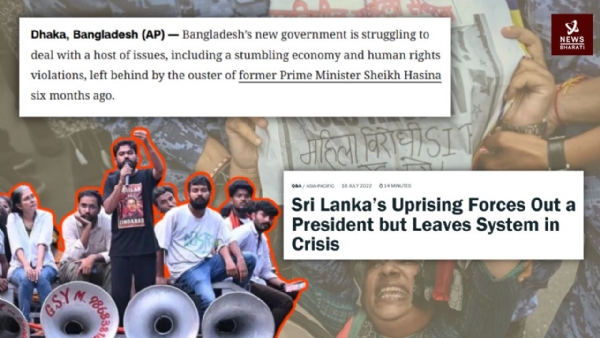
But history is a ruthless teacher, and we do not need to look far to see the curriculum. The smoke has barely cleared from the structural ruins surrounding India. Look intently at the neighborhoods of Sri Lanka, Bangladesh, and Nepal. The lesson carved into the broken infrastructure of our neighbors is singular, brutal, and undeniable. The consequences of nationwide anarchy are borne exclusively by the common man, never the elite.
Architecture of the 'Elite Escape'
When a state collapses into lawlessness, what happens to the political puppet masters? The elite, the ideologues who manufactured the anger, the wealthy plotters who funded the logistics, and the foreign-settled influencers who urged the youth onto the streets via secure digital channels, do not queue up for bread. They do not face police batons, and their families do not starve.
When Sri Lanka erupted during the Aragalaya movement, the elites who triggered structural economic and social vulnerability simply evacuated or insulated themselves in heavily guarded compounds. When the student-led job quota protests in Bangladesh snowballed into a sweeping anti-government purge, the ruling class fled across borders or retreated behind private security apparatuses. When Nepal’s youth-led digital fury forced consecutive regime collapses over arbitrary bans and corruption, the veteran politicians merely treated the transition as a routine game of musical chairs.
The elite survive because chaos is their currency. For them, instability is a calculated tactical maneuver designed to secure an ideological or political win. But for the ordinary citizen, chaos is an existential catastrophe.
What is Left for the Common Man?
Look at the stark, uncompromising reality of these countries today. The digital activists have long since logged off, but the ordinary citizen remains trapped in an economic quicksand.
Months after the euphoria of an ousted regime faded in Bangladesh, the common people are waking up to a devastated economy. Driven by persistent supply chain shocks and energy shortages, headline inflation remains trapped at a punishing 8.34 percent. Real wages for low-paid laborers are actively plummeting. Factories have shuttered, operating hours are slashed, and industrial hiring has frozen completely. The grand "revolution" gave the common man nothing but an inability to afford basic groceries.
In Sri Lanka, while institutional frameworks have staged a slow macroeconomic turnaround under strict IMF bailouts, the household reality remains deeply fractured. National poverty levels sit stubbornly at 16.9 percent, massively elevated above pre-crisis standards. While the elite continue their political maneuvering in Colombo, ordinary parents are forced to cut down on meals as household incomes lag far behind the cost of living.
The common man wanted systemic reform, but instead, they received a broken currency, a ruined job market, and a decades-long debt trap.
What is India's wake-up call?
The forces attempting to engineer a massive, nationwide unrest in India are using the exact same playbook. And they are doing it vocally. They hide behind noble catchphrases like "saving the constitution" or "demanding accountability," but their true objective is structural disruption. They want to trigger an institutional paralysis that turns Indian against Indian, paralyzes our manufacturing hubs, and scares away international capital.
If these forces succeed in dragging India into a state of structural anarchy, they will celebrate their ideological victory from the comfort of television studios and safe foreign havens. They will have achieved their political goal of weakening a democratically elected sovereign state.
Every ordinary Indian citizen must ask themselves the ultimate question before joining the theater of manufactured outrage; "What is there in this for me?" When the local market closes due to riots, the street vendor starves. When the highway is blocked for months by professional agitators, the daily-wage truck driver loses his livelihood. When national stability collapses, it is the middle-class taxpayer whose savings vanish into inflation.
India’s strength lies in its ballot box, not in engineered lawlessness on the streets. It is time to learn from the tragic economic ruins surrounding our borders, reject the siren song of manufactured revolution, and protect our domestic stability with unyielding force.

Himali Nalawade
Himali Nalawade is associated with News Bharati as an Author since a considerable period. She is mostly linked with researched articles from the areas of Defence, Defence Infrastructure and Culture-Religion. Along with her Masters in Mass Communication and Journalism after her graduation in History, she has also studied Diploma in Underwater Archaeology and Diploma in Indology.