Annamalai changed his tune, shouldn't we ask why?
Has Annamalai"s political tone and direction shifted? Unquestionably, yes. His transition from an assertive party president to a candidate re-evaluating his political approach highlights an evolving strategy.However, the primary issue at hand is not simply a battle between political parties.
Total Views |


Six months ago, a quiet warning was sounded about a subtle shift taking place within the political landscape. At the time, few took notice, dismissing the observation as mere speculation. Today, however, many political observers and supporters find themselves stunned by recent developments. Welcome to the inevitable hangover of uncritically idolizing political figures—or what many call Andhbhakti.
It is vital to draw a line in the sand: being a true nationalist does not mean acting as a political party's defense lawyer, nor does it mean serving as the opposition's eternal prosecutor. National interest demands that no politician regardless of their stature or party affiliation be granted blind faith. Accountability must remain the cornerstone of public life.
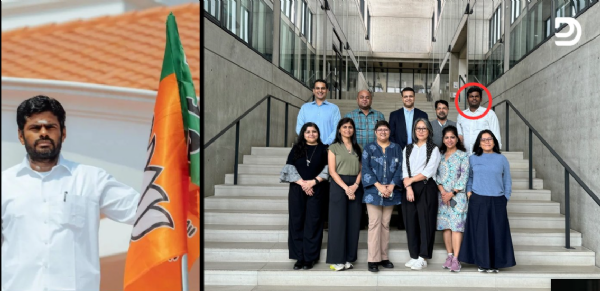
To understand the current political shift surrounding K. Annamalai, one must retrace the timeline of the past two years.
The Electoral Reality and the Foreign Interlude
The narrative takes shape on June 4, 2024. As the general election results rolled in, the verdict for the Bharatiya Janata Party in Tamil Nadu proved uncompromising. Under Annamalai’s high-profile tenure as State President, the party failed to secure a single parliamentary seat in the state. In the contested Coimbatore constituency, where he personally stood, the loss arrived with a margin exceeding 1.18 lakh votes.
ANNAMALAI: THE OXFORD QUESTION.
— Dr. Deepessh Divaakaran (Dr. DD) (@md_deepesh) October 23, 2026
Six months ago, I warned of a shift.
Few believed me.
Today, some supporters are stunned.
Welcome to the hangover of “Andhbhakti.”
I am a nationalist.
Not BJP's lawyer.
Not Congress's prosecutor.
No politician gets blind faith.
4 June 2024.… pic.twitter.com/CsvgObcUkE
Shortly after the electoral outcome, an intriguing transition took place. Annamalai was selected for the prestigious Chevening Gurukul Fellowship for Leadership and Excellence at the University of Oxford a program funded by the British government's Foreign, Commonwealth & Development Office. Notably, his application was submitted under the banner of his foundation, We The Leaders, rather than in his official capacity as a party chief.
A prominent political chief enrolling in a foreign-government-funded initiative shortly after an electoral setback naturally invited analysis.
The Post-Oxford Recalibration
Upon completing his stint at Oxford, the internal political trajectory changed swiftly. By December 4, 2025, Annamalai privately signaled his desire to step back from his leadership responsibilities. By June 5, 2026, his resignation from the BJP was formally accepted.
In subsequent public remarks, he credited his time at Oxford with providing a crucial period of introspection, helping him reassess his perspective on governance, regional strategy, and political engagement. Soon after, observers noted a recalibration in his public stance he began raising nuanced questions regarding policy decisions that he had previously defended without hesitation.
This transition has reignited broader discussions regarding international fellowships and foreign academic ecosystems. Historically, institutions like Oxford have stood at the intersection of global public policy, strategic influence, and soft diplomacy. Programs designed to engage emerging figures from developing nations explicitly aim to shape long-term global narratives.
This is what I mentioned then also.
— Dr. Deepessh Divaakaran (Dr. DD) (@md_deepesh) October 23, 2026
People need to wake up to reality.
Never blindly follow any Politicians. https://t.co/5H3fxjaRhi
While asserting sinister motives without direct evidence is irresponsible, questioning how foreign policy ecosystems influence the ideological arcs of domestic leaders remains a legitimate civic exercise. When leaders engage with international platforms, their perspectives on national policy and central governance frequently undergo visible recalibrations.
Has Annamalai's political tone and direction shifted? Unquestionably, yes. His transition from an assertive party president to a candidate re-evaluating his political approach highlights an evolving strategy.However, the primary issue at hand is not simply a battle between political parties.
The core issue here is not merely about one leader's changing political fortunes. It is about the dangerous tendency of voters to build personality cults around mortal politicians.
Whether it is the BJP selling infallible strongmen or Congress pushing hereditary political saviors, the system relies on blind allegiance. When loyalty turns into dogma, voters lose the capacity for independent thought.
Politicians are not gods to be worshipped; they are public servants to be held accountable. Scrutinize their actions. Question their consistency. Demand real results.True democratic health relies on an informed citizenry that evaluates leaders based on actions, policy outcomes, and ideological consistency rather than personal charisma or blind allegiance.
Leaders are temporary stewards of public trust. The principle must always remain clear: Nation First. Leaders Second. Every public figure, regardless of party banner, must be subjected to scrutiny. Faith belongs in temples and places of worship; accountability belongs strictly in the domain of politics.
Note :- This article is based on the x post.