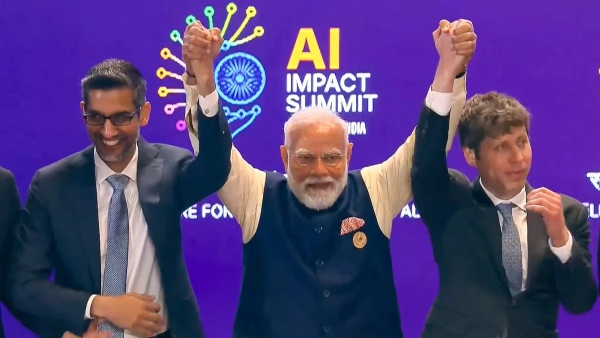
The India AI Impact Summit 2026, recently concluded at the Bharat Mandapam in New Delhi, served as a historic turning point for the Global South. For five days, India moved beyond the theoretical "existential risks" of Artificial Intelligence to showcase the "practical impact" of the technology. Under the overarching philosophy of "Sarvajana Hitaya, Sarvajana Sukhaya" (Welfare for all, Happiness for all), the summit cemented India's position as a global leader in human-centric technology.
Review of the India AI Impact Summit 2026
The summit was not merely a conference but a declaration of Digital Sovereignty. It was structured around the "Three Sutras" (People, Planet, and Progress) and "Seven Chakras" (Working Groups) that define the contours of modern governance.
The summit featured the "Seven Chakras" Framework, structured around seven pivotal pillars: Human Capital, Inclusion, Safe AI, and more, emphasizing the need for a holistic approach to implementing AI in societies.
Noteworthy announcements included major launches such as Sarvam AI’s indigenous large language models (LLMs) and BharatGen Param2, a state-of-the-art multilingual generative AI designed for public service. The summit was underscored by over $250 billion in investment commitments, particularly focusing on deep-tech and sovereign infrastructure, signaling robust growth in AI-driven initiatives.
The Global South Narrative: Unlike Western summits focused on regulation and safety, New Delhi focused on Applied AI. It championed "AI Commons"—the idea that compute power and data should be democratized rather than monopolized.
A defining characteristic of the summit was its focus on the Global South, aiming to democratize access to AI technologies. This charter aims to ensure that compute power and foundational AI models are not monopolized by a select few nations, thus promoting equitable growth and accessibility.
The New Delhi Frontier AI Commitments: A landmark agreement where 88 nations pledged to use AI for evidence-based policymaking in employment, productivity, and climate resilience.
Key Launches: The unveiling of Bharat Gen Param2, an indigenous LLM trained on 22 Indian languages, and MuleHunter.AI, a fraud detection system for the banking sector, demonstrated that India is now a creator of AI, not just a consumer.
- Bhashini is an AI-driven translation platform breaking down language barriers in governance. For instance, a farmer in Tamil Nadu can now communicate directly with a central official in Hindi through real-time AI translation.
- Healthcare access is also improving, with AI-powered symptom checkers available in rural wellness centers and AI technology being used to screen for diseases like tuberculosis and cancer from X-ray images.
- In the judiciary, AI facilitates the translation of court judgments into 22 vernacular languages, thereby increasing legal accessibility for citizens.
Empowering the Grassroots: AI for Farmers and the Economy
The "Kisan-AI" Revolution
India is home to over 140 million farmers, many of whom are vulnerable to climate volatility. The summit highlighted how AI is being deployed as a "Digital Companion" for the fields.
Precision Farming techniques use satellite imagery and advanced analytics to provide farmers with real-time data on soil health and moisture levels, aiding in informed decision-making.
Predictive Logistics: AI models now predict market demand and supply trends, helping farmers decide what to sow and when to sell, potentially adding ₹70,000 crore to the agricultural economy by 2030.
Kisan e-Mitra: AI chatbots in local dialects are breaking the literacy barrier, allowing farmers to access PM-Kisan subsidies via simple voice commands, assisting farmers in navigating government schemes and accessing crop insurance.
The National Pest Surveillance System utilizes AI to forecast pest outbreaks, helping minimize crop losses by up to 20%.
Economy & Commerce
AI is poised to strengthen the economic backbone of the country:
- Small and Medium Enterprises (MSMEs) are empowered through AI tools that assist with inventory management, demand forecasting, and alternative credit scoring via AI-based systems.
- The PM GatiShakti platform employs AI for real-time logistics optimization, effectively reducing transit times and costs, thus enhancing supply chain efficiency.
Scaling the Commerce and Common Mind Sector
For the "common mind"—the everyday citizen and small business owner—AI is the ultimate equalizer.
- MSME Growth: AI-driven credit scoring is allowing "unbanked" small businesses to get loans based on digital transaction history rather than collateral.
- The Vernacular Web: Tools like Bhashini and Chitralekha are translating court judgments and government documents instantly, ensuring that justice and information are no longer gated by the English language.
Technological Enablers
How 6G Enables Viksit Bharat
As India strides towards Viksit Bharat, 6G technology emerges as a cornerstone:
- With microsecond latency—1,000 times faster than current 5G technology—6G will enable real-time holographic communication and tele-robotics, especially beneficial for remote education and healthcare in rural areas.
Blockchain for Governance
Blockchain technology is being integrated into governance:
- Land records are being digitized using blockchain to eliminate legal disputes and fraudulent activities.
- Smart contracts facilitate direct benefit transfers (DBT), ensuring a leakage-free distribution of subsidies.
The Role of India AI Mission in Viksit Bharat 2047
The India AI Mission, backed by an outlay of ₹10,372 crore, is the engine driving the vision of a Developed India by 2047. It operates on seven strategic pillars:
Compute Capacity: Deploying over 38,000 GPUs to provide affordable AI infrastructure to startups at a fraction of global costs.
Foundation Models: Developing sovereign LLMs that understand the nuances of Indian culture and linguistics.
AIKosh (Datasets): A massive repository of anonymized, high-quality non-personal data for researchers.
Future Skills: Training 1 crore youth in AI to ensure the workforce is prepared for the shift from "effort-based" to "outcome-based" services.
Technological Enablers: 6G and Blockchain
A "Viksit Bharat" requires infrastructure that is not just fast, but intelligent and secure.
The 6G Leap: India’s Bharat 6G Mission aims for microsecond latency (1000x faster than 5G). This will enable Holographic Communication for rural education and Tele-robotics for remote surgeries in districts without specialized surgeons.
Blockchain for Transparency: By integrating Blockchain with the India Stack, the government is moving toward Immutable Land Records and Smart Subsidy Contracts, eliminating corruption and "red tape" in governance.
Challenges and Roadblocks to Digital India 2047
The path to 2047 is not without hurdles. To achieve a $30 trillion economy, India must address:
The Digital Divide: Currently, there is a stark gap in internet usage between urban (82%) and rural women (29%). Inclusion must be the priority to prevent a "Digital Class System."
The Skill Gap: While India has a massive talent pool, there is an urgent need to pivot from traditional IT services to high-end AI research and development.
Ethical AI and Bias: Ensuring that AI models trained on historical data do not perpetuate caste, gender, or regional biases.
The Way Ahead: Strategies for Transformation
To reach the pinnacle of global innovation, India must transition from being the "Back Office of the World" to the "AI Laboratory of the World."
Outcome-Oriented Governance: Shifting public service delivery from "Bespoke" (one-off) to "Productized" (scalable AI platforms).
Data Sovereignty: Strengthening data protection laws to ensure that Indian data serves Indian citizens first.
Inclusive Innovation: Programs like YUVAi (Youth for Unnati and Vikas with AI) must reach every school in Tier-2 and Tier-3 cities.
Conclusion
The "Manav" Vision encapsulates the core values guiding AI development in India: Moral, Accountable, National, Accessible, and Valid AI.
As a call to action, the summit encourages the youth to engage through initiatives like "YUVAi," fostering innovation and participation in the AI ecosystem. The IndiaAI Impact Summit 2026 set forth a compelling framework for leveraging artificial intelligence for societal good, exemplifying how emerging technologies can serve as catalysts for inclusive growth and development.
Through persistent efforts and collective engagement, India is poised not only to contribute significantly to the global AI landscape but also to ensure that AI serves as a force for good in the lives of all its citizens.
The India AI Impact Summit 2026 proved that India’s AI journey is not about building robots to replace humans, but about building systems to empower them. By 2047, AI will be the "decisive lever" that bridges the gap between aspiration and reality, making Viksit Bharat a lived experience for every citizen.
Summary Table for Governance Impact
| Governance Area | AI / Tech Application | Direct Benefit to Citizen |
| Land Records |
Blockchain + Satellite AI |
Clear titles; instant loans against property |
| Public Safety |
AI-driven Predictive Policing |
Reduced crime rates and faster emergency response |
| Social Welfare |
AI Fraud Detection in DBT |
More funds reach the truly needy; zero leakage |
--