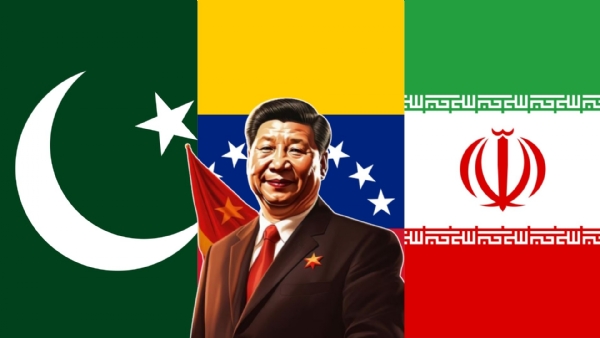
China’s image as a global military technology powerhouse has once again come under scrutiny. In several recent conflicts, defense systems supplied by China have failed to perform as expected, exposing serious shortcomings. Air defense systems that Beijing had promoted as advanced and reliable have been unable to counter major military operations in Pakistan, Venezuela, and most recently Iran. These systems appear unable to withstand technologically superior adversaries as advertised.
For years, Chinese leadership has showcased the HQ-9B air defense missile system and associated radar technologies at military parades and defense exhibitions. Marketed as a powerful long-range shield capable of tracking and neutralizing multiple targets simultaneously, recent battlefield performance has cast doubt on these claims.
The HQ-9B, also known as “Red Flag 9,” is regarded as China’s flagship long-range surface-to-air missile system. Developed by the China Aerospace Science and Industry Corporation, it draws inspiration from the American Patriot and Russian S-300 systems. It features advanced radar tracking, electronic countermeasures, and the capability to engage multiple aerial threats simultaneously. The system is designed to intercept aircraft, cruise missiles, and certain ballistic missiles at ranges up to 260 km and altitudes of approximately 50 km.
China has deployed these systems in key locations including Beijing, Tibet, and the South China Sea. However, their battlefield performance outside China has raised serious concerns. In real combat conditions, their effectiveness has been found severely lacking—effectively rendering them “blind, deaf, and mute.”
Warning Signs During Operation Sindoor
Concerns about Chinese systems first intensified after India launched Operation Sindoor following the Pahalgam terror attack. During this operation, Indian forces carried out precision strikes against terrorist and military infrastructure across the border.
Military assessments indicated that Chinese-supplied air defense systems deployed by Pakistan struggled to intercept incoming threats. Issues were particularly evident with platforms such as HQ-9 and HQ-16, as Indian missiles and aircraft repeatedly penetrated these defenses.
Over four consecutive days, Chinese missile systems failed to effectively detect, track, or destroy incoming threats. Pakistan, which sources nearly 82% of its military imports from China, faced a significant credibility setback. This has raised alarm among countries heavily dependent on Chinese defense equipment.
Venezuela Operation Exposes Radar Weaknesses
Doubts about Chinese defense technology deepened further during a dramatic U.S. military operation in Venezuela. The operation involved stealth aircraft, electronic warfare platforms, and special forces, ultimately resulting in the capture of Venezuelan leader Nicolás Maduro without any American casualties.
This mission exposed critical vulnerabilities in Venezuela’s radar and air defense network, including the Chinese-supplied JY-27A early warning radar system. The JY-27A is designed to detect and track targets at ranges between 280 and 390 km and is specifically marketed for its ability to detect stealth aircraft such as the F-22 and F-35.
However, during the operation, the radar system failed completely to detect incoming aircraft. Not a single one of approximately 150 intruding aircraft was identified. This failure became a major embarrassment, especially given China’s claims regarding the system’s anti-stealth capabilities.
Iran Attacks Intensify Scrutiny
Iran has heavily invested in Chinese radar systems and HQ-series missile defenses to protect its nuclear facilities and military bases. However, these systems proved ineffective against U.S. and Western airstrikes.
Slow Response Time:
Modern warfare demands split-second reactions. In Iran’s case, Chinese systems exhibited significant delays in response time, often detecting threats only after impact.
Heavy Damage:
The inability to intercept incoming strikes resulted in substantial damage to critical Iranian installations, raising concerns across the Middle East about the reliability of Chinese weapons.
During large-scale coordinated strikes by the U.S. and Israel targeting military infrastructure across more than 20 Iranian provinces, Iran’s layered air defense system failed to prevent widespread destruction. The system included long-range HQ-9B units, supported by Russian S-300PMU-2 and Iran’s indigenous Bavar-373, along with medium- and short-range systems like Khordad-15, Raad, Tor-M2, and Pantsir-S1.
Despite this multi-layered defense architecture, significant losses were incurred.
During Operation Epic Fury, Chinese HQ-9B systems once again underperformed. Modern air campaigns often employ saturation tactics—launching dozens or even hundreds of missiles and drones simultaneously—overwhelming even advanced systems. Additionally, electronic warfare, cyber operations, and stealth strikes may have neutralized radar and command nodes before the main attack.
Pressure on Export Credibility
China is one of the world’s largest arms exporters, supplying military equipment across Asia, Africa, the Middle East, and Latin America. Countries such as Pakistan, Iran, Egypt, and Azerbaijan have invested heavily in Chinese air defense systems.
Many of these nations chose Chinese equipment primarily due to its lower cost compared to Western alternatives like the Patriot system or advanced European platforms. However, the trade-off appears to be reliability and technological maturity.
Billions of dollars invested in these systems are now being questioned, with several countries reassessing their defense procurement strategies.
Implications for Taiwan
Developments in Pakistan, Venezuela, and Iran may offer some reassurance to Taiwan. China’s declining credibility in military technology suggests that its defense systems may not be as formidable as previously believed.
In comparison to U.S. systems, Chinese military technology—particularly in radar and air defense—has increasingly been viewed as unreliable and vulnerable.
Shifting Global Power Balance
Debate over the effectiveness of Chinese defense systems is set to intensify further. Battlefield performance has placed China’s defense industry under unprecedented scrutiny.
At the same time, ongoing global conflicts present a strategic opportunity for India. Indian weapon systems have demonstrated superior performance under combat conditions compared to Chinese systems. This creates a significant opportunity for India to expand its defense exports.
To capitalize on this moment, India must accelerate the growth of its arms and ammunition exports and position itself as a reliable alternative in the global defense market.
--