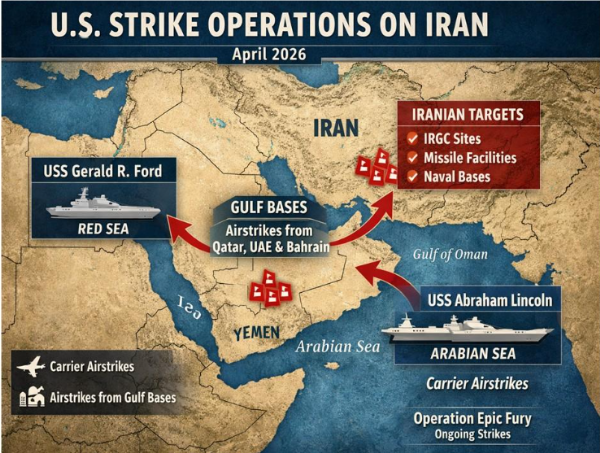
Iran war presents a sobering look at how "strategic hubris"—the gap between a leader's perception of power and the reality of the battlefield—leads to military and diplomatic quagmires. For India, the U.S. experience in Iran offers critical lessons in asymmetric warfare, diplomatic autonomy, and the dangers of "fighting the last war."
Here is an analysis of the lessons for India from an Indian perspective:
1. The Power of Asymmetric and Low-Cost Warfare
The U.S. failed to anticipate that Iran would use "cheap drones" rather than a traditional navy to close the Strait of Hormuz. India faces similar threats in the Indian Ocean and along its borders.
The Lesson: Material and numerical superiority (a larger navy or air force) does not guarantee security against "innovation-led" disruption.
Indian Application: India must accelerate its investment in anti-drone technology and decentralized defense. The fact that Iran crippled global shipping without a traditional blockade proves that "low-cost, high-impact" tools are the new standard. India’s focus should shift from just "big-ticket" platforms (like aircraft carriers) to securing chokepoints against swarms and asymmetric threats.
2. Dangers of the "Hubris/Humility Index"
The "clean victories" (like the U.S. in Venezuela) are dangerous teachers because they inflate confidence and dismiss uncertainty.
The Lesson: Success in a previous limited conflict (e.g., Balakot or surgical strikes) should not lead to the assumption that a full-scale conflict with a major adversary will follow the same pattern.
Indian Application: India must maintain Strategic Empathy. As the text suggests, a regime that believes its survival is at stake (be it in Rawalpindi or Beijing) will act "irrationally" by Western standards but rationally for its own survival. India's war gaming must account for "irrational" escalations rather than assuming the enemy will follow a "logical" script.
3. Protecting Strategic Autonomy
The U.S. sinking of an Iranian frigate near Sri Lanka—right after an exercise with India—shows how quickly a superpower's "blind spots" can jeopardize India’s regional interests.
The Lesson: Over-reliance on a single security partner can lead to "collateral diplomatic damage."
Indian Application: India was right to choose diplomacy with Iran to secure passage for its vessels. This reinforces the necessity of Multi-alignment. India must ensure that its partnership with the U.S. does not come at the cost of its influence in the "Global South" or its energy security. The "India first" approach in the Strait of Hormuz is a blueprint for future crises.
4. The Intelligence Gap and Local Context
The U.S. failed because it had no embassy in Tehran and relied on third-party intelligence (Israel) that had its own agenda.
The Lesson: Never outsource your intelligence or your understanding of a neighbor’s internal resilience.
Indian Application: India must maintain deep, independent human intelligence (HUMINT) and diplomatic channels even with adversaries. Relying on "technology" or "allied intelligence" can lead to the "conceptual and cultural failure" the U.S. faced in Vietnam and Iran. India’s strength lies in its deep historical and cultural ties to the Middle East and Central Asia; these must be leveraged to avoid the "strategic imagination" failure seen in Washington.
5. Economic Chokepoints as War Theaters
The U.S. viewed the Iran conflict as a military problem; Iran treated it as an insurance and energy problem.
The Lesson: The "battlefield" is often the global economy.
Indian Application: Since India’s economy is highly sensitive to oil prices and maritime trade, its defense strategy must be integrated with its economic strategy. India needs to lead in creating "Secured Maritime Corridors" and diversifying energy routes (like the International North-South Transport Corridor) to ensure that a closure of the Strait of Hormuz doesn't paralyze the Indian economy.
6. Maritime Security and Chokepoint Control
Control over sea lanes has emerged as a decisive factor.
Lesson for India
India must:
Strengthen its presence in the Indian Ocean Region (IOR)
Enhance naval capabilities to secure Sea Lines of Communication (SLOCs)
Develop partnerships with like-minded countries.
7. Energy Security as a Strategic Vulnerability
The conflict highlights the vulnerability of global energy flows, particularly through the Strait of Hormuz, a chokepoint critical to global oil supply.
Lesson for India
As one of the world’s largest energy importers:
- India must reduce dependence on volatile regions
- Expand strategic petroleum reserves
- Invest in nuclear, renewable, and alternative energy
- Energy security is national security.
Summary Table: Strategic Shifts for India
| U.S. Folly | Consequence | Indian Strategic Pivot |
| Over-reliance on Material Might |
Paralysis by cheap drones |
Focus on Asymmetric Defense & Anti-drone tech |
| Intelligence Outsourcing |
Misread Iranian resilience |
Prioritize Independent HUMINT and local expertise |
| Ignoring Allied Interests |
Damaged ties with India/Sri Lanka |
Maintain Strategic Autonomy and multi-alignment |
| “Fighting the Last War” |
Applied Venezuela lessons to Iran |
Avoid “Hubris”; prepare for unconventional escalation |
8. The Rise of Hybrid and Grey-Zone Warfare
The Iran conflict demonstrates that modern wars are rarely declared formally. Instead, they unfold in the grey zone—below the threshold of full-scale war.
- Iran relies heavily on proxy groups like Hezbollah and regional militias
- The U.S. and Israel use targeted strikes, cyber operations, and intelligence-led actions
Lesson for India
India must prepare for hybrid warfare, especially from adversaries like Pakistan and China:
Strengthen counter-proxy strategies
Integrate military, intelligence, cyber, and diplomatic tools
Develop rapid response capabilities for sub-conventional threats
9. Proxy Warfare: The New Normal
Iran has effectively used non-state actors to expand its influence while maintaining plausible deniability.
Lesson for India
India has long faced proxy warfare through cross-border terrorism. The Iran model highlights:
- The need for offensive counter-proxy doctrines
- Enhanced intelligence penetration of terror networks
- Use of covert capabilities to impose costs on adversaries
10. Economic Warfare and Sanctions
Sanctions imposed by the United States have significantly weakened Iran’s economy without direct military confrontation.
Lesson for India
Economic strength is now a core pillar of national security:
- Build resilience against financial and trade disruptions
- Diversify supply chains and energy sources
- Develop mechanisms to bypass sanctions if required
- Economic warfare can be as decisive as military action.
11. Drone Warfare and Low-Cost High-Impact Technology
Iran has demonstrated the effectiveness of cheap drones and missiles in challenging technologically superior adversaries.
Lesson for India
Future conflicts will be shaped by:
- Swarm drones
- Precision-guided munitions
- AI-enabled warfare
India must:
- Accelerate indigenous drone programs
- Deploy robust anti-drone systems
- Integrate drones into all three services
12. Information and Psychological Warfare
Narrative building, propaganda, and perception management are central to the conflict.
Lesson for India
- Develop a strong information warfare doctrine
- Counter misinformation and influence operations
- Use media and digital platforms proactively
13. Internal Stability: The Ultimate Strength
Internal cohesion in Iran was of a very high order. Iran remained united even in the most difficult phases of the conflict. The most important lesson, therefore, is that no country can sustain a long war without internal unity.
India’s internal security has improved significantly in recent years. Terrorism in Jammu and Kashmir is now at an all‑time low compared to a decade ago. Insurgency in the Northeast is over. Naxalism/Left‑wing terrorism has been completely eliminated. However, illegal migration from Bangladesh continues to pose a serious long‑term security challenge.
India must therefore work continuously on all fronts to strengthen its internal security architecture. Only a stable, internally cohesive India can avoid drifting into a three‑front war of the kind Pakistan is struggling with today, where it faces simultaneous internal militancy and external pressure on multiple borders.
14. Strategic Autonomy and Multi-Alignment.
Iran’s relative isolation contrasts with India’s balanced foreign policy approach.
Lesson for India
- Continue multi-alignment strategy
- Maintain relations with competing global powers
- Avoid overdependence on any one bloc
The Indian Tightrope
For New Delhi, the conflict is not a spectator sport; it is an existential challenge. India finds itself in a precarious balancing act:
Energy Security: As a massive importer of Gulf oil, India cannot afford a blockade or a price surge.
The Diaspora Factor: Millions of Indian citizens live and work in the Gulf. Any regional instability puts their safety—and the vital remittances they send home—at risk.
Strategic Autonomy: India must maintain its partnership with the U.S. while ensuring it doesn't alienate Iran or Russia.
India's "issue-based" diplomacy is being tested like never before. The pressure to take a side is mounting, yet the cost of doing so remains prohibitively high.
15. Nuclear Deterrence and Escalation Control
- Maintain credible nuclear deterrence
- Develop escalation control mechanisms
- Invest in second-strike capabilities
16. Long Wars Demand Strategic Patience
The Iran conflict shows that modern wars are prolonged, with no clear victory.
Lesson for India
- Prepare for long-duration conflicts
- Build economic and military endurance
- Focus on sustainability, not quick wins
Final Strategic Takeaway
- Hybrid warfare is the new battlefield
- Economic and energy security are decisive factors
- Technology (drones, cyber, AI) is reshaping conflict
- Internal stability and strategic autonomy are critical
The Final Verdict
If "winning" means achieving your stated objectives, the U.S. has under-performed. Iran’s nuclear program continues, its proxies are emboldened, and its government remains intact.
The U.S. did not lose on the battlefield in a classical sense, but it has failed to secure a decisive peace. In the cold language of geopolitics, a superpower that fails to impose its will is a superpower in transition. We are no longer moving toward a conflict; we are living in the reality of a multi-polar Middle East where the rules are being rewritten by those who refuse to break.
The Iran conflict is a template for 21st-century warfare, where battles are fought across multiple domains—military, economic, technological, and informational.
Human Factor and Importance of National Resilience
This conflict once again underscores that beyond advanced weapon systems, the most decisive factor in war remains the soldier—his training, morale, and fighting spirit.
Equally important is the role of civilians during wartime. In situations involving energy crises or shortages of essential commodities:
- Citizens must conserve fuel and resources
- Avoid panic and misinformation
- Cooperate with government authorities
In future multi-dimensional warfare, disciplined and resilient citizens will play a crucial role in ensuring national strength and ultimate victory.
For India, the key takeaway is clear:
Future wars will not be won by firepower alone, but by a nation’s ability to integrate all instruments of national power.
India must therefore evolve from a traditional military power into a comprehensive national security state, capable of handling hybrid threats, economic coercion, and technological disruption.
--