West Bengal & Kerala: Crumbled Red Fortress
State Assembly elections 2026: Where are the comrades?
Total Views |


The trajectory of the communist movement in India, led primarily by the Communist Party of India (Marxist) and the Communist Party of India, presents a study in rise, consolidation, and visible fall. Once formidable in their bastions of West Bengal and Kerala, the communists now face a structural crisis that goes beyond electoral arithmetic and enters the domain of ideological exhaustion.
Exit polls indicate that the ideological appeal of the Communist Party of India (Marxist) continues to wane in both West Bengal and Kerala. In Kerala, considered as the party’s last major bastion, the Left appears to be heading toward a potential electoral setback. In West Bengal, its position looks even more precarious, with projections suggesting it may be reduced to single-digit representation. Taken together, these trends paint a bleak outlook for the communist movement, raising serious questions about its future relevance and its ability to reconnect with the electorate. (West Bengal elections)
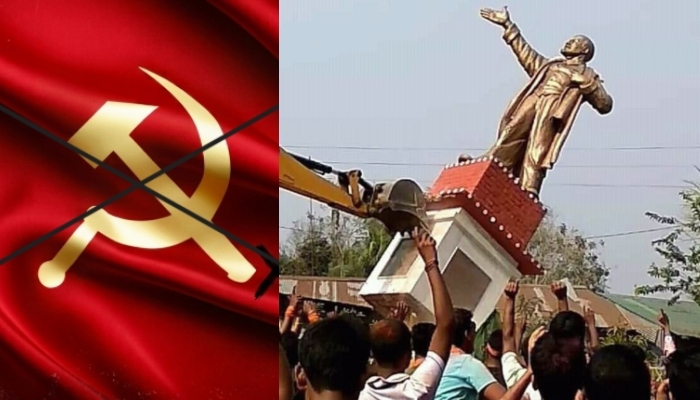
In May 2018, angry people of Tripura removed the statue of Lenin after Communists met with a humiliating debacle in Assembly elections
Historically, West Bengal was the crown jewel of communist politics in India. From 1977 to 2011, the Left Front, led by CPI(M), governed uninterruptedly and was one of the longest democratically elected communist regimes in the world. Leaders like Jyoti Basu and Buddhadeb Bhattacharjee became synonymous with administrative continuity. However, the 2011 electoral defeat at the hands of Mamata Banerjee and the All India Trinamool Congress marked a decisive rupture. The decline accelerated thereafter: in the 2016 assembly elections, the Left alliance failed to regain power, and by the 2021 elections, the Left was reduced to zero seats in the state assembly, a stunning collapse for a party that once dominated every level of governance.
Kerala presents a contrasting but equally telling picture. The depth of communist roots in Kerala is evident from the historic 1957 election, when E. M. S. Namboodiripad became India’s first non-Congress Chief Minister. This marked the world’s first democratically elected communist government, establishing Kerala as an early and enduring stronghold of Left politics. The Left, under the banner of the Left Democratic Front, has historically alternated power with the United Democratic Front. But even here, the 2021 victory of the Left under Pinarayi Vijayan was less a sign of ideological resurgence and more a product of welfare governance, crisis management during floods and the pandemic, and a fragmented opposition. The Left’s organisational machinery remains intact in Kerala, but its ideological appeal has narrowed, increasingly confined to administrative competence rather than transformative politics. (West Bengal Assembly elections)
Any honest assessment of the communist decline in West Bengal must confront the issue of political violence. Over decades, the Left regime was repeatedly accused of institutionalising a culture where party dominance extended into coercive control. Incidents like the Nandigram violence and the Singur protests became emblematic of this shift. What began as a movement claiming to represent the working class gradually acquired the traits of a political establishment intolerant of dissent. While violence in Bengal politics predates and outlasts the Left, the long tenure of communist rule undeniably normalised a system where political competition often turned confrontational and, at times, brutal. (Kerala elections)
The erosion of communist influence is not merely organisational, but it is fundamentally ideological. For decades, the Left positioned itself in opposition to what it described as majoritarian politics, particularly targeting the ideological framework associated with Hindutva. This anti-Hindutva stance, however, often appeared less like a principled civilisational critique and more like a reflexive opposition devoid of cultural engagement. In a country where civilisational identity plays a significant role in public life, the Left’s reluctance to engage with indigenous traditions created a disconnect with large sections of society.
This disconnect became politically consequential with the rise of the Bharatiya Janata Party. As the BJP expanded its footprint, especially in West Bengal, it capitalised on the perception that the Left was alienated from mainstream cultural sentiment. The communists’ ideological vocabulary, rooted in class struggle and material analysis, struggled to respond to narratives centred on identity, faith, and nationalism. In effect, their long-standing anti-Hindutva positioning, instead of evolving into a nuanced engagement, hardened into a rigidity that limited their appeal. (West Bengal Assembly elections)
Electoral data reinforces this decline. In the 2019 Lok Sabha elections, the Left failed to win a single seat in West Bengal, while the BJP emerged as the principal challenger to the Trinamool Congress. The 2021 assembly elections further cemented this shift, pushing the Left into political irrelevance in the state. In Kerala, while the Left retains power, its national presence is minimal, and its influence in shaping broader political discourse has diminished significantly.
Looking ahead, the prospects for the communists in their traditional bastions appear uneven. In Kerala, the Left is likely to remain competitive, benefiting from a robust cadre base and governance record. However, sustaining this position will require ideological renewal beyond welfare politics. In West Bengal, the path to revival is far more challenging. The political space once occupied by the Left has been largely appropriated by the BJP and the Trinamool Congress, leaving little room for a third force without a substantial reconfiguration of strategy and leadership. Ultimately, the decline of the communists in India reflects a broader failure to adapt to civilizational realities, which originate from Hindutva. (Kerala elections)