'Rituals not compulsory for person to identify as Hindu': SC during Sabarimala terms Hinduism as a way of life
(Hinduism) The hearings originate from petitions challenging restrictions on women at religious places, particularly the Sabarimala Ayyappa Temple in Kerala.
Total Views |


The Supreme Court of India, on Wednesday, May 13, remarked that Hinduism is fundamentally a 'way of life,' observing that visiting temples or performing specific rituals is not compulsory for a person to identify as Hindu. The observation came during the 15th day of hearings before a nine-judge Constitution bench examining issues related to religious freedom and discrimination across different faiths. (Supreme Court on Hinduism)
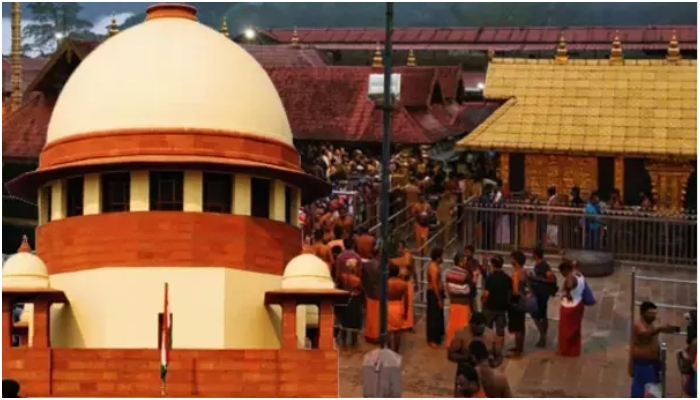
The debate arose during arguments presented by advocate G. Mohan Gopal, appearing for one of the petitioners. Gopal questioned a 1966 legal interpretation that defined a Hindu as someone who accepts the Vedas as the supreme authority in matters of religion and philosophy. (Supreme Court on Hinduism)
The hearings originate from petitions challenging restrictions on women at religious places, particularly the Sabarimala Ayyappa Temple in Kerala. The matter also involves practices followed by other religious groups, including the Dawoodi Bohra community.
While hearing the matter, the court noted the delicate balance between safeguarding individual rights and preserving religious autonomy. The bench had earlier warned that if every religious custom were routinely challenged before constitutional courts, every religion could 'break' under the burden of endless litigation. (Supreme Court on Hinduism)
Headed by Chief Justice of India Surya Kant, the bench highlighted the deeply personal nature of faith in India. Stressing that religion is not dependent on outward displays or rituals, the CJI observed that even lighting a lamp inside one’s home could be sufficient to express religious belief.
The debate arose during arguments presented by advocate G. Mohan Gopal, appearing for one of the petitioners. Gopal questioned a 1966 legal interpretation that defined a Hindu as someone who accepts the Vedas as the supreme authority in matters of religion and philosophy. (Supreme Court on Hinduism)
“They never asked me. None of us ever said that,” Gopal argued, raising doubts over whether all Hindus today necessarily regard the Vedas as the ultimate spiritual authority.
Responding to the submissions, Justice B. V. Nagarathna observed that Hinduism’s non-ritualistic character is precisely why it has often been described as a 'way of life'. She further stated that no one should interfere with an individual’s personal faith and emphasized that temple attendance is not essential to religious identity.
STORY | Hinduism way of life, not mandatory to go to temple to prove belief: SC
— Press Trust of India (@PTI_News) May 13, 2026
Observing that Hinduism is a way of life, the Supreme Court on Wednesday said it is not necessary for a Hindu to mandatorily go to a temple or perform a ritual in order to remain a Hindu and even… pic.twitter.com/wRIWiCHj5C
The Constitution bench, also comprising Justices M. M. Sundresh, Ahsanuddin Amanullah, Aravind Kumar, Augustine George Masih, Prasanna B. Varale, R. Mahadevan, and Joymalya Bagchi, is currently examining broader questions surrounding religious practices, constitutional rights, and gender equality. (Supreme Court on Hinduism)
The hearings originate from petitions challenging restrictions on women at religious places, particularly the Sabarimala Ayyappa Temple in Kerala. The matter also involves practices followed by other religious groups, including the Dawoodi Bohra community.
While hearing the matter, the court noted the delicate balance between safeguarding individual rights and preserving religious autonomy. The bench had earlier warned that if every religious custom were routinely challenged before constitutional courts, every religion could 'break' under the burden of endless litigation. (Supreme Court on Hinduism)
The ongoing proceedings are linked to the landmark 2018 verdict in which a five-judge bench, by a 4:1 majority, allowed women between the ages of 10 and 50 to enter the Sabarimala Ayyappa Temple. The judgment struck down the centuries-old restriction as unconstitutional and paved the way for the present larger constitutional review into the relationship between fundamental rights and longstanding religious traditions.
Is Hinduism just a way of life?
Legally and philosophically, Indian courts have often described Hinduism as a 'way of life'. The Supreme Court of India has used this expression in several judgments to highlight the broad and diverse nature of Hindu traditions. Hinduism is definitely a religion. In fact, it is the Mother of all religions, because the Indian Vedas had already postulated in very ancient times the existence of such a Supreme Being. (Supreme Court on Hinduism)
At the same time, for millions of Hindus, Hinduism as a religion involves devotion, temples, rituals, scriptures, festivals, philosophies, and spiritual practices. Different Hindus practice their faith differently. Some are deeply ritualistic and regularly visit temples, while others focus more on philosophy or meditation. Some follow family traditions without strict rituals, while others may identify culturally as Hindu even without active religious practice.
In the given case, 'way of life' does not usually mean that Hinduism is not a religion. Rather, it is often used to describe its wide diversity and flexible nature compared to more centrally defined religious systems.
Legally and philosophically, Indian courts have often described Hinduism as a 'way of life'. The Supreme Court of India has used this expression in several judgments to highlight the broad and diverse nature of Hindu traditions. Hinduism is definitely a religion. In fact, it is the Mother of all religions, because the Indian Vedas had already postulated in very ancient times the existence of such a Supreme Being. (Supreme Court on Hinduism)
At the same time, for millions of Hindus, Hinduism as a religion involves devotion, temples, rituals, scriptures, festivals, philosophies, and spiritual practices. Different Hindus practice their faith differently. Some are deeply ritualistic and regularly visit temples, while others focus more on philosophy or meditation. Some follow family traditions without strict rituals, while others may identify culturally as Hindu even without active religious practice.
In the given case, 'way of life' does not usually mean that Hinduism is not a religion. Rather, it is often used to describe its wide diversity and flexible nature compared to more centrally defined religious systems.