Great Nicobar Island Development Project: Gandhi Family Must Explain To The Nation
NewsBharati 02-May-2026 15:42:18 PM
Total Views |


The debate over the Great Nicobar Island Development Project is no longer merely about environment versus development. It has evolved into a larger question of India’s strategic clarity versus political obstructionism. At the center of this debate stand Rahul Gandhi and Sonia Gandhi, whose opposition reflects a familiar pattern: raising concerns that appear principled on the surface but often disregard national imperatives.
To begin with, the strategic importance of Great Nicobar cannot be overstated. Located near the Malacca Strait, one of the busiest maritime chokepoints in the world, the island is a geopolitical asset. Over 40% of global trade passes through this corridor. Any serious nation with maritime ambitions would prioritize infrastructure in such a location. The project’s proposed transshipment port, dual-use airport, and associated logistics hub are not vanity exercises; they are hard strategic necessities. In an era marked by China’s aggressive expansion in the Indo-Pacific, including its “String of Pearls” strategy, India’s delayed assertion in this region is already a concern.
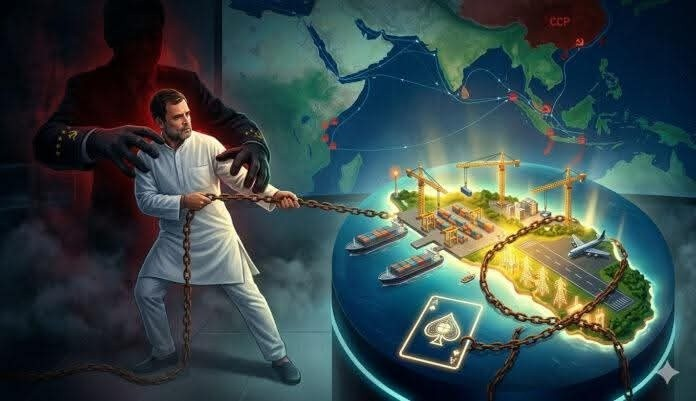
But, the Congress leadership’s approach appears disconnected from this reality. Rahul Gandhi has termed the project environmentally destructive and socially unjust. Sonia Gandhi has echoed concerns about tribal rights and ecological fragility. But the question is not whether safeguards are needed. The question is whether development itself should be stalled in the name of absolutist environmentalism.
The benefits of the project for local residents are substantial and tangible. For decades, the Andaman and Nicobar Islands have remained on the margins of India’s developmental story. Basic infrastructure like advanced healthcare, higher education institutions, and reliable connectivity has been inadequate. The current initiative aims to correct precisely this historical neglect. As articulated by policymakers, economic activity linked to handling even one million TEUs (twenty-foot equivalent units) can generate employment for 3,000 to 5,000 individuals. For a sparsely populated island, this is transformative. It means jobs, skills, exposure, and integration into the national economic framework.
The Congress narrative, however, tends to romanticize isolation. By repeatedly emphasizing “untouched forests” and “fragile ecosystems,” it risks reducing local populations to passive subjects of preservation rather than active participants in progress. This is a familiar ideological pattern wherein development is viewed with suspicion, while poverty is inadvertently perpetuated in the name of protection.
Equally significant is the Congress party’s historical record. For decades after independence, when Congress dominated Indian politics, the Andaman and Nicobar Islands did not receive the strategic or developmental attention they deserved. Despite their obvious maritime significance, infrastructure remained minimal. There was no serious attempt to build a world-class port, no major push for economic integration, and limited focus on defence preparedness. The islands were treated more as distant outposts than as strategic frontiers.
_202605021609222233_H@@IGHT_400_W@@IDTH_700.jpg "Andman Nicobar island")
In contrast, the current push represents a long-overdue course correction. It aligns with India’s broader Indo-Pacific vision, its maritime doctrine, and its aspiration to counterbalance China’s growing influence. To oppose such a project without offering a viable alternative framework raises legitimate questions about the intent and strategic thinking of the Congress party.
This brings us to a more contentious dimension, the recurring allegations and perceptions regarding Congress’s historical posture towards China. It is important to approach this carefully, distinguishing between documented interactions and politically charged claims. However, certain facts are part of the public record. The Congress-led government’s handling of China in the past, particularly leading up to the Sino-Indian War, is widely criticized as strategically naive. The lack of preparedness and misreading of Chinese intentions resulted in a national setback.
Against this backdrop, opposition to the Great Nicobar project acquires a different dimension. When a strategically vital initiative is resisted, and that resistance is combined with a history of ambiguous positioning in China, it inevitably raises questions. Is the opposition rooted purely in environmental concern, or does it reflect a deeper discomfort with India asserting itself decisively in the Indo-Pacific? Gandhis owe an explanation to the nation on this question.

None of this implies that environmental or tribal concerns should be dismissed. On the contrary, they must be addressed with rigor. Environmental impact assessments, sustainable development practices, and genuine consultation with indigenous communities are non-negotiable in a democratic framework. But these should function as correctives within development, not as pretexts to halt it altogether.
Rahul Gandhi’s recent visit to the Andaman region, following Sonia Gandhi’s line of criticism, reinforces the political messaging. However, symbolism cannot substitute for strategy. Visiting the islands and reiterating concerns without acknowledging their strategic urgency risks appearing selective. A balanced approach would recognize both the need for ecological safeguards and the imperative of national security.
Ultimately, the Great Nicobar project represents a test case for India’s ability to think and act as a maritime power with long-term vision. It is about whether India can leverage its geography to secure economic and strategic advantages, or whether it will remain constrained by internal political contestation.
The Congress party, and the Gandhi family in particular, face a choice. They can continue to oppose such initiatives in a manner that appears reflexive and ideologically rigid, or they can evolve a more nuanced position that integrates environmental responsibility with strategic realism. At present, their stance leans heavily toward obstruction and insufficiently toward constructive engagement. For a nation navigating an increasingly complex geopolitical landscape, this is not a trivial matter. Development in regions like the Andaman and Nicobar Islands is not just about roads, ports, or airports but it is about India’s place in the world.

Editor's Desk
Editor's Desk