Ballots are over: Focus now shifts to the borders
NewsBharati 05-May-2026 15:02:21 PM
Total Views |


For far too long, cross-border infiltration into India has been shaped by sentiment, outrage and political expediency rather than clear-headed policy. The recent elections in Assam and West Bengal brought this reality into sharp focus. What should fundamentally be treated as an issue of sovereignty, demographic balance and the rule of law is often reduced to vote-bank arithmetic by parties like the Congress and the Trinamool Congress. In fact, the issue played a decisive role in shaping electoral outcomes.
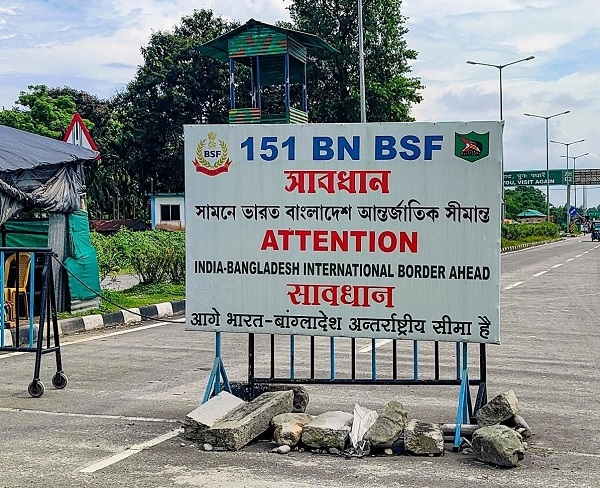
At its core, infiltration is not a humanitarian abstraction; it is a national issue with tangible consequences. In border states, residents have repeatedly voiced concerns about pressure on land, public resources, and employment opportunities. Administrative systems, already stretched thin, are forced to bear the added burden of undocumented populations. In West Bengal, allegations of political patronage and the existence of organized rackets have further complicated the situation. Assam, in contrast, has demonstrated greater vigilance in recent years and has seen more encouraging outcomes.
This is where the political response led by the Bharatiya Janata Party marks a clear shift. Unlike the ambiguity that characterised earlier approaches, the BJP has framed illegal migration as a matter of national security and governance. Its rise in states like Assam reflects a consolidation of public sentiment in favor of stricter border controls, robust identification mechanisms, and firm enforcement of citizenship laws. Efforts such as updating the National Register of Citizens (NRC) and strengthening border infrastructure indicate a move toward institutional solutions rather than rhetorical positioning.
Every sovereign nation has the right to regulate who enters and resides within its borders. When this distinction is not enforced consistently, it leads to precisely the kind of social friction and political polarization that critics often claim to oppose.

A look at Europe reinforces this argument. Countries such as France, Germany, and Sweden have grappled with migration surges over the past decade. While the contexts differ, the policy challenges, ranging from integration pressures to strain on welfare systems, are strikingly similar. In several cases, policies initially driven by moral urgency had to be recalibrated as ground realities asserted themselves. The European experience shows that unmanaged migration, regardless of origin, can trigger socio-political backlash when governance appears weak or inconsistent.
India’s response, however, has evolved within a democratic framework. Electoral outcomes in Assam and West Bengal have acted as a barometer of public sentiment. Support for the BJP in these regions indicates a growing preference for a firmer approach to border management and internal security. In that sense, the election results have lent democratic legitimacy to this stance.
The implications extend beyond India’s borders. Bangladesh, which is central to discussions on eastern border migration, is closely watching these developments. Stricter enforcement and the identification of undocumented migrants inevitably raise questions about bilateral coordination and the management of cross-border movement. Concerns about potential “reverse migration” have already surfaced in some quarters.
So what is the broader takeaway? There is an increasing demand for zero tolerance toward illegal infiltration. This requires not just tough rhetoric but consistent policy backed by firm action. Instances such as the reported reluctance of the West Bengal government to transfer land to the Border Security Force, despite Supreme Court directions, raise serious questions about political intent.

Ultimately, this issue comes down to political will. In recent years, that will has become more visible at the national level. Prime Minister Narendra Modi has sent strong signals that infiltration will no longer be treated as a peripheral concern. Whether one sees this as a necessary correction or a hardline approach, it undeniably marks a shift from ambiguity to clarity.
With the elections now behind them, Assam and West Bengal have an opportunity to turn political mandate into administrative action. Tighter border surveillance, faster identification processes, and stricter enforcement of citizenship laws are likely to define the next phase. If implemented effectively, these measures could ease long-standing demographic concerns and restore public confidence.
More importantly, they could serve as a model demonstrating how democratic endorsement can translate into firm, lawful, and accountable governance on issues that lie at the heart of national security.

Editor's Desk
Editor's Desk