Decoding ‘Modi Effect’ of 25 years through ‘RRR’ lens
NewsBharati 11-Jun-2026 18:03:38 PM
Total Views |


The Constitution of India starts with the expression ‘India, that is, Bharat…’. Over the decades, there came a stage when critics spoke about the ‘India vs Bharat’ clash. However, over the past more than a decade, the Constitutional spirit of ‘India, that is, Bharat’ has stood rekindled in the souls of Indians residing in India and abroad, reflecting progress with pride. An attempt can be made to decode this transformation through the ‘RRR’ lens.
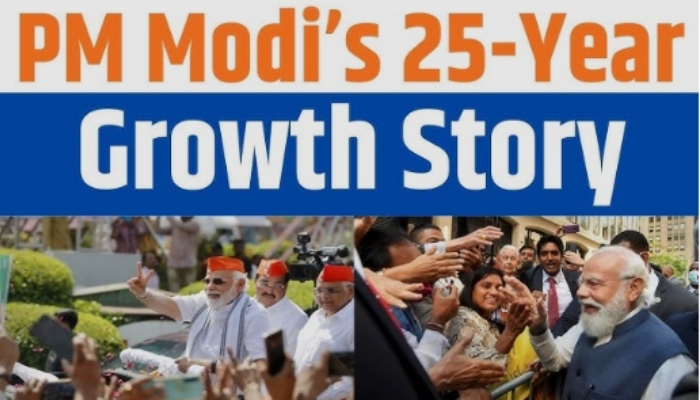 In sum, it is moving from the colonial era concept of ‘Nation-State’ to ‘Civilisational Continuity’.
In this context, ‘RRR’ does not refer to the title of the popular movie but indicates three dimensions – Reorientation, Revival, and Resurgence. This three-dimensional lookback at the ‘first 25’ years of this Century with specific reference to India also decodes the positive impact of the ‘Modi Effect’ by default since it coincides with this timeline.
Narendra Modi first assumed public office in 2001 as Chief Minister of Gujarat, and rose to become Prime Minister of India in 2014. When Modi took over as Chief Minister of Gujarat, it was a State reeling from the Bhuj earthquake, water scarcity, and an ailing economy. He reoriented governance towards infrastructure-led, investor-friendly development. Initiatives like the ‘Sujalam Sufalam’ water conservation drive, ‘Jyotigram Yojana’ for reliable rural power, and the ‘Vibrant Gujarat’ investor summit repositioned Gujarat as a development powerhouse and a preferred global investment destination.
The shift from administrative routine to outcome-focused, project-based governance marked a structural reorientation of the State’s development model. When he became Prime Minister, he scaled up this model of reorientation at the pan-India level, and positive results were visible with the same administrative and bureaucratic machinery.
For instance, the ‘Sujalam Sufalam’ scheme laid the groundwork for the ‘Jal Jeevan Mission’ for supply of tap water to every rural household. ‘Vibrant Gujarat’ served as the blueprint for ‘Make in India’ and ‘Atmanirbhar Bharat’ initiatives, positioning India as a global manufacturing hub. Besides, the tax system was reoriented from a fragmented and complex one to a single national market through the Goods and Services Tax (GST), lethargic implementation of government schemes with poor accountability was reoriented with ‘speed and scale’ and convergence. Initiation of military theaterisation and appointment of the Chief of Defence Staff added other dimensions to the reorientation story. ‘Padma Awards’ were freed of ‘elitist’ or ‘politically convenient’ mould, and reoriented into ‘People’s Padma’ recognising unsung heroes making meaningful contributions in various spheres of life and different regions of the country. Foreign policy, too, was reoriented from reluctant ‘non-alignment’ to bold ‘multilateralism’.
All this reorientation led to revival – of the economy from ‘Fragile Five’ to ‘Top Five’, the cultural symbol of Ram Mandir at Ayodhya, of deeper integration of Kashmir through abrogation of Article 370, etc. A major push was given to decolonisation, reflected visibly in the renaming of various islands, prominent cities, and even defence areas. The elements of strength, agility, and lethality were revived in security-related architecture; ordnance factories were restructured to revive their original purpose, turning them into vibrant symbols of India’s defence manufacturing capability. Emphasis on reducing oil imports, having strategic ties with various countries, building own reserves, investing effort in alternate fuels to reduce oil dependence, building foreign exchange reserves… the list may be too long to incorporate each and every aspect. Besides, a conscious effort was made to improve the internal security situation by way of resolute action against the thorn of Maoism in the flesh of national security.
Obviously, when reorientation yields results, and conscious efforts are made for revival of the spirit of pride, a country links development with cultural heritage, emphasises restoration of temples, heritage sites, and institutions like Nalanda as part of cultural resurgence. The idea of ‘Viksit Bharat@2047’ is rooted in this resurgence. India is marching ahead towards becoming the third largest economy of the world. The element of resurgence reflects that India of the future will not only be an economically strong developed nation but also a spiritually enriched and culturally self-assured one. Hence, when required, it can take up ‘Operation Sindoor’ to teach terrorists and terror-sponsors a lesson. India is transforming externally into a developed nation through AI full-stack architecture, Quantum Policy, Aerospace Policy, etc and internally preserving cultural confidence rooted in the ‘Bharat’ identity.
Kartik Lokhande
Kartik Lokhande is a senior journalist with experience of 26+ years. He is a former Deputy Editor of The Hitavada, Nagpur. Naxalism, defence, and security issues are the topics of particular interest.