Smart border project + demography mission: India’s new anti-infiltration blueprint?
(Smart Border Project) Home Minister described infiltration not merely as a law-and-order issue, but as a long-term challenge linking demography, narcotics rackets, fake currency operations and national security.
NewsBharati 26-May-2026 18:17:09 PM
Total Views |


India’s border security debate is entering a new phase. For decades, the focus remained largely on fencing, armed patrols, and physical checkpoints. But the announcements made by Home Minister Amit Shah during the BSF Investiture Ceremony in May 2026 suggest that the government now wants to move toward something much broader: a technology-driven border management system combined with a demographic monitoring mechanism.
The government’s language was unusually direct. The Home Minister described infiltration not merely as a law-and-order issue, but as a long-term challenge linking demography, narcotics rackets, fake currency operations and national security. He also repeatedly compared the campaign against infiltration with the government’s anti-Naxal operations. That comparison signals a significant shift: the Centre now sees border infiltration as a structural national security problem rather than an isolated policing issue.
But what exactly are these initiatives? And why is India suddenly talking about “smart borders” and “demographic change” together?
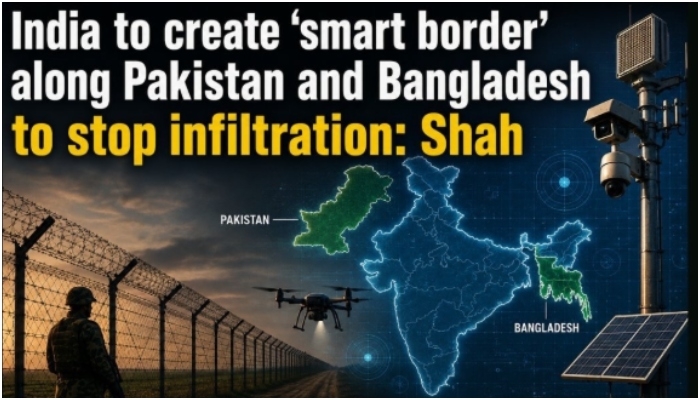
The Smart Border project is expected to rely heavily on surveillance technology rather than only on manpower. The proposed system will include drone radars, thermal cameras, AI-based monitoring tools, underground sensors and integrated command centres. The objective is to create an “impenetrable security grid” across India’s 6,000-kilometre international border.
This is not entirely new. India has experimented with the Comprehensive Integrated Border Management System for several years in selected border sectors. But the latest announcement indicates a larger national rollout. The shift also reflects a global pattern. Across the world, border security is increasingly becoming digital.
The United States uses facial recognition technology, motion sensors, surveillance towers, drones, and AI-supported monitoring along parts of the Mexico border. Israel’s borders rely heavily on automated sensors and smart fencing systems. European countries, too, have invested in biometric monitoring and integrated migration databases after facing repeated migration crises.
Traditional border fencing is no longer seen as enough because threats have changed. Small drones can transport narcotics, weapons, or fake currency across borders within minutes. Human trafficking routes are becoming more organised. Smuggling networks now use encrypted communication systems. In some regions, infiltration happens through rivers, forests, and densely populated villages where conventional fencing becomes difficult.
This is where India’s Smart Border plan fits in. Surveillance technology can reduce human gaps in border management and create faster coordination between the BSF, intelligence agencies, local police, and district administration.
The second part of the discussion, however, is more politically and socially sensitive.

The Mission will work with border forces and state administrations to identify infiltration routes, track undocumented migrants, and support deportation mechanisms. He emphasised coordination with local officials like patwaris, district collectors, and police stations. This suggests that the policy may extend beyond border fencing into local governance and data verification systems.
At the same time, the language around demography raises important questions.
How will the government define “artificial demographic change”? What safeguards will exist to prevent the wrongful targeting of poor migrants, linguistic minorities, or legitimate citizens lacking documentation? How will data be collected and verified in border districts where documentation gaps already exist?
There is also the practical challenge of implementation. Building a technology-heavy security grid across thousands of kilometres will require massive coordination, maintenance, and funding. Surveillance systems are only as effective as the institutions managing them. Drones, AI systems, and sensors can detect movement, but they cannot solve deeper problems like corruption, forged documents, local political networks, or cross-border economic dependency.
Another question is whether technology-led border systems could eventually increase surveillance within civilian spaces near border regions. If demographic monitoring expands into welfare databases, land records, and identity systems, debates around privacy and state overreach are likely to grow sharper.
For now, the Smart Border project and the High Power Demography Mission are presented as necessary responses to emerging security threats. But the real debate may begin once these ideas move from speeches and announcements into actual policy frameworks, legal mechanisms, and ground-level enforcement.
Two announcements stood out. The first was the rollout of a countrywide “Smart Border” project along the Pakistan and Bangladesh borders. The second was the proposed High Power Demography Mission, which, according to the government, will identify and act against “artificial demographic changes” caused by illegal infiltration.
The government’s language was unusually direct. The Home Minister described infiltration not merely as a law-and-order issue, but as a long-term challenge linking demography, narcotics rackets, fake currency operations and national security. He also repeatedly compared the campaign against infiltration with the government’s anti-Naxal operations. That comparison signals a significant shift: the Centre now sees border infiltration as a structural national security problem rather than an isolated policing issue.
But what exactly are these initiatives? And why is India suddenly talking about “smart borders” and “demographic change” together?
The Smart Border project is expected to rely heavily on surveillance technology rather than only on manpower. The proposed system will include drone radars, thermal cameras, AI-based monitoring tools, underground sensors and integrated command centres. The objective is to create an “impenetrable security grid” across India’s 6,000-kilometre international border.
Another important part of the Smart Border idea is technological self-reliance. India wants to control not just the physical equipment, such as drones and sensors, but also the software, algorithms, and data systems behind them. In an era of cyber threats and AI surveillance, relying too much on foreign technology for border intelligence is increasingly seen as a strategic vulnerability.
This is not entirely new. India has experimented with the Comprehensive Integrated Border Management System for several years in selected border sectors. But the latest announcement indicates a larger national rollout. The shift also reflects a global pattern. Across the world, border security is increasingly becoming digital.
The United States uses facial recognition technology, motion sensors, surveillance towers, drones, and AI-supported monitoring along parts of the Mexico border. Israel’s borders rely heavily on automated sensors and smart fencing systems. European countries, too, have invested in biometric monitoring and integrated migration databases after facing repeated migration crises.
Traditional border fencing is no longer seen as enough because threats have changed. Small drones can transport narcotics, weapons, or fake currency across borders within minutes. Human trafficking routes are becoming more organised. Smuggling networks now use encrypted communication systems. In some regions, infiltration happens through rivers, forests, and densely populated villages where conventional fencing becomes difficult.
This is where India’s Smart Border plan fits in. Surveillance technology can reduce human gaps in border management and create faster coordination between the BSF, intelligence agencies, local police, and district administration.
The second part of the discussion, however, is more politically and socially sensitive.
The High Power Demography Mission introduces the idea that illegal infiltration can gradually alter the demographic profile of border districts. The unchecked illegal migration affects voter rolls, land ownership patterns, welfare delivery, and local administrative systems. Shah repeatedly used the phrase “artificial demographic change” while discussing infiltration from neighbouring countries.
This debate is not entirely new either. Assam has witnessed demographic and migration-related tensions for decades, particularly around the NRC debate and illegal migration from Bangladesh. Similar concerns have also surfaced periodically in parts of West Bengal and north-eastern states. The difference now is that the Centre appears ready to institutionalise demographic monitoring at a national level.
The Mission will work with border forces and state administrations to identify infiltration routes, track undocumented migrants, and support deportation mechanisms. He emphasised coordination with local officials like patwaris, district collectors, and police stations. This suggests that the policy may extend beyond border fencing into local governance and data verification systems.
At the same time, the language around demography raises important questions.
How will the government define “artificial demographic change”? What safeguards will exist to prevent the wrongful targeting of poor migrants, linguistic minorities, or legitimate citizens lacking documentation? How will data be collected and verified in border districts where documentation gaps already exist?
These concerns become important because demographic monitoring can quickly move from an administrative exercise to political controversy. India has already seen how citizenship and migration debates can create fear and uncertainty among vulnerable communities.
There is also the practical challenge of implementation. Building a technology-heavy security grid across thousands of kilometres will require massive coordination, maintenance, and funding. Surveillance systems are only as effective as the institutions managing them. Drones, AI systems, and sensors can detect movement, but they cannot solve deeper problems like corruption, forged documents, local political networks, or cross-border economic dependency.
Another question is whether technology-led border systems could eventually increase surveillance within civilian spaces near border regions. If demographic monitoring expands into welfare databases, land records, and identity systems, debates around privacy and state overreach are likely to grow sharper.
For now, the Smart Border project and the High Power Demography Mission are presented as necessary responses to emerging security threats. But the real debate may begin once these ideas move from speeches and announcements into actual policy frameworks, legal mechanisms, and ground-level enforcement.

Anjali Ankad
Anjali Ankad has completed graduation in Journalism and Mass Communication and Masters in Journalism. While working as a sub-editor to Newsbharati, she aims to make her hand robust on sports.