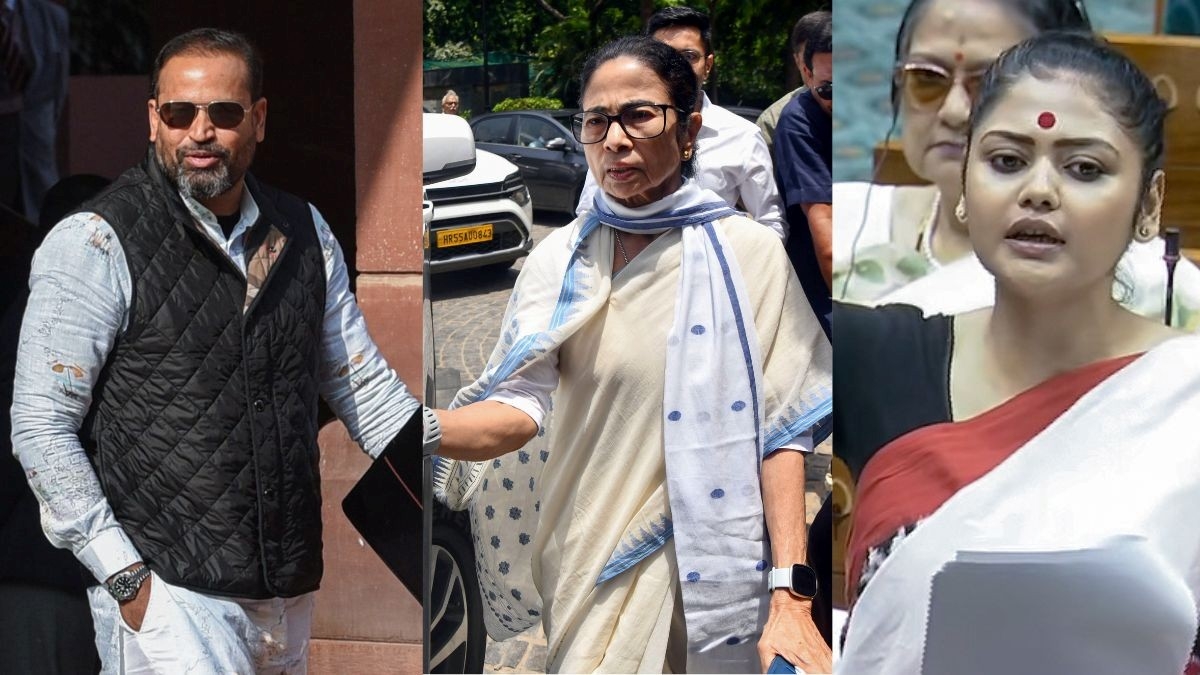
The Trinamool Congress appears to be heading towards an unprecedented split after a large group of MPs reportedly broke ranks with the party leadership and formed a dissident bloc.
The rebellion comes at a time when the party is already facing growing internal tensions, leadership disputes and dissatisfaction among MPs, MLAs and senior leaders. What began as murmurs of discontent has now turned into an organised challenge to Mamata Banerjee's authority.
Reports claim the dissident camp is preparing to seek recognition as the "Real TMC", making this the most serious challenge faced by Mamata Banerjee since she founded the party in 1998.
Who is leading the rebellion?
The rebel camp is being led by senior Lok Sabha MP Kakoli Ghosh Dastidar, a multiple-term parliamentarian from Barasat who is regarded as one of the party's strongest organisational leaders.
The dissidents have reportedly informed Lok Sabha Speaker Om Birla about their intention to function as a separate parliamentary bloc and are expected to seek formal recognition.
According to rebel leaders, around 20 MPs support the move.
Which MPs are part of the rebel camp?
According to reports, the MPs associated with the dissident camp include Kakoli Ghosh Dastidar, Shatrughan Sinha, Yusuf Pathan, Saayoni Ghosh, Jagadish Chandra Basunia, Khalilur Rehman, Abu Taher Khan, Partha Bhowmick, Bapi Haldar, Mala Roy, Mitali Bag, Deepak Adhikari (Dev), Kalipada Soren, June Malia, Arup Chakraborty, Sharmila Sarkar, Asit Kumar Mal, Satabdi Roy, Rachana Banerjee and Prasun Banerjee.
The inclusion of such a diverse group of leaders has given the rebellion added significance. The names include veteran politicians, celebrity MPs, youth leaders and organisational figures, suggesting that the dissatisfaction cuts across different sections of the party.
What makes the rebellion particularly damaging for the Trinamool Congress is not just the number of MPs involved but who they are.
TMC's big 2024 victory face
Former Indian cricketer Yusuf Pathan became one of the biggest faces of TMC's 2024 Lok Sabha campaign after defeating Congress veteran Adhir Ranjan Chowdhury in Baharampur.
His reported association with the dissident camp is significant because he represented Mamata Banerjee's attempt to expand the party's appeal beyond traditional political circles.
Saayoni Ghosh rose rapidly through the party ranks and became president of the Trinamool Youth Congress. She was widely seen as part of the next generation of TMC leadership and closely associated with the party's future plans.
Her reported support for the rebellion suggests that the unrest is not limited to the party's old guard.
A former Union Minister and one of India's most recognisable politicians, Shatrughan Sinha was brought into the party as part of Mamata Banerjee's national expansion strategy.
His presence in the dissident camp carries symbolic importance because he represents TMC's ambitions beyond West Bengal.
Unlike celebrity politicians, Kakoli Ghosh Dastidar built her political career through years of grassroots work and organisational management.
Her emergence as the face of the rebellion suggests that dissatisfaction has spread into the party's core structure.
What does the rebel camp want?
The dissident MPs have reportedly decided not to resign from the Trinamool Congress immediately or formally join the BJP.
Instead, they want to function as a separate parliamentary bloc while extending support to the BJP-led National Democratic Alliance (NDA).
The group is expected to argue before the Speaker that it represents the majority of TMC MPs in the Lok Sabha and should therefore be recognised as the "Real TMC".
Since the rebel faction claims the support of more than two-thirds of the party's Lok Sabha strength, it may also seek protection from anti-defection provisions.
How big is the blow for Mamata Banerjee?
The numbers make the crisis particularly serious.
The Trinamool Congress currently has 28 Lok Sabha MPs, with one vacancy following the death of Basirhat MP Haji Nurul Islam.
If the dissident camp's claim of support from around 20 MPs is accurate, Mamata Banerjee's effective support base in the Lok Sabha could shrink dramatically.
The development would significantly weaken the party's parliamentary position and strengthen the bargaining power of the rebel faction.
The rebellion comes after a series of high-profile resignations.
Rajya Sabha MP Sushmita Dev resigned from both Parliament and the party. Earlier, senior parliamentarian Sukhendu Sekhar Ray also resigned.
Ray's exit carried particular significance because he was considered one of the party's most trusted and influential leaders in Parliament.
His resignation gave credibility to complaints that had previously been dismissed as isolated dissatisfaction.
Kalyan Banerjee's open revolt against Abhishek Banerjee
The crisis deepened further when senior advocate and veteran TMC leader Kalyan Banerjee publicly attacked party national general secretary Abhishek Banerjee.
He accused Abhishek of arrogance and announced that he would no longer represent him in legal matters.
In a direct challenge to the party leadership, Kalyan Banerjee reportedly asked Mamata Banerjee to choose between him and her nephew, highlighting the growing divisions within the organisation.
The rebellion is not limited to Parliament.
Reports suggest that a large number of TMC MLAs have also defied the leadership in the West Bengal Assembly, creating a parallel crisis within the state unit.
The simultaneous unrest in both Parliament and the Assembly has raised serious questions about the party leadership's ability to maintain unity.
Police visit Abhishek Banerjee's residence amid crisis
Adding to the drama, police personnel reportedly visited Abhishek Banerjee's residence in the early hours of Saturday morning.
According to reports, officials from Salboni Police Station arrived around 3 am, though the reason for the visit has not been officially disclosed.
Soon afterwards, Mamata Banerjee reportedly reached the residence. Meanwhile, Enforcement Directorate officials also visited senior TMC leader Madan Mitra's residence, further fuelling speculation amid the ongoing political turmoil.
All eyes are now on the planned meeting between the rebel MPs and Lok Sabha Speaker Om Birla.
If the dissidents formally seek recognition as the "Real TMC", the battle could move beyond political messaging and become a legal and parliamentary contest over who represents the party's legacy.
For nearly three decades, Mamata Banerjee's greatest strength was her ability to keep leaders from different backgrounds, generations and political ambitions united under one banner. The current rebellion is different because it involves many of the very faces that helped build the party's image, from Yusuf Pathan and Saayoni Ghosh to Shatrughan Sinha and Kakoli Ghosh Dastidar.
Whether the revolt ultimately fizzles out or results in a formal split remains to be seen. But one thing is clear: the Trinamool Congress is passing through the most turbulent phase in its history, and the outcome could reshape the future of West Bengal politics.