Bengal's Bhagwa Moment
A road name cannot change the past. But it can change what a society sees when it looks into the mirror.
NewsBharati 22-Jun-2026 14:08:15 PM
Total Views |


History is not merely written in books. It is also written on road signs, public squares, monuments, and the names a society chooses to honour. Every nameplate is a declaration of memory. It tells future generations who deserves gratitude, who deserves remembrance, and what values a civilization wishes to celebrate.
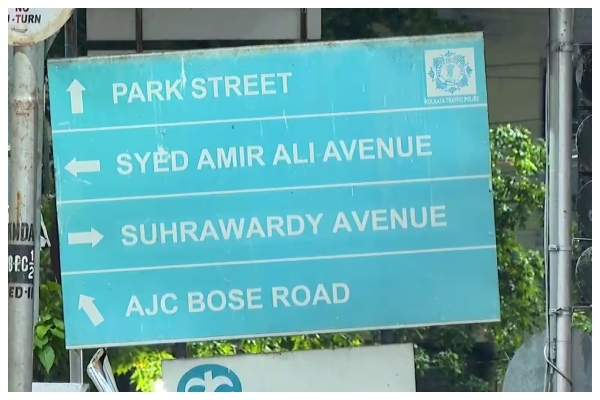 That is why the renaming of Suhrawardy Avenue as Gopal Mukherjee Road is much more than a municipal decision. It is Bengal's Bhagwa moment at the street level. No slogans. No processions. No political theatre. Just a simple declaration that Hindu lives mattered in 1946, Hindu suffering deserves acknowledgement, and Hindu courage deserves honour in 2026.
The irony becomes even sharper when one examines the history of the road itself. The avenue was originally named in the 1930s after Sir Hassan Suhrawardy, a surgeon, educationist and the first Muslim Vice-Chancellor of the University of Calcutta. He died before Partition. Over time, however, the name "Suhrawardy Avenue" became inseparably associated in public memory with his nephew, Huseyn Shaheed Suhrawardy, the last Premier of undivided Bengal, whose role during the direct action day riots remains deeply painful. After Partition, Huseyn Shaheed Suhrawardy migrated to Pakistan and eventually became its Prime Minister in 1956. Gopal Mukherjee, by contrast, never left Bengal. He lived, fought and remained rooted in the very soil whose people he sought to protect. The renaming therefore does more than replace one name with another; it shifts Bengal's public memory from Karachi's political history back to Bengal's own civilizational experience.
History often honours statesmen, intellectuals, and philosophers. But every civilization also survives because of its defenders. When law collapses, when institutions fail, when mobs rule the streets, it is courage that becomes the last line of defence. Gopal Patha emerged from precisely such circumstances. He was not a scholar. He was not a poet. He was not a minister. He was a son of Bengal who refused to watch helplessly while his people were slaughtered. That is why this renaming carries emotional weight far beyond a municipal file.
Symbol wound. Symbols also heal. For nearly eight decades, every direction pointing towards Suhrawardy Avenue carried an uncomfortable reminder of Bengal's unresolved past. Every schoolchild, taxi driver, shopkeeper, and office-goer unconsciously repeated a name associated with a tragedy that many families still remember through stories passed down across generations.
The replacement of that name is not an act of vengeance. It is an act of symbolic justice. For Bengali Hindus, the relief is emotional, cultural, and generational. Emotionally, parents can now tell their children that the road is named after a man who protected lives rather than one associated with their destruction. Culturally, Bengal's Hindu memory receives public legitimacy. A society's self-respect depends upon whom it chooses to honour. When Gopal Mukherjee stands taller in public memory than a political figure who eventually became Prime Minister of Pakistan, Bengal quietly reorders its moral priorities.
Generationally, the message may be even more profound. The grandson of a survivor of 1946 will grow up seeing Gopal Mukherjee Road on maps, signboards, and official records. Memory is no longer confined to family conversations. It becomes part of public consciousness. The chain of inherited trauma begins to break. The deeper significance, however, lies in what this says about Bengal's changing political and cultural landscape.
For decades, discussing the Hindu experience of partition and direct action day was treated as an uncomfortable subject. The dominant political culture preferred selective remembrance. Certain historical wounds were acknowledged. Others were expected to remain silent. That silence is now ending.
The renaming signals that Bengal is beginning to reclaim ownership of its own historical narrative. It suggests that historical justice cannot remain hostage to political sensitivities forever. A mature society does not erase painful chapters. It confronts them honestly.
The choice of Gopal Mukherjee is particularly significant because it represents a distinctly Bengali expression of Hindutva. This is not the celebration of an imported symbol. It emerges organically from Bengal's own soil, history, and experience. The message is clear: Bengal's Hindu awakening will speak in Bengali accents and draw inspiration from Bengali heroes. This is where the larger lesson of history emerges.
Civilizations decline when they forget those who defended them. A society that remembers only its poets but forgets its protectors becomes vulnerable. Bengal has given India giants such as Vivekananda, Bankim Chandra, Rabindranath Tagore, and Netaji Subhas Chandra Bose. Their contributions are eternal. But history also belongs to men like Gopal Patha, whose courage ensured that countless ordinary families lived to tell their stories. A civilization needs both wisdom and strength. It needs both a pen and a sword. It needs saints, thinkers, reformers and defenders.
The assertion of Hindutva in Bengal must be understood in this context. At its best, it is not about hostility towards others. It is about recovering historical memory, restoring civilizational confidence, and refusing to apologize for the right of a community to remember its suffering and honour its heroes.
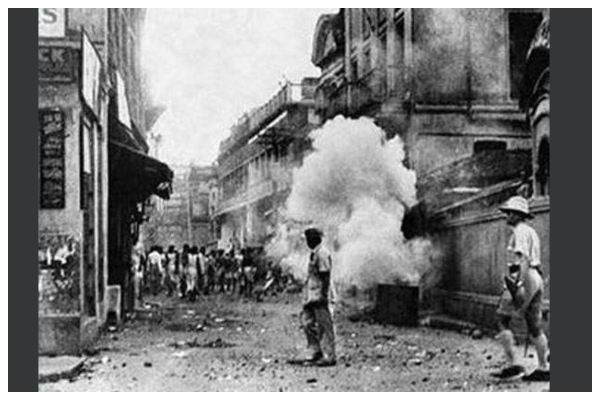
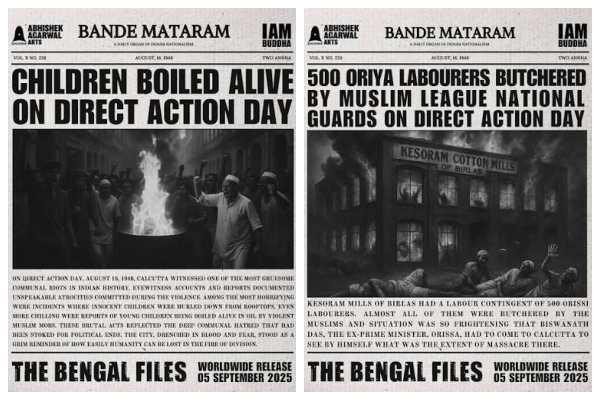
For decades, Bengal lived with a deep pain. The land that witnessed the horrors of direct action day continued to carry the name of a man inseparably associated with one of the darkest chapters in its history. On August 16, 1946, Kolkata descended into a nightmare. Thousands died in communal violence that scarred Bengal forever. Families were uprooted, neighbourhoods destroyed, women raped and a deep wound was inflicted upon the Hindu psyche.
The irony becomes even sharper when one examines the history of the road itself. The avenue was originally named in the 1930s after Sir Hassan Suhrawardy, a surgeon, educationist and the first Muslim Vice-Chancellor of the University of Calcutta. He died before Partition. Over time, however, the name "Suhrawardy Avenue" became inseparably associated in public memory with his nephew, Huseyn Shaheed Suhrawardy, the last Premier of undivided Bengal, whose role during the direct action day riots remains deeply painful. After Partition, Huseyn Shaheed Suhrawardy migrated to Pakistan and eventually became its Prime Minister in 1956. Gopal Mukherjee, by contrast, never left Bengal. He lived, fought and remained rooted in the very soil whose people he sought to protect. The renaming therefore does more than replace one name with another; it shifts Bengal's public memory from Karachi's political history back to Bengal's own civilizational experience.
But independent India developed a strange habit. It remembered the perpetrators with sophistication and forgot the victims with embarrassment. It celebrated political figures but remained silent about those ordinary men who stood between their communities and annihilation. Among those men was Gopal Mukherjee, remembered by generations as Gopal Patha.
History often honours statesmen, intellectuals, and philosophers. But every civilization also survives because of its defenders. When law collapses, when institutions fail, when mobs rule the streets, it is courage that becomes the last line of defence. Gopal Patha emerged from precisely such circumstances. He was not a scholar. He was not a poet. He was not a minister. He was a son of Bengal who refused to watch helplessly while his people were slaughtered. That is why this renaming carries emotional weight far beyond a municipal file.
Symbol wound. Symbols also heal. For nearly eight decades, every direction pointing towards Suhrawardy Avenue carried an uncomfortable reminder of Bengal's unresolved past. Every schoolchild, taxi driver, shopkeeper, and office-goer unconsciously repeated a name associated with a tragedy that many families still remember through stories passed down across generations.
Generationally, the message may be even more profound. The grandson of a survivor of 1946 will grow up seeing Gopal Mukherjee Road on maps, signboards, and official records. Memory is no longer confined to family conversations. It becomes part of public consciousness. The chain of inherited trauma begins to break. The deeper significance, however, lies in what this says about Bengal's changing political and cultural landscape.
For decades, discussing the Hindu experience of partition and direct action day was treated as an uncomfortable subject. The dominant political culture preferred selective remembrance. Certain historical wounds were acknowledged. Others were expected to remain silent. That silence is now ending.
The renaming signals that Bengal is beginning to reclaim ownership of its own historical narrative. It suggests that historical justice cannot remain hostage to political sensitivities forever. A mature society does not erase painful chapters. It confronts them honestly.
The choice of Gopal Mukherjee is particularly significant because it represents a distinctly Bengali expression of Hindutva. This is not the celebration of an imported symbol. It emerges organically from Bengal's own soil, history, and experience. The message is clear: Bengal's Hindu awakening will speak in Bengali accents and draw inspiration from Bengali heroes. This is where the larger lesson of history emerges.
Civilizations decline when they forget those who defended them. A society that remembers only its poets but forgets its protectors becomes vulnerable. Bengal has given India giants such as Vivekananda, Bankim Chandra, Rabindranath Tagore, and Netaji Subhas Chandra Bose. Their contributions are eternal. But history also belongs to men like Gopal Patha, whose courage ensured that countless ordinary families lived to tell their stories. A civilization needs both wisdom and strength. It needs both a pen and a sword. It needs saints, thinkers, reformers and defenders.
The tragedy of 1946 cannot be undone. The dead cannot return. Partition cannot be reversed. But history offers a choice. A society can either remain imprisoned by its wounds or transform those wounds into sources of strength.
That is what makes this moment significant. A road name cannot change the past. But it can change what a society sees when it looks into the mirror. For decades, that mirror reflected confusion, silence, and historical discomfort.
Today, it reflects memory, gratitude, and self-respect. has not merely renamed a road. It has made a statement about whom Bengal and rest of India chooses to remember. And perhaps, after eighty years of silence, Bengal has finally begun to reclaim its voice.

Editor's Desk
Editor's Desk