Introduction
The discourse surrounding Bharat’s demographic composition has moved from the margins of statistical tracking to the absolute center of national security and policymaking. Demography is not merely a collection of numbers; it is the foundational bedrock that shapes a nation's socio-cultural fabric, economic distribution, resource sustainability, and electoral landscape.
The announcement by Union Home Minister Amit Shah by the end of May 2026, regarding the constitution of a high-level committee chaired by retired Justice Prakash Prabhakar Naolekar highlights the gravity with which the state views these changes. This committee, comprising the Census Commissioner, former bureaucrats, and leading economists, is tasked with assessing "unnatural demographic changes" driven by illegal infiltration.
With the last comprehensive decadal census conducted in 2011, Bharat currently navigates a significant fifteen-year data gap. Yet, alternative empirical data sources, including the National Family Health Surveys (NFHS) and localized demographic audits, reveal shifting balances, particularly across highly sensitive border districts. Understanding the scale, the drivers, and the long-term national security implications of these shifts is vital for protecting Bharat's future.
ALSO READ: Book Review,Great Maratha General: Mahadaji Scindia By Brig HemantMahajan,YSM
Contextualizing the Core Data: 1951 vs. 2011 Baseline Trends
To understand the trajectory of demographic shifts in Bharat, one must look closely at the long-term baseline trends recorded between the first post-independence census in 1951 and the most recent complete census in 2011. Over these six decades, the overall population share of the majority community (Hindus) witnessed a steady, gradual decline, while the percentage share of minority communities, particularly Muslims, experienced a distinct upward trend.
1951 Baseline vs. 2011 Census Trends (National Share)
The Spatial Redistribution of Communities
The macro-level national shift does not fully capture the localized gravity of the situation. The true transformation is visible at the district level. In 1951, approximately 70% to 75% of all Bharatn districts featured a Muslim population well below the 10% threshold. By 2011, this category shrunk dramatically to between 55% and 60%.
Concurrently, the number of districts falling into higher concentration bands—ranging from 10%–20%, 21%–30%, up to absolute majority zones (greater than 50%)—grew steadily. This shift indicates that the demographic profile of the country is not evolving uniformly; rather, it is concentrating heavily within specific geographical corridors.
Global Proportions and Comparative Stagnation
A telling indicator of Bharat's unique demographic trajectory is its shifting weight in global population shares. In 1951, Bharat was home to roughly 8.3% of the global Muslim population. By 2011, this figure climbed to 10.9%.
In contrast, other nations with large Muslim populations experienced stable demographic baselines. For instance, Indonesia—which holds the world's largest Muslim population—saw its global share remain virtually flat at around 12% over the same historical period. This suggests that the internal population dynamics within the Bharatn subcontinent are driven by unique, localized variables that merit closer investigation.
Micro-Level Analysis: District-Wise Regional Transformations
The structural changes in Bharat's demographic map are most pronounced along its outer borders and specific sensitive ecological zones. The data shows a clear pattern: a continuous decline in the relative share of the Hindu and indigenous tribal populations, balanced by an inorganic increase in minority concentrations.
The Border Contagion: From Gujarat to Uttar Pradesh
This phenomenon is not restricted to the eastern frontier. Along the western and northern borders, a similar pattern emerges:
- Rajasthan & Gujarat: Border districts such as Jaisalmer, Barmer, and parts of the Kutch region have registered localized decadal growth rates that far outpace the interior districts of these states.
- Uttar Pradesh: The northern "Terai" belt, which runs along the open border with Nepal, has seen a rapid expansion of high-concentration districts, notably in areas like Rampur (50%) and Moradabad (48%). This trend has significant implications for cross-border surveillance and internal security.
Dissecting the Drivers: Why the Population Balance is Shifting
The causes behind these shifting demographics are complex. They cannot be attributed to a single factor, but rather to a combination of historical migration, varying demographic metrics, and porous borders.
CRITICAL DEMOGRAPHIC DRIVERS
Accelerated Demographic Change
Reason 1: Unchecked Infiltration and Open Borders
The primary driver of unnatural demographic change in Bharat's border states is illegal infiltration, particularly from neighboring Bangladesh. This is not a recent phenomenon, but rather a long-term historical trend with deep roots:
- The 1971 Footprint: The Bangladesh Liberation War triggered a massive wave of displacement. While millions of refugees returned, large numbers fleeing persecution and economic migrants remained within Bharat's borders, settling across Assam, West Bengal, and Tripura.
-
- The Infiltration Disparity: Between 2001 and 2011, the population of Bangladesh grew by roughly 17%. During that exact same decadal window, the Muslim population inside Bharat expanded by 24.6%. This stark statistical discrepancy cannot be explained by natural birth rates alone; it points clearly to a continuous, unmonitored cross-border migration flow.
ALSO READ: Who is Osman Faizan Ali from the USA, hailed by 'cockroaches' at the Jantar Mantar protest?
Reason 2: The Total Fertility Rate (TFR) Differential
While fertility rates across all communities in Bharat are dropping due to urbanization, female literacy, and rising income levels, a structural gap between the majority and minority communities remains.
According to data from the National Family Health Survey (NFHS-5):
- The Hindu TFR has dropped to 1.94, falling below the net replacement level of 2.1 required to keep a population stable over generations.
- The Muslim TFR stands at 2.36.
Although this marks a significant decline from historical highs, the differential creates a compounding demographic momentum. Over several decades, even a minor variance in fertility rates can lead to substantial changes in the overall population balance, particularly within localized regional clusters.
Reason 3: The Mathematical Discrepancy in Baseline Calculations
A key point raised by demographic researchers is an apparent math anomaly within national growth estimates. Bharat currently records roughly 2.4 crore (24 million) live births annually, against approximately 90 lakh (9 million) deaths. This yields a natural annual population increase of roughly 1.5 to 1.6 crore people.
However, real-world census tracking and multi-indicator surveys indicate that Bharat's absolute population has been expanding at an estimated rate of 1.8 crore per year. This leaves an unexplained annual gap of roughly 20 lakh (2 million) individuals. This statistical variance strongly points to an unaccounted population influx, likely driven by illegal migration through porous border sectors.
4. National Security Threats and Social Stability
Uncontrolled, rapid demographic alterations along a nation's borders can create a range of vulnerabilities that expand from local communities into broader national security challenges.
DEMOGRAPHIC SHIFTS: THE CASCADING SECURITY IMPACT
Border Infiltration ──► Resource Strain ──► Political Realignment ──► Security Risk
(Porous Frontiers) (Land & Welfare) (Electoral Changes) (Radicalization)
Critical Security Vulnerabilities
- Erosion of Tribal Sovereignty: In regions like Jharkhand's Santhal Pargana and parts of the Northeast, indigenous tribal communities are facing displacement. Illegal settlers often acquire land through informal channels, which disrupts local customs and dilutes legal protections designed for tribal communities.
- Strain on Public Resources: Illegal migration places immense pressure on local infrastructure, including primary healthcare, public education, and subsidized food distribution systems. This can stretch local state budgets thin, redirecting resources meant for legal citizens.
- Altering Electoral Dynamics: When concentrated demographic shifts occur within specific border constituencies, they can alter the local political landscape. This can lead to situations where elected representatives prioritize the interests of immigrant blocks over long-term national security goals.
- Asymmetric Border Security: Homogeneous communities along international borders can complicate intelligence gathering. If border populations share deeper ties with neighboring nations than with their home state, it can make it harder to detect cross-border crime, smuggling, and radicalization networks.
5. Strategic Roadmap: How Bharat Can Meet the Challenge
To protect its borders and ensure social stability, Bharat must adopt a multi-layered strategy that combines rigorous
legal reforms, advanced technology, and coordinated administrative execution.
Phase 1: Institutional Auditing and Data Integrity
The Naolekar Committee represents a critical first step. Bharat must prioritize completing a comprehensive, data-driven national census to replace outdated 2011 statistics. This data should be paired with a granular demographic audit of all districts that border Pakistan, Bangladesh, and Nepal. This will allow the state to establish a clear, verifiable baseline of legal residency.
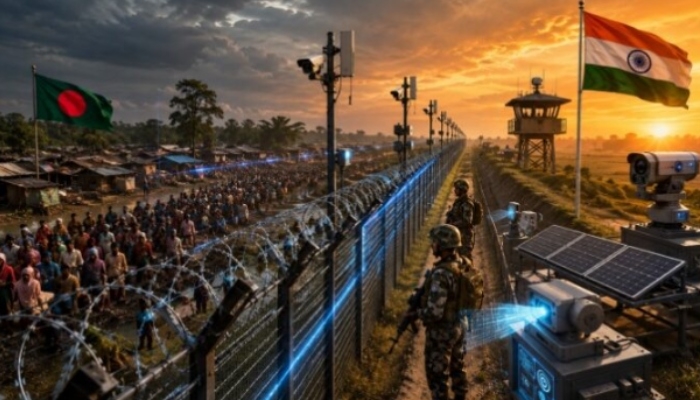
Phase 2: Border Fortification and Technical SurveillancePhysical fencing alone is insufficient for securing complex terrain. Bharat needs to deploy a comprehensive technological solution:
SMART BORDER MANAGEMENT INFRASTRUCTURE
- Smart Fencing: Deploying subterranean sensors to detect tunneling, along with thermal imaging systems for low-visibility operations.
- Laser Barriers: Utilizing active laser networks across riverine gaps and marshlands along the Indo-Bangladesh border, where physical fences are difficult to maintain.
- Aerial Reconnaissance: Deploying continuous drone patrols linked to localized quick-response border outposts to spot and intercept illegal crossings in real time.
Phase 3: Legal and Policy Implementations
- National Register of Citizens (NRC): Implementing a transparent, digitized residency verification system to distinguish legal citizens from undocumented residents.
- Uniform Civil Code (UCC): Enacting a standardized personal law framework across all states to ensure legal uniformity regarding marriage, inheritance, and family planning. This will replace community-specific provisions and support balanced, sustainable population growth nationwide.
- Strict Enforcement of the Foreigners Act: Strengthening legal penalties for individuals who falsify documentation, and clamping down on networks that facilitate illegal settlement or illicit land transfers.
Demographic stability is a vital, invisible pillar of national defense. The data from 1951 to 2011, combined with current projections, indicates that Bharat faces a quiet but significant challenge along its borders. Left unaddressed, these shifts have the potential to alter the country's social fabric and create long-term security vulnerabilities.
By utilizing the expertise of the Naolekar Committee, deploying modern border-security technology, and implementing firm legal policies, Bharat can protect its borders and support its diverse communities. The country must approach this challenge with clarity and determination, ensuring its sovereignty, stability, and security remain secure for generations to come.