Operation Blue Star: Negotiations were nothing more than a pretence
NewsBharati 14-Jul-2026 16:27:40 PM
Total Views |


Any government wants to maintain law and order, peace, and harmony, which are essential for the progress of all sectors. As the situation in Punjab was changing fast, the PM expressed the need for finding a solution to the problem. She also made it clear that she would not hesitate to take appropriate action against Bhindranwale.
As a result, the government started negotiations with the Akali leadership as a result of their agitation. Sometimes there were cordial interactions too. The author notes that when a meeting ended without any result, Akalis were labeled as being adamant or uncooperative. If the discussion arrived at some consensus, it was deliberately disturbed by adding Haryana and Rajasthan ministers.
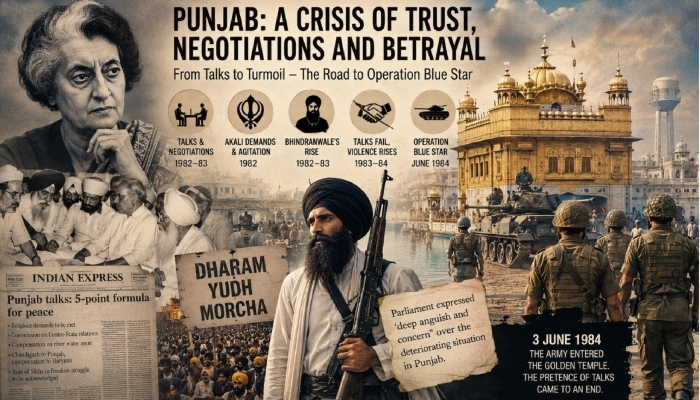
Obviously, 1 Akabar Road also wanted to weaken the hold of Akalis. On the other hand, Bhindranwale's extremism and violence were not given due attention. Some sections of society were losing faith in the moderate Akalis when it came to protecting their interest.
Interestingly, Bhindranwale's extremist activities were somewhat ignored, Punjab police were also confused. In April 1983, DIG Avatar Singh Atwal was eliminated at Harmandir Saheb by Bhindranwale. A commando operation was planned, but the PM thought it could not be carried out as it would cause many more casualties. Operation Blue Star resulted in much greater loss of life, as it is a known fact, the author stated.
The round of talks continued with Akali leaders, but there were issues like withdrawing the cases on water sharing. PM did promise to compensate, but the talks declared failed due to the Akalis.
On the other hand, Bhindranwale's stature was growing; even when he came to Delhi, he and his followers were allowed to carry weapons openly. He was addressed as a Saint. The situation in Punjab was worsening, even the parliament in its resolution described it with ' deep anguish and concern '. Then too, some leaders like Harkishan Singh Surjit criticised the Congress and Akalis in the parliament for protecting Bhindranwale and endangering peace in the state.
Akalis wanted to avoid the aggressive style of working of Bhindranwale, but in a way, they found themselves in a fix; they were being dragged. In this situation, they sought the help of Saradar Swarn Singh. Right from 1946 to 1977, he had been working as a minister at the state and later at the national level. His negotiation skills were well-known. He went to Jalandhar after losing the elections in 1977.
In 1982, he visited Delhi frequently and mostly stayed with the author. He met the PM in October 1982 and explained the need for some sort of face-saving for Akalis, to which she agreed and asked him to go ahead. He met Akali leaders in jails to find out their demands, helped them make the demands acceptable, and suggested that the final decision should be left to the PM.
He even met Bhindranwale, explained the situation, and expressed that his fair demands, too, could get accommodated once the negotiation formula was approved.
Bhindranwale agreed that if his men were released, he would move back to Chowk Mehta. Of course, the PM was kept informed about all the developments.

Swarn Singh kept reaching out to all the stakeholders involved from both sides. The condition of release of Bhindranwale's men was to be fulfilled, as the cases against them were bound to fall in court. They were released, but died during Operation Blue Star later. The discussion on the demands of the Akalis continued. Swarn Singh wanted some way out to withdraw the agitation. On 2'nd and 3'rd November 1982, all arrived at a point acceptable to all. The next day, the announcement was to be made in the parliament.
The points were as follows.
1) Some of the religious demands were to be met.
2) A commission was to be appointed to analyse centre-state relations and make recommendations.
3) The loss of Punjab regarding river water distribution was to be compensated
4) Chandigarh was to be transferred to Punjab; Haryana was to be compensated for it. Haryana wouldn't insist on the transfer of Fazilka and Abohar districts.
5) The role of sikhs in the freedom movement and after independence was to be mentioned.
The report was published (4 November 1982) as front-page news. The points were changed overnight; as a result, Swarn Singh dissociated himself from the future negotiations. In spite of the repeated requests by Indira ji, Swarn Singh kept himself away. Akalis viewed it as a betrayal.
It was stated that there were some concerns from other states too, so the process of consultation was to be initiated again. The interest of national unity, integrity, and the welfare of all could not be ignored, the letter read in the parliament stated. A senior correspondent of the Indian Express felt the role of Gnyani Zail Singh was quite dubious.
Again, the act of finding solutions began, and Rajiv Gandhi and his team were in charge of it. (Many ministers and bureaucrats were a part of the team ) The credit was supposed to go to Rajiv Gandhi. Talks were held; approval from Akali leaders was sought. The proposal was opposed by Bhajan Lal, Indira ji's loyal follower, in the name of protecting Haryana's interests.
The negotiations again started in January 1983. They failed by February. June 1983, the Sarkaria Commission was appointed to look into the centre-state relations. The author observes that earlier, this could have helped a lot. Of course, all this had to have a similar fate to the government, which was not interested in finding the solutions, it seems. Kuldip Nayyar noted that ' he feared something fishy was in the air '.
As a result, the government started negotiations with the Akali leadership as a result of their agitation. Sometimes there were cordial interactions too. The author notes that when a meeting ended without any result, Akalis were labeled as being adamant or uncooperative. If the discussion arrived at some consensus, it was deliberately disturbed by adding Haryana and Rajasthan ministers.
The meetings were being held in Delhi, and at the same time, militant attacks were witnessed in Punjab; government employees, police personnel, and higher cadre officers were attacked. Some religious demands were accepted, for example, the permission to carry a Kirpan was granted on domestic flights. Even some political points, like sharing water, were part of the discussion. One interesting observation about the discussion by Mr P C Alexander was that Akalis were losing grip over agitation and community.
Obviously, 1 Akabar Road also wanted to weaken the hold of Akalis. On the other hand, Bhindranwale's extremism and violence were not given due attention. Some sections of society were losing faith in the moderate Akalis when it came to protecting their interest.
Interestingly, Bhindranwale's extremist activities were somewhat ignored, Punjab police were also confused. In April 1983, DIG Avatar Singh Atwal was eliminated at Harmandir Saheb by Bhindranwale. A commando operation was planned, but the PM thought it could not be carried out as it would cause many more casualties. Operation Blue Star resulted in much greater loss of life, as it is a known fact, the author stated.
The round of talks continued with Akali leaders, but there were issues like withdrawing the cases on water sharing. PM did promise to compensate, but the talks declared failed due to the Akalis.
On the other hand, Bhindranwale's stature was growing; even when he came to Delhi, he and his followers were allowed to carry weapons openly. He was addressed as a Saint. The situation in Punjab was worsening, even the parliament in its resolution described it with ' deep anguish and concern '. Then too, some leaders like Harkishan Singh Surjit criticised the Congress and Akalis in the parliament for protecting Bhindranwale and endangering peace in the state.
In April 1982, ' Dal Khalsa ' and Jagjit Singh Chouhan's ' National Council of Khalistan ' were declared unlawful. The killing of Hindus continued. To avoid arrest, Bhindranwale shifted to Guru Nanak Nivas. To stop the canal work as per the water distribution and to attract some attention of the community, Dharam Yudh Morcha was launched from the Golden Temple in August 1982.
Akalis wanted to avoid the aggressive style of working of Bhindranwale, but in a way, they found themselves in a fix; they were being dragged. In this situation, they sought the help of Saradar Swarn Singh. Right from 1946 to 1977, he had been working as a minister at the state and later at the national level. His negotiation skills were well-known. He went to Jalandhar after losing the elections in 1977.
In 1982, he visited Delhi frequently and mostly stayed with the author. He met the PM in October 1982 and explained the need for some sort of face-saving for Akalis, to which she agreed and asked him to go ahead. He met Akali leaders in jails to find out their demands, helped them make the demands acceptable, and suggested that the final decision should be left to the PM.
He even met Bhindranwale, explained the situation, and expressed that his fair demands, too, could get accommodated once the negotiation formula was approved.
Bhindranwale agreed that if his men were released, he would move back to Chowk Mehta. Of course, the PM was kept informed about all the developments.
By the same time ( 0ctober 1982 ), the author clearly stated that he learned from his sources that Congress had deliberately created the crisis and later wanted to win general elections by presenting a solution dramatically in Punjab. He conveyed that if the information was correct, no compromise formula would be arrived at. Swarn Singh discarded it as he thought that intelligent people are hyper-suspicious unnecessarily. In a way, Sidhu treated this as a test of the credibility of the information. (This really surprises any reader)
Swarn Singh kept reaching out to all the stakeholders involved from both sides. The condition of release of Bhindranwale's men was to be fulfilled, as the cases against them were bound to fall in court. They were released, but died during Operation Blue Star later. The discussion on the demands of the Akalis continued. Swarn Singh wanted some way out to withdraw the agitation. On 2'nd and 3'rd November 1982, all arrived at a point acceptable to all. The next day, the announcement was to be made in the parliament.
The points were as follows.
1) Some of the religious demands were to be met.
2) A commission was to be appointed to analyse centre-state relations and make recommendations.
3) The loss of Punjab regarding river water distribution was to be compensated
4) Chandigarh was to be transferred to Punjab; Haryana was to be compensated for it. Haryana wouldn't insist on the transfer of Fazilka and Abohar districts.
5) The role of sikhs in the freedom movement and after independence was to be mentioned.
It could have given Akalis a fair ground to withdraw the agitation.
ALSO READ: Operation Blue Star: A carefully planned phenomenon?
The report was published (4 November 1982) as front-page news. The points were changed overnight; as a result, Swarn Singh dissociated himself from the future negotiations. In spite of the repeated requests by Indira ji, Swarn Singh kept himself away. Akalis viewed it as a betrayal.
It was stated that there were some concerns from other states too, so the process of consultation was to be initiated again. The interest of national unity, integrity, and the welfare of all could not be ignored, the letter read in the parliament stated. A senior correspondent of the Indian Express felt the role of Gnyani Zail Singh was quite dubious.
Again, the act of finding solutions began, and Rajiv Gandhi and his team were in charge of it. (Many ministers and bureaucrats were a part of the team ) The credit was supposed to go to Rajiv Gandhi. Talks were held; approval from Akali leaders was sought. The proposal was opposed by Bhajan Lal, Indira ji's loyal follower, in the name of protecting Haryana's interests.
Haryana police were ordered to allow any sikhs in Delhi without search and questioning. ( for The Asian Games ) Sikhs in Haryana, too, faced unpleasant situations.
Army moved into the Golden Temple on 3 June 1984. As Maj. Gen. K S. Braddock, who led the operation, was told about 15 days earlier. This was the end of the prolonged Pretense or farce of negotiations, Sidhu quips.
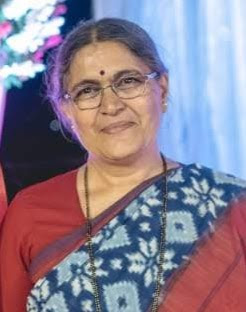
Prof. Vidya Deshpande
Professor Vidya Deshpande has had a journey of more than four decades in the field of education. Her main expertise is in the subject of Philosophy, and she has worked as a teacher of philosophy and logic with Nowrosjee Wadia college for 36 years. She has been associated with the Janakalyan Blood bank for last for 38 years and has also carried out the responsibility as a management committee member of Karve Stree Shikshan Sanstha for 10 years. Her special fields of interest are Philosophy of social sciences, school education, development of skills for self reliance, and top up skills to make students profession ready,