A Masterclass in Resilience and Compassion: A Comprehensive Review of Voice for the Voiceless


Tibetan soft power & spiritual strength may survive longer than the present regime in China.
It may also serve as an example of ethno solidarity & religious resistance for other minority groups seeking self-expression in China today.
For as long as the sky remains blue,
Tibet will never be part of China.
But it is possible that
China might become part of Tibet one day.
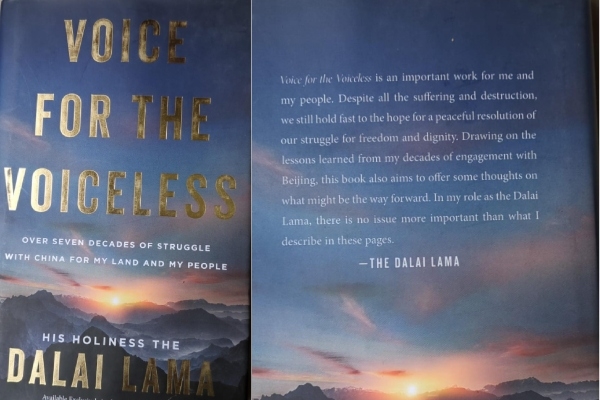
His memoir, Voice for the Voiceless, stands as a definitive, deeply moving historical testament. Rather than serving merely as a chronological record of political grievance, the book is a profound moral appeal for justice, cultural survival, and non-violent resistance. Spanning over seventy-five years of displacement, back-channel diplomacy, and spiritual grounding, it offers a rare, first-hand account of modern history seen through the eyes of a statesman who possesses no borders, no standing army, and yet commands the moral attention of the world.
What sets this work apart from standard political autobiographies is its absolute transparency, humility, and lack of rancor. Writing not from a place of bitter anger, but from a deeply rooted sense of Buddhist compassion and universal responsibility, the Dalai Lama transforms his personal and national pain into an enduring message of hope. He provides readers with an intimate glimpse into his interactions with generations of Chinese leaders—from Chairman Mao Zedong to President Xi Jinping—and chronicles his evolution from an idealistic young leader seeking total independence to a pragmatic strategist championing genuine autonomy within the Chinese constitutional framework.
Structural Breakdown: A Narrative Architecture of Survival
The book is meticulously structured across sixteen thematic and historical chapters, supported by five rich appendices that anchor the spiritual text in hard legal and diplomatic reality. The narrative arc gracefully mirrors the Dalai Lama's internal and external journey: beginning with the shock of invasion, moving through the trials of negotiation and flight, establishing a democratic community in exile, and concluding with forward-looking appeals for global harmony.

Chapter 1: The Invasion and Our New Master
The memoir opens with an atmosphere of sudden, jarring transition. The Dalai Lama details the chilling reality of 1950, when the People’s Liberation Army (PLA) crossed the Drichu River into eastern Tibet. The text vividly conveys the immense burden placed upon a teenager suddenly tasked with navigating the existential crisis of an isolated, deeply religious nation confronting a highly disciplined, ideologically driven military superpower. The author candidly admits the structural weaknesses of the old Tibetan ruling elite, noting how their isolationism left the country vulnerable and unequipped for the aggressive paradigms of twentieth-century realpolitik.
Chapter 2: Meeting Chairman Mao
One of the most historically illuminating sections of the book recounts the Dalai Lama's extended visit to Beijing in 1954–1955. His descriptions of Chairman Mao Zedong are layered and remarkably objective. He paints Mao as a charismatic, highly disciplined, yet deeply ideological leader who initially showed warmth and promised social progress that respected Tibetan traditions.
The emotional climax of this chapter occurs during their final private meeting, where Mao leaned in and quietly told the young monk, "Religion is poison." This chilling phrase served as the ultimate wake-up call, signalling the fundamental incompatibility between the Marxist-Leninist vision for the PRC and the deeply spiritual, autonomous identity of the Tibetan people.
Chapter 3: Visit to India
In 1956, the Dalai Lama travelled to India to participate in the 2,500th Buddha Jayanti celebrations. This chapter captures his profound internal conflict. Surrounded by the worsening oppression in Tibet, he seriously contemplated seeking political asylum in India right then. He discusses his crucial conversations with Indian Prime Minister Jawaharlal Nehru, who counselled patience, advising him to return to Tibet and work within the framework of the 17-Point Agreement while warning that India could not risk an open war with China. This chapter highlights the beginning of a lifelong bond between the Dalai Lama and India, which he beautifully describes as his "spiritual home" and the birthplace of the Nalanda tradition that underpins Tibetan Buddhism.
Chapter 4: Fleeing Home
March 1959 remains the defining pivot of modern Tibetan history. Confronted by a massive popular uprising in Lhasa and the imminent threat of Chinese shelling targeting the Norbulingka palace, the Dalai Lama describes the tense, agonizing decision to flee into the night disguised as a simple soldier. The writing here is cinematic yet emotionally restrained, focusing on the sheer terror of navigating the treacherous Himalayan passes while pursued by Chinese forces, and the overwhelming grief of looking back at his capital city, knowing he might never return.
Chapter 5: Geopolitical Reflection
Stepping out of immediate history, Chapter 5 offers a sophisticated analysis of how the Tibetan plateau serves as a crucial geopolitical pivot point in Asia. The Dalai Lama frames Tibet not as an isolated wasteland, but as the "Water Tower of Asia," whose major rivers feed billions of lives downstream in India, China, Bangladesh, and Southeast Asia. He explains how the militarization of Tibet permanently destabilized the natural buffer between the two Asian giants, India and China, transforming a historically peaceful border into a zone of chronic tension.
Chapter 6: Devastation at Home and Rebuilding in Exile
This chapter contrasts the systematic destruction occurring inside Tibet—particularly during the horrors of the Cultural Revolution—with the parallel miracle of reconstruction in exile. Settling in Dharamshala, India, the Dalai Lama and his fellow refugees faced the immense task of starting from scratch. He recounts how they successfully preserved their endangered identity by setting up independent Tibetan refugee schools, establishing agricultural settlements, and recreating destroyed monastic institutions to ensure their centuries-old spiritual traditions would survive.
Chapter 7: Overtures Towards a Dialogue
Following the death of Mao Zedong and the rise of Deng Xiaoping in the late 1970s, a brief window of diplomatic hope emerged. The Dalai Lama recounts the early back-channel communications and the historic fact-finding delegations he sent into Tibet. The text documents the profound shock of Chinese authorities when these delegations were met by massive, weeping crowds of thousands of Tibetans, demonstrating to the world that decades of communist re-education had entirely failed to erase the people's devotion to their cultural heritage and their exiled leader.
Chapter 8: Reaching Out to Our Fourth Refugee
The "fourth refugee" refers metaphorically to the expanding global diaspora and the ongoing challenges of maintaining a cohesive national identity across multiple generations in exile. The Dalai Lama discusses his travels to Western democracies, his efforts to internationalize the Tibetan issue, and his landmark address to the United States Congress in 1987, where he formally introduced the Five-Point Peace Plan, cementing Tibet's cause as a benchmark for international human rights.
Chapter 9: In the Aftermath of Tiananmen
The year 1989 brought both global tragedy and personal recognition. The Dalai Lama reflects on the brutal military crackdown on student-led democracy protests in Beijing's Tiananmen Square, an event that dashed hopes for political liberalization within the PRC. Concurrently, his lifelong commitment to resolving conflicts without bloodshed was recognized with the Nobel Peace Prize. He shares how he viewed the prize not as a personal victory, but as a validation of the collective resilience of the Tibetan people and the universal power of non-violence.
Chapter 10: Practices I Find Useful in Face of Suffering
Serving as the spiritual heart of the memoir, this chapter steps away from historical dates and policy disputes to offer personal, practical insights into managing deep emotional trauma. The Dalai Lama details how his daily practices of Tonglen (giving and taking, where one visualizes absorbing the suffering of others and breathing out compassion) and reflections on Shunyata (emptiness and interdependence) kept him from succumbing to bitterness or despair. He reveals that he regularly visualizes Chinese leaders, surrounding them with compassion rather than hatred, arguing that true spiritual practice is meaningless if it cannot be maintained in the crucible of real-world suffering.
Chapter 11: As the Millennium Comes to an End
As the 20th century drew to a close, the Dalai Lama turned his attention toward long-term institutional stability. He reflects on his conscious, systematic efforts to democratize the Central Tibetan Administration (CTA). He describes his intentional steps to strip away the traditional political powers of the office of the Dalai Lama, preparing his people to govern themselves through an elected parliament and leadership, ensuring that the democratic struggle for Tibet would outlive any single individual.
Chapter 12: The Final Series of Dialogue
This chapter covers the formal rounds of talks held between his envoys and representatives of the Chinese government between 2002 and 2010. The Dalai Lama provides a transparent look at these complex discussions, detailing how the Tibetan side presented the "Memorandum on Genuine Autonomy for the Tibetan People". He reveals the immense frustration of dealing with an entrenched bureaucracy that consistently mischaracterized his efforts as a hidden attempt at total secession, leading to the eventual suspension of formal talks.
Chapter 13: Taking Stock
Looking back over seven decades of continuous engagement, the Dalai Lama assesses the balance sheet of their struggle. He acknowledges the harsh realities on the ground: the massive influx of Han Chinese migration into Lhasa, the systematic suppression of the Tibetan language, and the extensive damage to the high-altitude environment through mining and damming. Yet, he balances this stark reality with an important truth: the spirit of the Tibetan people inside their homeland remains entirely unbroken, and global awareness of their cause has never been stronger.
Chapter 14: What Gives Me Hope
Despite decades of political deadlock, the Dalai Lama remains a determined optimist. His hope is rooted not in the policies of ruling governments, but in the evolving consciousness of ordinary citizens. He notes the growing interest in Tibetan Buddhism among millions of mainland Chinese citizens, who are increasingly seeking spiritual depth within a hyper-materialistic society. He asserts that totalitarian regimes are fundamentally brittle because they run counter to the basic human desire for freedom and truth, whereas movements grounded in compassion possess a natural resilience.
Chapter 15: Situation Today and the Path Forward
Addressing the modern landscape under Xi Jinping's administration, the author analyzes the intensified efforts toward cultural assimilation and ideological control. He reaffirms that the "Middle Way Approach" remains the most viable and realistic path forward. This strategy does not seek a historical separation from China, but instead demands a meaningful, constitutionally guaranteed autonomy that grants Tibetans full control over their domestic education, culture, religion, and environment, while leaving foreign affairs and defense to Beijing.
Chapter 16: Appeal
The book culminates in a universal, heartfelt appeal. The Dalai Lama addresses the international community, the Chinese leadership, and ordinary citizens everywhere. He begs humanity to move past the outdated, destructive patterns of warfare and narrow nationalism, urging a collective shift toward the "oneness of seven billion human beings." He reminds his readers that the survival of Tibetan culture is not merely a local political issue, but a vital asset for global heritage, offering profound psychological and ethical tools that the modern world desperately needs.
Core Thematic Pillars
1. The Realpolitik of the Middle Way Approach
The central political thesis of Voice for the Voiceless is the evolution and defense of the Umaylam, or the Middle Way Approach. This pragmatic framework represents an innovative middle ground between the complete independence demanded by younger, more radical Tibetan activists and the total assimilation enforced by Beijing.

2. Radical Compassion as Strategic Resistance
To critics who argue that non-violence has failed to alter China’s policies over the last seven decades, the Dalai Lama offers a profound, long-term counter-perspective. He frames non-violence (Ahimsa) not as a passive surrender or a sign of weakness, but as an active, courageous form of moral resistance.
He argues that choosing violent resistance would destroy the moral integrity of the Tibetan cause and play directly into the hands of a massive military state, providing an excuse for total destruction. By maintaining absolute non-violence, the Tibetan movement preserves its undeniable moral clarity, turning their struggle into a mirror that constantly reflects the ethical responsibilities of the global community and China itself.
3. Environmental Interdependence and Global Responsibility
A major strength of this memoir is its forward-looking emphasis on environmental ethics. The Dalai Lama elevates the Tibetan struggle from a localized border dispute to an essential global climate priority. He describes the unique, fragile ecology of the Tibetan plateau, warning that glacial melting and river diversion threaten the water security of nearly half the world’s population. Through this perspective, saving Tibet's environment ceases to be a minority political interest and becomes a vital necessity for the survival of the entire Asian continent.
Critical Evaluation
Strengths and Literary Value
Voice for the Voiceless succeeds on multiple levels, blending personal memoir with historical documentation and spiritual guidance.
While the book is an undeniable masterpiece of historical testimony, an objective critique reveals a few minor issues:
Ultimately, Voice for the Voiceless is far more than a simple political memoir or a backward-looking historical record. It stands as a brilliant manifesto on ethical leadership, a profound defense of cultural survival, and a practical handbook for maintaining inner peace amidst immense personal and national tragedy. As His Holiness approaches his milestone 90th year, this book serves as his definitive literary and philosophical legacy to the world.
The Dalai Lama’s message is clear and challenging: even when faced with catastrophic loss, systematic oppression, and the apparent indifference of a cynical world, human dignity, non-violence, and hope must never be abandoned. It is an essential read for anyone interested in the complex dynamics of modern Asia, the philosophy of peaceful resistance, and the enduring power of the human spirit to outlast the iron fist of empires.
Book Title: Voice for the Voiceless: Over Seven Decades of Struggle with China for My Land and My People
Author: His Holiness the 14th Dalai Lama (Tenzin Gyatso)
Publisher: HarperCollins / William Morrow (2025)
Scope: 16 Chapters with 5 Appendices
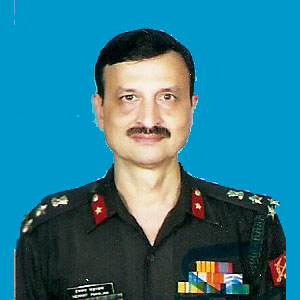
BRIG Hemant Mahajan
Passionate writer on National Security related issues, Brig Hemant Mahajan YSM (Retd) is M Sc, M Phil in Defence Studies. He joined IMA Dehradun in July 1973 and passed out as a Commissioned Officer on 15 June 1975. He was commissioned into 7 MARATHA LIGHT INFANTRY. He has served extensively in Counter Insurgency Operations in Insurgency and Terrorist prone areas of Jammu & Kashmir, Punjab and North East and has taken part in all important operations undertaken by the Army since 1975.
Brig Hemant Mahajan served in Jammu & Kashmir, in the deserts of Rajasthan, in Super High Altitude areas of Kargil and Leh, forward areas of Arunachal Pradesh. He was deployed in Punjab in ‘Operation Avert’. He was also involved in maintaining peace post ‘Operation Bluestar’ days in Punjab in the worst affected district of Gurdaspur, Taran Taran and Amritsar.He served in the areas of Darjeeling, Kurseong, Siliguri and Sikkim. He commanded his battalion 7 MARATHA LIGHT INFANTRY in Operation Rakshak in the most difficult areas of Poonch and Rajouri during the times of highest militancy. His unit was responsible for stopping terrorists from Pakistan into Jammu and Kashmir. His unit was awarded Unit Citation, 18 gallantry awards including YSM (gallantry) for the officer.