Opposition's crisis has a name: Congress
NewsBharati 28-Jul-2026 15:45:18 PM
Total Views |


The latest agitation at Jantar Mantar is not merely another protest against the Narendra Modi government. It is a political commentary on the present condition of India's Opposition. Once again, the streets have become the preferred battlefield for parties that have repeatedly failed to challenge the BJP through organisation, ideology and electoral performance. Every agitation is projected as a national movement, every demonstration as a struggle to save democracy. Yet behind these spectacles lies a more uncomfortable truth: the Opposition, led by the Congress, is struggling to redefine its own relevance.
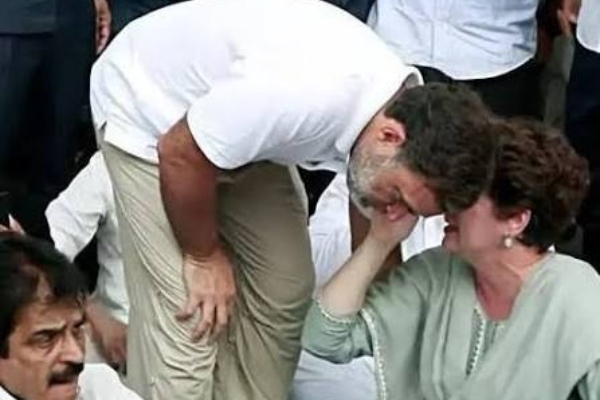 A national political party is expected to shape public opinion, not merely attach itself to every agitation that captures media attention. The Congress once led national movements. Today, it appears content to become a fellow traveller in movements conceived and led by others. Whether it is the anti-CAA protests, the farmers' agitation or the latest mobilisation at Jantar Mantar, the party has increasingly relied on street politics to regain political relevance instead of rebuilding itself from the grassroots.
Rahul Gandhi has emerged as the principal face of this strategy. His political campaigns, yatras and speeches have ensured that he remains one of the country's most visible opposition leaders. But visibility alone does not win elections. Politics ultimately demands organisation, a coherent programme and the ability to convince voters that a credible alternative government is waiting in the wings. Most importantly, the opposition leader badly needs credibility. On all these counts, the Congress continues to face serious questions.
The party has suffered repeated defeats in national elections, but there is little evidence of the kind of organisational overhaul that such setbacks ordinarily demand. Internal restructuring has remained limited, leadership renewal has been slow and dependence on the Gandhi family continues to define the party's identity. Instead of introspection, the Congress often appears to believe that another public agitation will somehow reverse its electoral fortunes. That assumption ignores the transformation of Indian politics over the last decade.
The BJP did not emerge as India's dominant political force by participating in every protest. It built a nationwide organisation, expanded its cadre, strengthened its booth-level machinery and invested in long-term political work. Agree or disagree with its ideology, its rise was rooted in sustained organisational effort. The Congress, by contrast, increasingly appears to search for political shortcuts. Every agitation becomes an opportunity, every protest a possible turning point. But movements cannot substitute for political organisation.
Another disturbing trend is the attempt to shift the centre of political contest from Parliament to the streets. Public protests have a legitimate place in every democracy. They have often corrected governments and influenced public policy. However, when political parties begin to treat agitation as their principal instrument instead of parliamentary debate and electoral mobilisation, democracy itself becomes poorer. Governments are ultimately changed through ballots, not barricades.
The Congress must also recognise that voters today expect more than criticism of the government. They want answers. What is the Congress's economic vision? How does it propose to create jobs? What is its roadmap for education, agriculture, national security and administrative reform? These questions cannot be answered through slogans shouted at protest sites. They require policy, preparation and political credibility.
 The events at Jantar Mantar will soon pass. Another agitation will inevitably replace it, followed by another round of slogans and political theatre. The larger question, however, will remain unanswered. Will the Congress continue to search for political revival in every protest, or will it undertake the difficult task of rebuilding itself as a serious national party?
Until that question is answered, the crisis of India's Opposition will remain, above all, the crisis of the Congress. And Rahul Gandhi's biggest political challenge will not be finding the next agitation to support, but convincing the people of India that his party is once again capable of leading the nation.
Jantar Mantar has become the latest stage where disparate groups, activists and political parties have assembled under the familiar banner of opposing the BJP. The faces may change, the slogans may differ and the immediate demands may vary, but the political script remains remarkably similar. The Congress is invariably present ,sometimes in the front row, sometimes in the background but almost always hoping that public discontent will compensate for its own organisational weakness. This is where the real crisis begins.
ALSO READ: BJP governments to withdraw cases against CJP protesters
The party has suffered repeated defeats in national elections, but there is little evidence of the kind of organisational overhaul that such setbacks ordinarily demand. Internal restructuring has remained limited, leadership renewal has been slow and dependence on the Gandhi family continues to define the party's identity. Instead of introspection, the Congress often appears to believe that another public agitation will somehow reverse its electoral fortunes. That assumption ignores the transformation of Indian politics over the last decade.
The BJP did not emerge as India's dominant political force by participating in every protest. It built a nationwide organisation, expanded its cadre, strengthened its booth-level machinery and invested in long-term political work. Agree or disagree with its ideology, its rise was rooted in sustained organisational effort. The Congress, by contrast, increasingly appears to search for political shortcuts. Every agitation becomes an opportunity, every protest a possible turning point. But movements cannot substitute for political organisation.
The Congress must also recognise that voters today expect more than criticism of the government. They want answers. What is the Congress's economic vision? How does it propose to create jobs? What is its roadmap for education, agriculture, national security and administrative reform? These questions cannot be answered through slogans shouted at protest sites. They require policy, preparation and political credibility.
The irony is that repeated agitations may temporarily embarrass the government, but they have done little to restore the Congress as a national alternative. Instead, they have reinforced the perception that the party depends more on anti-government movements than on its own organisational strength. A party that once mobilised the nation now often appears to be following movements rather than leading them.
A strong democracy unquestionably needs a strong Opposition. The government must be questioned, challenged and held accountable. But an effective Opposition is not built on permanent agitation alone. It is built on ideas, organisation, leadership and public trust. Street protests may create headlines; they cannot by themselves create governments.
ALSO READ: 'Dipke is avatar of Lord Vishnu,' Uddhav Thackeray's insane comparison cracks internet, video viral
Until that question is answered, the crisis of India's Opposition will remain, above all, the crisis of the Congress. And Rahul Gandhi's biggest political challenge will not be finding the next agitation to support, but convincing the people of India that his party is once again capable of leading the nation.

Editor's Desk
Editor's Desk