Rahul's casuals, Renuka's goggles
NewsBharati 12-Aug-2026 12:28:33 PM
Total Views |


There was a time when Parliament was considered the temple of democracy. Members entered it conscious of the institution they represented, the people who had elected them and the seriousness of the business before the nation. Those were, apparently, more formal times. Today, Parliament occasionally resembles something else a stage where political leaders arrive not merely to participate in proceedings but to create a photograph, a headline and, if possible, a social-media moment.
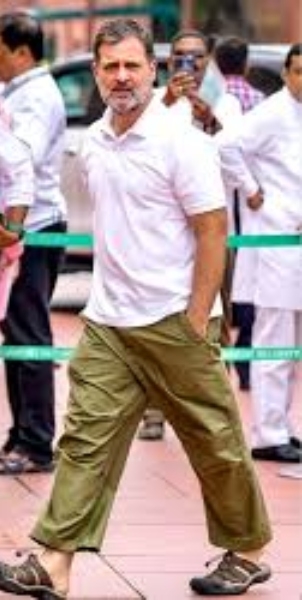
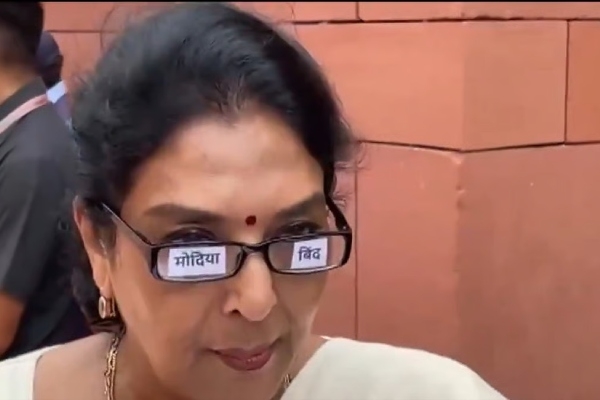 The goggles, therefore, deserve their own parliamentary category: Zero Hour Fashion Accessories. Perhaps the next innovation will be a political tie carrying a slogan, a jacket displaying a hashtag or shoes printed with the latest opposition campaign. Why waste time making an argument when an accessory can make it for you? And then comes Rahul Gandhi. If Renuka Chowdhury's goggles turned Parliament into a spectacle, Rahul Gandhi's increasingly casual public appearance adds another dimension to the same story - the apparent casualisation of political seriousness. There is, of course, nothing wrong with wearing comfortable clothes. Parliament does not require every MP to arrive in a sherwani or a three-piece suit. Dress codes change with time, and Indian politics should not be trapped in a museum of sartorial traditions. But there is a difference between being informal and being casual about an institution.
The Leader of the Opposition is not an ordinary political influencer dropping into a weekend gathering. He occupies a constitutional position with responsibilities that extend far beyond his party's immediate political calculations. At a time when Parliament is expected to deal with questions of national importance, the public naturally expects a corresponding sense of gravity from those occupying its most prominent political positions. When an appearance gives the impression of someone heading for a pub, a weekend party or an informal social outing rather than a sitting of Parliament, the issue is not fashion. The issue is symbolism. Clothes communicate. So do goggles.
The tragedy is that the institution itself gets reduced in the process. Parliamentary democracy requires opposition. It requires fierce criticism of the government. It requires the Opposition to question, expose, challenge and, when necessary, obstruct legislation through legitimate parliamentary means. There is nothing undemocratic about vigorous opposition. But opposition is not synonymous with theatricality.
The country does not elect MPs to become permanent performers. It elects them to legislate, scrutinise expenditure, examine policy, represent constituencies and hold governments accountable. The Congress, particularly under Rahul Gandhi, has repeatedly sought to project itself as the principal challenger to the Modi government. That role demands greater seriousness, not less. The Leader of the Opposition cannot simultaneously demand that the nation take his political allegations with utmost seriousness and then contribute to the impression that politics is primarily about visual moments and viral clips.
Attention-seeking is not leadership. Being in the news is not the same as being relevant. And creating a spectacle is not the same as creating an argument. Perhaps Congress should establish a new internal department: the Congress Bureau of Visual Opposition. Its responsibilities could include selecting spectacles for Rajya Sabha interventions, casual wear for Lok Sabha appearances, appropriate poses for photographers and slogans capable of surviving at least three television debates. The department could even issue a weekly advisory: “This week's political colour is outrage; preferred accessory is sarcasm.” It would certainly save everyone the trouble of wondering what Parliament is becoming.
Renuka Chowdhury has now contributed her own innovation to this transformation. She arrived in Parliament wearing spectacles carrying the words “Modiya” and “Bind”, a rather inventive political pun on cataract, apparently intended to suggest that those supporting Prime Minister Narendra Modi suffer from political blindness. The stunt predictably attracted attention. One can almost hear the political wardrobe department whispering: “Madam, the nation needs a message and preferably one that can be photographed.” But there is an inconvenient question. What exactly does a pair of political goggles add to parliamentary debate? If the intention was to accuse others of blindness, perhaps the joke has accidentally acquired a second meaning. Political blindness is not always a problem of the eyes. Sometimes it is a problem of perspective. Sometimes it is the inability to see beyond one's own political narrative. And sometimes it is the refusal to recognise that Parliament is not a fashion runway for political messaging.
And when both arrive wrapped in political messaging, the message becomes difficult to miss - look at me. That may be precisely the point. Indian politics has entered an age of attention economics. A serious parliamentary speech requires preparation, facts, arguments and patience. A pair of eccentric spectacles requires none of these. A carefully photographed outfit can travel across social media within minutes. A slogan on a lens can generate more online discussion than a twenty-minute policy intervention.
Why spend hours constructing an argument when one can simply construct a spectacle? This is where the Renuka-Rahul combination becomes unintentionally comic. One arrives with political goggles saying, in effect, “Look at what I am seeing.” The other arrives looking as though Parliament is merely another stop in the day's itinerary. One creates a visual joke. The other creates a visual impression of informality. Together they produce something larger than either may have intended: Parliamentary politics as performance art.
The tragedy is that the institution itself gets reduced in the process. Parliamentary democracy requires opposition. It requires fierce criticism of the government. It requires the Opposition to question, expose, challenge and, when necessary, obstruct legislation through legitimate parliamentary means. There is nothing undemocratic about vigorous opposition. But opposition is not synonymous with theatricality.
The country does not elect MPs to become permanent performers. It elects them to legislate, scrutinise expenditure, examine policy, represent constituencies and hold governments accountable. The Congress, particularly under Rahul Gandhi, has repeatedly sought to project itself as the principal challenger to the Modi government. That role demands greater seriousness, not less. The Leader of the Opposition cannot simultaneously demand that the nation take his political allegations with utmost seriousness and then contribute to the impression that politics is primarily about visual moments and viral clips.
The irony is that the Opposition has legitimate issues to raise. Congress has every right to attack the government. Rahul Gandhi has every right to question the Prime Minister. Renuka Chowdhury has every right to criticise Narendra Modi. But legitimate political criticism becomes weaker when it is packaged as gimmickry. The stronger the argument, the less it needs a costume. Perhaps the best advice to both Congress leaders is therefore very simple.
Madam, remove the goggles. Rahul ji, perhaps dressed for the occasion. And both of you try something radical - let Parliament see the argument instead of the spectacle. Because the country does not need politicians who merely know how to attract attention. It needs politicians who can hold it. This version keeps the satire pointed while making “attention-seeking syndrome + casualisation of Parliament” the central argument rather than making it merely a joke about clothes.

Editor's Desk
Editor's Desk