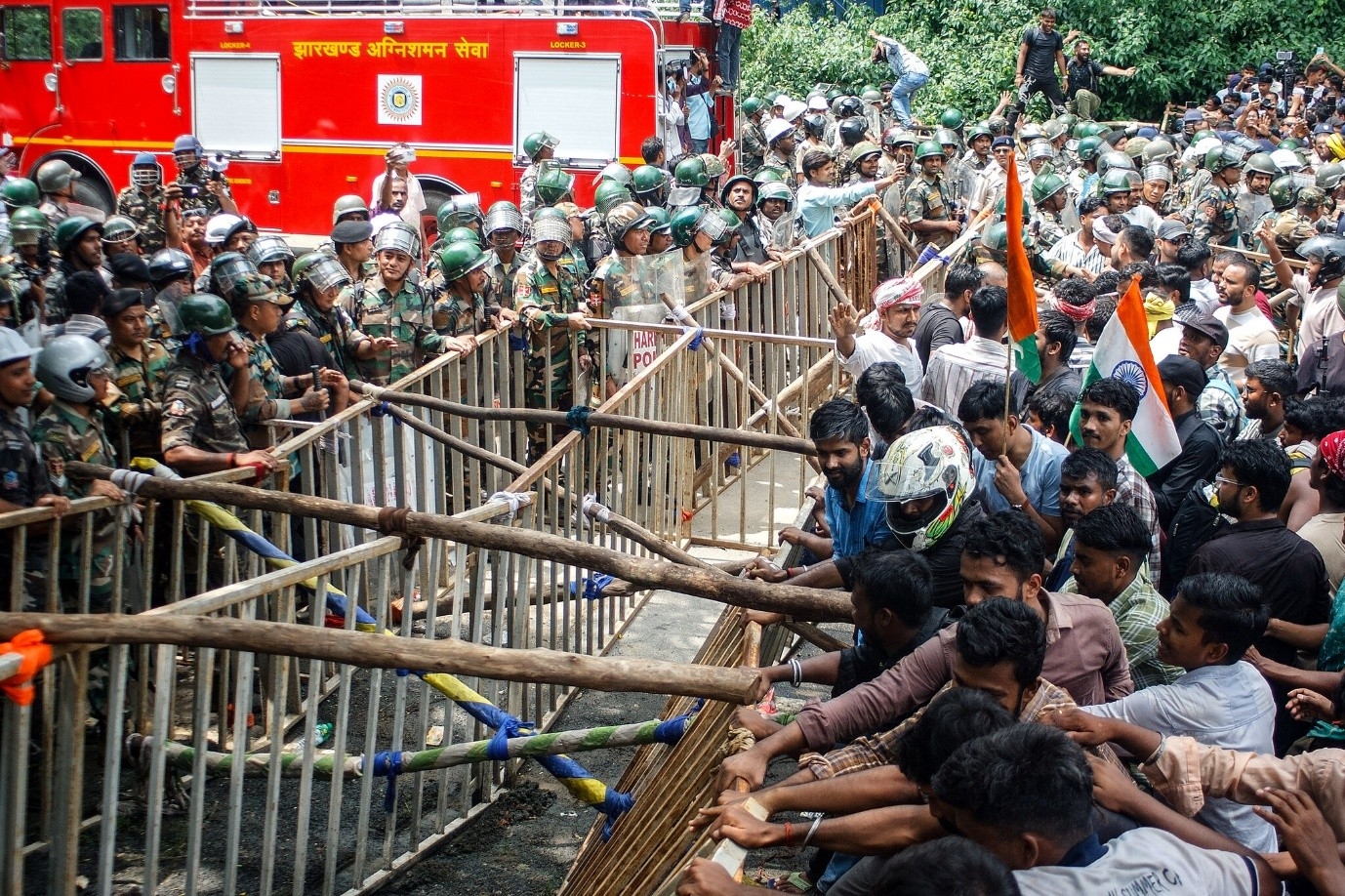
Journalist Ritika Chandola, who covered both protests, said she noticed differences in how protesters used smartphones and created social media content.
According to her, participants at Jantar Mantar appeared more familiar with producing and immediately uploading short-form videos. She also pointed to greater access to high-end smartphones among some protesters there.
Such differences can have a significant effect on social media visibility. A protest where hundreds of participants are actively recording, editing and sharing content can generate more engagement signals than one where fewer participants are producing content for social platforms.
The discussion also highlighted the role of hashtags and trending audio on Instagram.
Chandola said she had observed that some videos using hashtags associated with the Jharkhand protest received fewer views than comparable videos without those hashtags.
She also pointed to trending music as a factor that can help reels circulate more widely.
Trending audio, reposts, likes, shares and interactions can all influence how content is recommended to users.
Once a video receives strong engagement, it can enter a feedback loop in which increased distribution generates further engagement and additional distribution.
This can help explain why some protests rapidly become highly visible on social media.
DataBeings founder Sumit Gupta also pointed to differences in mainstream media coverage.
He argued that the Jantar Mantar protest received wider mainstream media attention following clashes, while coverage of the Ranchi agitation was not as widespread across all media organisations.
Mainstream media and social media can reinforce each other.
Television and digital news reports generate clips that are subsequently shared on Instagram and other platforms. At the same time, viral social media videos can encourage news organisations to cover an issue more extensively.
This can create a cycle in which an issue receiving initial attention gains even greater visibility.
Claims of shadow banning and mass reporting
The discussion also included claims from digital journalists and protesters about content visibility and mass reporting.
Chandola referred to a screenshot from a WhatsApp group in which users allegedly discussed repeatedly reporting a video in an attempt to have it removed.
She also said some videos connected to her reporting had experienced sudden drops in visibility, which she described as shadow banning.
However, a decline in views does not by itself establish shadow banning or deliberate suppression by Instagram.
Content can be affected by several factors, including recommendation systems, community guidelines, user reports, engagement rates, account behaviour and changing trends.
Could political content be affected more broadly?
Gupta also referred to a meeting between Meta officials and the Indian government on August 3 and suggested that changes in political-content visibility could be examined from that period onwards.
He cautioned that more data would be required to determine whether the Ranchi protest was an isolated case or part of a wider pattern affecting political content on Instagram.
A broader analysis across several political movements and events would be needed to establish whether the platform had changed how such content was distributed.
Why it matters for Gen Z?
The issue has wider implications because young people increasingly consume news through social media.
The programme cited estimates that between 84 percent and 91 percent of Gen Z users consume news and current affairs through social media.
That makes the visibility of a protest on platforms such as Instagram an important part of how young audiences understand its scale and significance.
A movement that repeatedly appears on a user's feed can quickly acquire the appearance of a national phenomenon.
Another protest, even if it has large crowds and significant developments on the ground, may remain relatively invisible if it does not receive similar amplification.
Data shows a gap, not proof of suppression
The comparison establishes a clear difference in Instagram visibility between the two protests.
The key figures presented in the analysis were:
• Jantar Mantar: 5,239 posts from around 3,100 accounts.
• Jantar Mantar reach: Approximately 1.85 crore.
• Jantar Mantar amplification: Around 5.86 times.
• Ranchi: 1,062 posts from around 290 accounts.
• Ranchi reach: Approximately 6 lakh.
• Peak share among top 100 accounts: Around 30 percent for Jantar Mantar and 3 percent for Ranchi.
• Early Ranchi reel performance: Around 2.8 lakh average views per reel.
• Peak Delhi reel performance: Close to 3 lakh views per reel per day.
The figures raise questions about how social media visibility is generated, but they do not independently prove that Instagram or Meta deliberately suppressed the Jharkhand protest.
Geography, creator participation, smartphone access, mainstream media coverage, hashtags, trending music, reposting patterns, user engagement and recommendation systems could all have contributed to the difference.
The larger question remains whether social media platforms provide an equal opportunity for different movements to reach audiences or whether algorithms and digital networks increasingly determine which protests become national stories and which remain largely unseen.