Is Meta deliberately promoting politically sensitive acts against India? All you need to know about new viral 'Dimagi Naxal Party' after CJP
The online reaction traces back to Modi"s Independence Day speech from the Red Fort, where he said the government had largely dismantled armed Maoist insurgency and reclaimed territory once affected by Naxal violence, but argued that the threat had not vanished, only changed form.
Total Views |


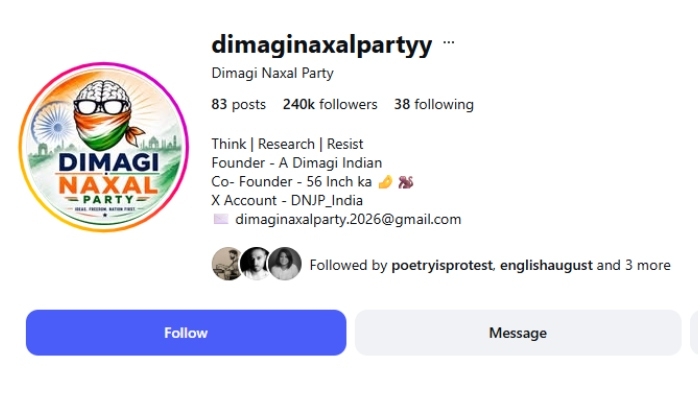
A satirical Instagram account called "Dimagi Naxal Party" has appeared just a day after Prime Minister Narendra Modi used the phrase in his Independence Day address, racking up more than 240k followers within hours of launching, as of Monday, August 17.


Despite this, the identity of the people behind the account remains unclear.
Its Instagram bio simply describes the founder as "a dimagi Indian."

In one caption, the group wrote: "We are Followers of Bhagat Singh… If THEY try to suspend our accounts or label us Anti-Nationals, just know, they are disrespecting Bhagat Singh." It seems that the CJP made the Indian Constitution and Dr Babasaheb Ambedkar the shield, and now Digital Naxal Party might end up making Bhagat Singh the shield.
The account has also spawned a wave of posts drawing parallels between Modi's "dimagi Naxal" remark and the concept of "thought crime" from George Orwell's dystopian novel 1984. In one caption, the page quotes a line from the book itself, describing a "dimagi Naxal" as "a mind that can identify systematic patterns of oppressive regimes."
What sparked the row

Union Minister Kiren Rijiju clarified that Modi was not targeting opposition leaders, saying the term referred to those who support Maoist ideology, reject the Constitution, back separatism, favour Article 370 or advocate cutting the “chicken neck” linking the Northeast with the rest of India.

When political visibility is shaped not by authentic public engagement but by opaque algorithmic decisions or paid promotion, it strikes at the core of a healthy democratic information ecosystem. This is no longer a conversation about ordinary social media marketing; it touches on transparency, accountability, and the risk of external influence over India's political processes.
Some questions that Meta needs to answer
1. Why did Meta reportedly stay silent on the amplification of content tied to the CJP campaign, even though concerns were said to have been flagged before the Parliamentary Committee?
2. What internal parameters govern when Meta chooses to boost political content, and who has the authority to greenlight such interventions?
3. If the amplification is tied to commercial deals, who funds these campaigns like CJP or now the new DNP, and what checks exist to stop money from shaping political narratives?
4. If Meta's recommendation algorithms end up disproportionately amplifying content critical of the elected Modi government, is that purely an automated by-product or the result of deliberate editorial or algorithmic choices?
These aren't just technical concerns. At their core, they raise a far bigger question; can a private multinational corporation shape political opinion in a country without being answerable for how it does so?
Positioning itself as an online satirical collective, the account appears to draw inspiration from the earlier "Cockroach Janta Party" movement. Among its first posts is a tongue-in-cheek list of "membership criteria," topped by the line: "you can join our party only if you can disagree with your own leaders."
The page went briefly offline on Monday, with its administrators claiming on X that it had come under "cyber attacks." The disruption only fuelled its visibility further, as numerous accounts reshared the page on their Instagram stories, urging followers to "follow before it gets taken down."
Among the followers are 240k-plus people, but the Instagram page follows several leftists, anti-Hindu, anti-India pupils like Neha Bora, Kunal Kamra, Vijeta Dahiya, YouTuber Shyam Meera Singh, Ravish Kumar, CJP Spokesperson Ashutosh Ranka, Anurag Kashyap, Prakash Raj, Dhruv Rathee, CJP's Sourav Das, Abhijeet Dipke, Sonakshi Sinha, and Cockroach Janata Party. The list evidently showcases how Dimagi Naxal Party is a potential subordinate of the CJP.
Despite this, the identity of the people behind the account remains unclear.
Its Instagram bio simply describes the founder as "a dimagi Indian."
The page's tagline reads: "We think. We research. We resist," and its posts frame the account as inspired by the ideology of revolutionary freedom fighter Bhagat Singh.
In one caption, the group wrote: "We are Followers of Bhagat Singh… If THEY try to suspend our accounts or label us Anti-Nationals, just know, they are disrespecting Bhagat Singh." It seems that the CJP made the Indian Constitution and Dr Babasaheb Ambedkar the shield, and now Digital Naxal Party might end up making Bhagat Singh the shield.
The account has also spawned a wave of posts drawing parallels between Modi's "dimagi Naxal" remark and the concept of "thought crime" from George Orwell's dystopian novel 1984. In one caption, the page quotes a line from the book itself, describing a "dimagi Naxal" as "a mind that can identify systematic patterns of oppressive regimes."
What sparked the row
The online reaction traces back to Modi's Independence Day speech from the Red Fort, where he said the government had largely dismantled armed Maoist insurgency and reclaimed territory once affected by Naxal violence, but argued that the threat had not vanished, only changed form.
The Prime Minister stated that individuals sympathetic to Maoist ideology had, for years, held influential positions within government structures, including advisory roles on official committees, and had used that access to shape public policy from within. "For years, people with a Maoist mindset sat occupying spaces within the corridors of power in the country. Even as advisors in government committees, this Maoist mindset influenced policies," Modi said, a remark that has since triggered a wider political and social media debate over what he termed "dimagi Naxalism."
The remark drew controversy over 48 hours, with senior Congress leader P. Chidambaram saying, "I am proud to be a dimagi naxal". AAP leader Arvind Kejriwal also stated that he was proud to be a 'Dimagi Naxal'.
Union Minister Kiren Rijiju clarified that Modi was not targeting opposition leaders, saying the term referred to those who support Maoist ideology, reject the Constitution, back separatism, favour Article 370 or advocate cutting the “chicken neck” linking the Northeast with the rest of India.
"Very unfortunate and highly damaging statement by respected former Home Minister of India," Rijiju said in another post on X, with the correct numbers of the three points that he had earlier listed to explain who are 'dimagi Naxals'. BJP MP Ravi Shankar Prasad also condemned Chidambaram's remark, calling it "utterly irresponsible".
It is important to note that Instagram is owned by Meta, the American company founded by Mark Zuckerberg, who recently apologised over lapses in policies it used in running its platforms, including Facebook. Fresh revelations about how Meta amplifies content on its platforms have raised pressing questions about the influence global tech companies wield over political conversation in India. The company's own admissions, combined with a parliamentary panel's scrutiny, have deepened worries over whether specific campaigns were pushed to audiences far wider than their organic reach would justify.
When political visibility is shaped not by authentic public engagement but by opaque algorithmic decisions or paid promotion, it strikes at the core of a healthy democratic information ecosystem. This is no longer a conversation about ordinary social media marketing; it touches on transparency, accountability, and the risk of external influence over India's political processes.
Some questions that Meta needs to answer
1. Why did Meta reportedly stay silent on the amplification of content tied to the CJP campaign, even though concerns were said to have been flagged before the Parliamentary Committee?
2. What internal parameters govern when Meta chooses to boost political content, and who has the authority to greenlight such interventions?
3. If the amplification is tied to commercial deals, who funds these campaigns like CJP or now the new DNP, and what checks exist to stop money from shaping political narratives?
4. If Meta's recommendation algorithms end up disproportionately amplifying content critical of the elected Modi government, is that purely an automated by-product or the result of deliberate editorial or algorithmic choices?
These aren't just technical concerns. At their core, they raise a far bigger question; can a private multinational corporation shape political opinion in a country without being answerable for how it does so?