Neha Bora: A new face, but an old ideology
NewsBharati 25-Aug-2026 14:50:46 PM
Total Views |


India has just been given a glimpse of a disturbing form of political intolerance - defeat your opponent at the ballot box if you can; if you cannot, question his right to exist. Neha Bora, national president of the All India Students’ Association (AISA), provided that glimpse in Bengaluru on Monday. Speaking at a youth gathering, she said that merely defeating the BJP was not enough. What would be enough, she said, was when the “BJP-RSS system would have been uprooted from the soil of this country.” She also spoke of a future with “no place” for the RSS and BJP. Bora called for a “Second War of Independence”.
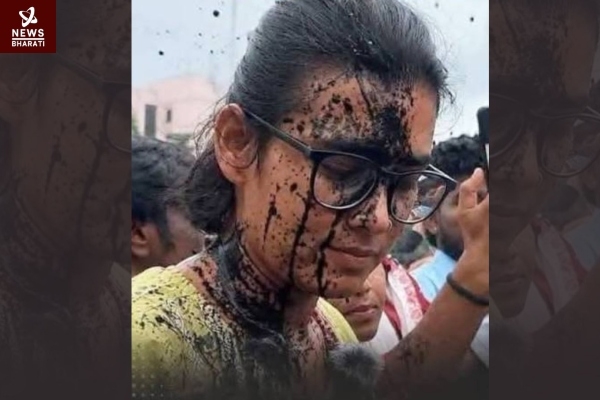 AISA is not a spontaneous Gen Z platform that appeared with the latest student protests. It was founded on August 9, 1990, at Allahabad University and describes itself as a “revolutionary students movement”. Its manifesto speaks of Marxism, revolutionary transformation and draws an ideological connection with the tradition of the Naxalbari movement. It also identifies CPI(ML) Liberation as its political ideological reference. Ideology matters when its national leader speaks of uprooting an established social organisation from Indian soil. CPI(ML) Liberation itself traces its political lineage to the Naxalbari uprising and the Marxist-Leninist tradition. The background therefore cannot simply be ignored.
Bora is a JNU PhD scholar and national president of AISA. She became prominent during the Jantar Mantar student mobilisation and subsequently emerged as one of the visible faces of the wider GenZ campaign. That makes her words politically significant. She is not merely a student expressing personal frustration. She is the national president of an organised ideological movement. And there is no need to invent mysterious “handlers” to understand the ecosystem, on which Its relationship with the Left movement is public. Its leadership structures are public. Bora went beyond calling for BJP's electoral defeat. She spoke of defeating the RSS and its ideology within shared spaces and of a future in which there would be “no place” for the RSS or BJP. This distinction is fundamental.
The history of the Left in India shows a deep intolerance towards organisations and movements that work for Hindutva. Kerala and West Bengal remain enduring examples of this political and ideological hostility. The contradiction is striking: communists speak constantly of democracy and pluralism but often struggle to tolerate political and intellectual opposition, particularly when it challenges their ideological dominance. The Real DNA of Dictatorship. Dictatorship does not always begin by abolishing elections. Sometimes it begins with something more basic: the belief that the opponent is not legitimate enough to exist. That is why Bora's statement deserves scrutiny.
Today the target is the RSS. Tomorrow another organisation could be declared intolerable. The vocabulary changes; the principle remains. The irony is glaring. AISA speaks of democracy while its national president speaks of a future with “no place” for one of India's most established social organisations. Democracy cannot mean freedom for my ideology and extinction for yours. The RSS does not need Neha Bora's permission to exist. It does not need AISA's approval or the Left's certificate. It needs only the constitution, the law and the voluntary participation of citizens. If millions of Indians choose to associate with the RSS, nobody has the democratic authority to declare that association illegitimate merely because they dislike its ideology. Neha Bora is free to speak but India must ask a very simple question: When does “defeat the BJP” become “uproot the RSS”? When does political opposition become ideological eradication? And when does the language of revolution reveal its authoritarian instinct? The answer matters. Nobody has the constitutional or moral right to declare that the RSS has no place in India. That is not democracy.
Neha Bora’s politics must be seen against a larger historical backdrop. The gun of Naxalism has lost its ideological legitimacy, while Communism itself is steadily withering away as a political force. What remains is the attempt to revive the same intolerance through new faces, new vocabulary and new platforms. But history has moved on. India has rejected political violence and ideological absolutism, and no recycled version of either can permanently defeat the democratic and civilisational forces of the nation.
There is nothing undemocratic about saying: defeat the BJP. Political parties win elections and lose elections. But the RSS is not a political party competing for parliamentary seats. It is a voluntary social/cultural organisation. It has the same constitutional right to organise, associate, speak and carry forward its activities as any other lawful organisation. AISA has every right to propagate Marxism. The RSS has every right to propagate its own social and cultural philosophy. AISA can campaign against the RSS. The RSS can challenge AISA's ideology. The young comrade has seriously failed to understand the core of democratic values.
ALSO READ: Allahabad HC upholds school uniform rules, rejects plea to wear hijab
A government can be removed. A party can be defeated. An ideology can be challenged. But a lawful organisation cannot be democratically declared unwanted.
If Bora believes the RSS is wrong, she should defeat its ideas through argument. If AISA believes BJP policies are wrong, it should defeat BJP through elections. If the Left believes India needs revolutionary transformation, it should persuade Indians to accept that transformation. That is democracy.
Neha Bora’s politics must be seen against a larger historical backdrop. The gun of Naxalism has lost its ideological legitimacy, while Communism itself is steadily withering away as a political force. What remains is the attempt to revive the same intolerance through new faces, new vocabulary and new platforms. But history has moved on. India has rejected political violence and ideological absolutism, and no recycled version of either can permanently defeat the democratic and civilisational forces of the nation.
Satyajit Shriram Joshi
Satyajit Shriram Joshi is Pune based senior journalist.