India’s Higher Education Network Expands Sharply Over the Decade, AISHE Data Shows
Total Views |


New Delhi , August 31: India’s higher education ecosystem has witnessed significant expansion over the past decade, with a sharp rise in the number of universities, colleges, student enrolment, female participation, faculty strength and infrastructure, according to data from the All India Survey on Higher Education (AISHE) conducted annually by the Ministry of Education.
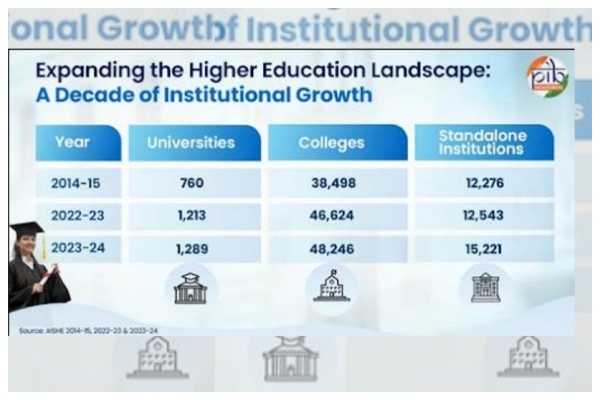
The growth aligns with the vision of the National Education Policy (NEP) 2020, which seeks to promote holistic, multidisciplinary and inclusive education while supporting Sustainable Development Goal (SDG) 4, aimed at ensuring inclusive and equitable quality education and lifelong learning opportunities.
India’s higher education sector has witnessed significant growth over the past decade, with total student enrolment rising 31.5% from 3.42 crore in 2014–15 to 4.50 crore in 2023–24. The Gross Enrolment Ratio (GER) also improved from 23.7% to 30%, bringing the country closer to the NEP 2020 target of 50% GER by 2035.
ALSO READ: "The Ancient Wisdom Behind Dr. Bhagwat’s US Speech”
Research and advanced education have recorded particularly strong growth. PhD enrolment nearly tripled, rising from 1.17 lakh to 3.43 lakh, while integrated programme enrolment grew more than threefold.
Female participation has grown faster than overall enrollment, increasing 42.2% from 1.57 crore to 2.24 crore during the decade. Female GER rose from 22.9% to 31.2%, surpassing the male GER of 28.9% for the seventh consecutive year.
The Gender Parity Index (GPI) improved from 0.92 to 1.08, indicating greater participation of women in higher education. Participation among SC, ST and OBC students has also increased, with their respective shares and GERs showing notable improvement.
Enrolment in Science, Technology, Engineering and Mathematics (STEM) increased from 91.5 lakh to 1.02 crore, reflecting growing interest in technology and research-oriented education.
India’s appeal as an international education destination has also strengthened, with foreign student enrolment rising from 42,293 to 58,134 over the decade.
ALSO READ: Jan Dhan: When the Last Layer Entered the Economy
The higher education teaching workforce expanded from 14.73 lakh to 17.32 lakh, while the number of female teachers increased by 36.7%. Their share of the teaching workforce rose to 44.9% in 2023–24.
Infrastructure has improved as well, with libraries available in 98% of universities, colleges and standalone institutions. A large majority also have playgrounds and laboratories, indicating continued investment in campus facilities.
Overall, the data points to a larger, more inclusive and increasingly future-ready higher education ecosystem, with stronger participation by women and disadvantaged communities and growing emphasis on STEM, research and global engagement.