The Uzbekistan nobody wanted to talk about: A closer look at the country now being held up as a compliment
Strict secular rules of Uzbekistan on religion expose the irony in recent political praise
Total Views |


When the Indian Prime Minister was handed the highest state honour, the Order of “Oliy Darajali Dustlik” (Order of "Highest Degree of Friendship"), by President Shavkat Mirziyoyev of Uzbekistan during on August 30, 2026, a familiar voice back home turned it into a jibe. The Prime Minister, the remark went, keeps returning from foreign trips with awards and how ironic that the very land Babur came from was now honouring a man whose supporters, the speaker suggested, had spent years running Babur down. It was meant as a clever dig. But it was, at best, half the story.
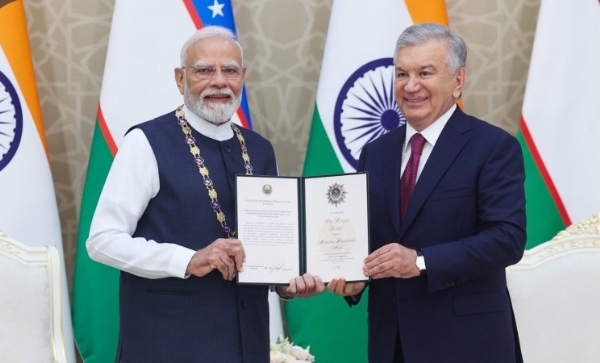
Image Source: PMO India
Because if you actually look at what Uzbekistan is, how its government treats religion in public life, the compliment starts to look a little uncomfortable for the person who made the remark. This is a country that has spent decades building exactly the kind of strict, secular state that many of the same voices would call unacceptable if it were ever attempted in India.
Start with clothing. In 2023, Uzbekistan’s President signed a law banning face-covering garments like burqas in public, with fines running into hundreds of dollars for anyone who hides their face in a way that makes identification impossible. The official reason given was public order and a city surveillance system. The hijab itself sits in a grey zone: a 2021 law lifted the old blanket ban on religious dress in public, yet in practice schools and many government offices still keep headscarves out. In the Tashkent region, teachers have reportedly been told to stand at the school gate each morning and ask girls to remove their scarves before stepping inside. Imagine that scene playing out at a school here. Last time a headscarf was denied in school premises in India, political victimhood drama was unleashed by Islamists and liberals in India.
Also Read: When a Muslim-Majority Nation Says No to the Hijab
Then there is the harder machinery of the state. Uzbekistan doesn’t just discourage political Islam, it outlaws it. The country’s constitution blocks the formation of political parties on religious lines and the government keeps a long list of banned organisations. According to the U.S. State Department’s religious freedom report, that list includes the Muslim Brotherhood, Hizb ut-Tahrir, the Islamic Movement of Uzbekistan and around twenty other groups. Merely belonging to one of them is a crime. Hizb ut-Tahrir, a group that campaigns for a global caliphate was banned by Uzbekistan’s Supreme Court in 2016 and police still round up suspected members in raids across the country.
The control goes right down to the mosque. Religious life is supervised by a state Committee on Religious Affairs working alongside the official Muslim Board. Only registered mosques and approved clerics may operate and the government has a heavy hand in who gets appointed to lead prayers. Owning or sharing banned Islamist literature or videos can bring raids, fines or prison. This is not a live-and-let-live arrangement; it is a system designed to keep organised religion firmly under the thumb of the state.
It doesn’t stop there, copies, translations and publications of the Quran in Uzbekistan must be checked, approved and regulated by state authorities before they can be legally printed, imported, or distributed. The secular government of Uzbekistan exercises tight oversight over all religious literature to prevent the spread of extremism and ensure text accuracy. Imagine this being done in India and the uproar that would create.
The same firmness shows up on the street. In October 2023, as anger over Gaza spread through much of the Muslim world, activists tried to hold a pro-Palestine rally in Tashkent’s Amir Temur Square. The authorities simply didn’t allow it. Around a hundred people were detained and three of them were handed the maximum 15 days in jail for taking part in an unsanctioned gathering. The government offered its sympathy for Palestinians and sent aid but an unapproved crowd chanting in the capital square was not on the menu. A secular state, the message ran, decides when and how faith spills into public protest. And this is a Muslim majority country.
There is one more silence worth naming. Uzbekistan is home to a deep-rooted Uyghur community, yet open discussion of China’s treatment of Uyghurs in Xinjiang is effectively off-limits. Keeping Beijing close matters more to Tashkent than airing solidarity, so the subject stays quiet. Religious sympathy, once again, bends to the interests of the state.
Put all of this together and a picture emerges that the original jibe conveniently left out. The people praising Uzbekistan as a badge of honour rarely mention that this is a country which fines you for covering your face, keeps scarves out of classrooms, jails you for an unapproved protest, licenses your imam and bans the very political-Islam outfits that some back home treat as ordinary civil society. Uzbekistan doesn’t merely tolerate a firm, secular public square, it enforces one.
And that is the real awkwardness. If even a fraction of these measures, a face-veil ban, scarves barred from schools, tight limits on religious politics were proposed in India, the loudest cheerleaders for Uzbekistan would very likely be the first to cry foul. It is easy to admire a country from a distance and turn its honours into a talking point. It is harder to look at how that country actually runs and ask whether you would accept the same at home.
As for Babur: the man was pushed out of Ferghana by his own kinsmen, drifted to Kabul and from there marched into India. Whatever one makes of that history, the country he left behind has, in our own time, built something its admirers might not recognise and might not want. It's a modern evolved state which is moving fast with the world and is not in the clutches of political Islam. Perhaps the honour says less about the past than about a present that many would rather not examine too closely.
Start with clothing. In 2023, Uzbekistan’s President signed a law banning face-covering garments like burqas in public, with fines running into hundreds of dollars for anyone who hides their face in a way that makes identification impossible. The official reason given was public order and a city surveillance system. The hijab itself sits in a grey zone: a 2021 law lifted the old blanket ban on religious dress in public, yet in practice schools and many government offices still keep headscarves out. In the Tashkent region, teachers have reportedly been told to stand at the school gate each morning and ask girls to remove their scarves before stepping inside. Imagine that scene playing out at a school here. Last time a headscarf was denied in school premises in India, political victimhood drama was unleashed by Islamists and liberals in India.
Also Read: When a Muslim-Majority Nation Says No to the Hijab
Then there is the harder machinery of the state. Uzbekistan doesn’t just discourage political Islam, it outlaws it. The country’s constitution blocks the formation of political parties on religious lines and the government keeps a long list of banned organisations. According to the U.S. State Department’s religious freedom report, that list includes the Muslim Brotherhood, Hizb ut-Tahrir, the Islamic Movement of Uzbekistan and around twenty other groups. Merely belonging to one of them is a crime. Hizb ut-Tahrir, a group that campaigns for a global caliphate was banned by Uzbekistan’s Supreme Court in 2016 and police still round up suspected members in raids across the country.
The control goes right down to the mosque. Religious life is supervised by a state Committee on Religious Affairs working alongside the official Muslim Board. Only registered mosques and approved clerics may operate and the government has a heavy hand in who gets appointed to lead prayers. Owning or sharing banned Islamist literature or videos can bring raids, fines or prison. This is not a live-and-let-live arrangement; it is a system designed to keep organised religion firmly under the thumb of the state.
It doesn’t stop there, copies, translations and publications of the Quran in Uzbekistan must be checked, approved and regulated by state authorities before they can be legally printed, imported, or distributed. The secular government of Uzbekistan exercises tight oversight over all religious literature to prevent the spread of extremism and ensure text accuracy. Imagine this being done in India and the uproar that would create.
The same firmness shows up on the street. In October 2023, as anger over Gaza spread through much of the Muslim world, activists tried to hold a pro-Palestine rally in Tashkent’s Amir Temur Square. The authorities simply didn’t allow it. Around a hundred people were detained and three of them were handed the maximum 15 days in jail for taking part in an unsanctioned gathering. The government offered its sympathy for Palestinians and sent aid but an unapproved crowd chanting in the capital square was not on the menu. A secular state, the message ran, decides when and how faith spills into public protest. And this is a Muslim majority country.
There is one more silence worth naming. Uzbekistan is home to a deep-rooted Uyghur community, yet open discussion of China’s treatment of Uyghurs in Xinjiang is effectively off-limits. Keeping Beijing close matters more to Tashkent than airing solidarity, so the subject stays quiet. Religious sympathy, once again, bends to the interests of the state.
Put all of this together and a picture emerges that the original jibe conveniently left out. The people praising Uzbekistan as a badge of honour rarely mention that this is a country which fines you for covering your face, keeps scarves out of classrooms, jails you for an unapproved protest, licenses your imam and bans the very political-Islam outfits that some back home treat as ordinary civil society. Uzbekistan doesn’t merely tolerate a firm, secular public square, it enforces one.
And that is the real awkwardness. If even a fraction of these measures, a face-veil ban, scarves barred from schools, tight limits on religious politics were proposed in India, the loudest cheerleaders for Uzbekistan would very likely be the first to cry foul. It is easy to admire a country from a distance and turn its honours into a talking point. It is harder to look at how that country actually runs and ask whether you would accept the same at home.
As for Babur: the man was pushed out of Ferghana by his own kinsmen, drifted to Kabul and from there marched into India. Whatever one makes of that history, the country he left behind has, in our own time, built something its admirers might not recognise and might not want. It's a modern evolved state which is moving fast with the world and is not in the clutches of political Islam. Perhaps the honour says less about the past than about a present that many would rather not examine too closely.