National interest is the worst for international interest
There are 195 nations in the world, some very small and some huge, some very rich, some very poor, but each needs to survive.
NewsBharati 04-Aug-2026 11:52:43 AM
Total Views |


"The love of one's country is a splendid thing. But why should love stop at the border?" — Pablo Casals
Nations are as selfish as individuals
When a person applies for a job, he is in a way fighting for survival- his survival and the survival of his family. In a ‘dog eat dog world’, there are twenty applicants for one job and all twenty want to grab it. Therefore, it is a fierce competition. You apply whatever tricks you have up your sleeve to get the job, and why not, - it is saam, daam, dand, bhed. It boils down to ‘I, me, myself ’; that is the philosophy of an individual human being. You seek help from anyone, relative, friend, or your neighbour. You are selfish to the core, and people say Why not. It is survival of the smartest in a way.
Similarly, nations behave as individuals and put ‘self-interest first '–which is called ‘national interest’.
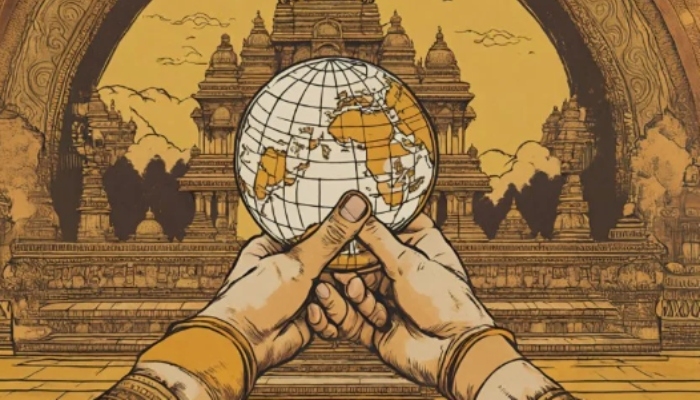
A nation is not a land mass, but it behaves like a living being. If a nation is an organism, its different parts function much like human organs, working together to maintain homeostasis. Citizens are like cells; leadership/government is the head, shared language, values, and media is the nervous system, and it derives its immunity through armed forces, police, and a health system. A healthy nation consumes resources and energy, builds infrastructure, and evolves its systems to support its growing "body." Above all, every nation has a unique spirit or "folk soul". A nation as an organism is a delicate, interconnected ecosystem. When one part suffers, the whole body feels the pain. Therefore, the nation has to preserve itself at all times.
First amongst equals
If there is a fire in a cinema hall, everyone runs for their life; that is how humans or even animals are built. Yet some people help others to save themselves. Since a nation is like a living entity, it first tries to preserve its own being. Some nations that are strong enough do help others in crisis. There are no free lunches amongst nations, too- you get returns in kind or just build strong goodwill to be encashed on a later date.
But each one feels he is the most important.
There are 195 nations in the world, some very small and some huge- some very rich, some very poor, but each needs to survive.
National Interest- what does it mean?
The nation (Rashtra) comes before the narrower kingdom (Rajya), and the ruler is merely the chief servant, duty-bound to protect it.’ Chanakya
National interest is the foundation of a country's foreign policy and security strategy. It refers to a sovereign state's ultimate goals, ambitions, and priorities—essentially, the collective well-being, survival, and advancement of a nation on the global stage.
Most importantly, it has to safeguard its security. It has to be in step with the times and remain aligned with as many nations as possible. Today, nations are so much dependent on each other that no one nation can sideline any other nation. Nations seek to shape their external environment to minimize threats. This includes building strategic alliances, maintaining a balance of power in their region, and participating in international bodies (like the UN or WTO) to ensure global rules don't work against them. Today, global threats like climate change, cyber warfare, pandemics, and supply chain disruptions mean that a country's national interest is increasingly tied to global cooperation and some central body to regulate relations between countries.
A nation's power and internal stability depend heavily on its economic health. Securing economic interests involves safeguarding access to critical resources (like energy and water), maintaining favourable trade routes, securing foreign markets for exports, and fostering innovation to ensure long-term wealth and financial stability.
Often, a country's national interest includes the projection/protection of its core values, culture, or governance model—whether that is promoting democracy, human rights, or historical philosophies. While secondary to physical survival, public diplomacy and cultural capital (often called "soft power") enhance a nation's global standing.
Survival and Security is the most fundamental, non-negotiable aspect of national interest. It encompasses protecting the nation’s physical borders from foreign invasion, maintaining territorial integrity, and ensuring the safety of its citizens. Without security, a state cannot pursue any other goals.
Ultimately, national interest is not static. It is constantly redefined by a country’s leadership, evolving geopolitical realities, and the shifting balance between internal capabilities and external challenges. It is the ultimate North Star that guides how a country acts, reacts, and interacts with the rest of the world.
National interest is worst for international interest
This sounds like an oxymoron because we tend to think of "interests" as universally positive things. How can an interest destroy an interest? But there are strong reasons for this idea.
Here is why that tension exists.
Resources, power, and security are finite. If a Country acts strictly in its own national interest (e.g., hoarding global supply chains, raising tariffs, or aggressively expanding territory), it almost always hurts the international interest (global stability, free trade, and peace).
For instance, most of the Western nations hoarded vaccines during Covid crisis- it did because it was self-preservation- safety of their own people- was paramount for them; they were not bothered about the rest of the world. This was downright selfish.
"Nationalism is an infantile disease. It is the measles of mankind." — Albert Einstein
From this perspective, the two- national and international interest- are inherently incompatible. One country winning means the rest lose. When a country defines its "national interest" purely as isolationism or dominance, it absolutely threatens the international community. The real debate isn't whether the phrase is an oxymoron, but whether nations will ever realize that their own long-term survival depends on the well-being of the whole.
In a globalized world, threats don't stop at borders. Pandemics, climate change, and economic collapses don't care about passports.
Therefore, a country's true national interest is actually served by maintaining a stable, cooperative international system. If the international interest fails, everyone's national interest goes down with the ship.
It has to be cooperation.
‘India says- the world is one family- Vasudeva kutumbakam’ and wishes the world adopts this sanity.
However, it doesn’t always have to be a conflict. Modern international relations often talk about "enlightened self-interest"- or cooperative national interest. This is the idea that a nation can best serve its own people by cooperating globally.
Saints cannot run nations
A saint operates on absolute moral principles—honesty, compassion, non-violence, and total selflessness. A nation, however, operates on power, resource competition, and survival. For example, MK Gandhi was hell-bent on giving Rs 50 crore to Pakistan after partition. This seemed stupid to those who were neither saints nor who thought like saints.
A saint views morality as absolute. But politics is the art of compromise. To pass a law or keep the peace, a leader often has to give something up, cut deals with less-than-honourable figures, or accept a lesser evil. For a pure moralist, that feels like selling your soul.
However, history isn't entirely black and white. While pure, cloistered ascetics rarely make good heads of state, there is a rare hybrid archetype: the statesman-saint or the prophet-reformer.
Think of figures like Nelson Mandela or Abraham Lincoln. While they weren't flawless saints, they injected an uncompromising moral framework into brutal political realities. They proved that while you might need tough, practical strategies to run the day-to-day machinery of a state, a nation without a moral compass eventually loses its legitimacy and crumbles from within.
Ultimately, running a nation might require the street-smart pragmatism of a realist, but without a touch of the saint's vision, a leader is nowhere meaningful to guide the people.
That a saint operates on absolute moral principles—honesty, compassion, non-violence, and total selflessness. A nation, however, operates on power, resource competition, and survival.
When those two worlds collide, a few major friction points tend to emerge.
India's paradox, or catch 22 the state of affairs today.
As a nation, India is progressing rapidly. Like in a class of 40 students in a school, there is inter-student rivalry or even jealousy- especially amongst the top five; backbenchers don’t care. Similarly, among nations in the top five as per the perceived pecking order – mostly judged by the GDP and political stance- there is a race for ‘superiority’. Every nation wants to be in the limelight. It is also important to be good to your people to an extent without losing grip on power and at the same time flex muscles in front of the rest of the world. It is walking on a tightrope.
The Paradox of Force: A state holds a monopoly on the legitimate use of force. To protect its citizens from external threats or internal chaos, a government must be willing to use police power, intelligence operations, and military force. A saintly leader committed to absolute non-harm ( or absolute pacifism) might hesitate to strike, inadvertently leaving the nation vulnerable.
Machiavellian Realism: Niccolò Machiavelli famously argued in The Prince that a ruler who tries to be good in every way will inevitably be ruined by the many who are not good. In his view, a ruler must learn "how not to be good" when necessity demands it, purely to preserve the state.
Be that as it may- a nation’s own interest comes first and always, and that of the others in the world comes next.
“The national interest is predetermined by geopolitics or the history of a country. Important political leaders never just followed their interests – they were concerned about the interests of their people.” — Joseph Nye
Virender Kapoor
A thinker, educationist and an inspirational guru. Kapoor is an Indian who wears many hats. An educationist of repute, he was the Director of a prestigious management Institute under the Symbiosis umbrella. He has emerged as a leading think tank in human behavior, motivation and success. As a celebrity author, his name appears with the likes of Thomas Friedman and Dale Carnegie. He has authored more than 30 books as of now which are on Amazon worldwide and several of his books are in the pipeline.