Book Review: Climate Change 2100- Survive or Thrive
This book paints a grave doomsday scenario with some hard-hitting facts that will stun you. His contention, rightly, is that we may have infinite needs but Earth has finite resources.
NewsBharati 06-Aug-2026 11:35:54 AM
Total Views |


I have known Prof Chetan Singh Solanki since the time he created a Guinness World Record for assembling solar torches across the world in a single day nearly 8 years back. A professor of environment at IITB who had reached this academic level comes from an agriculturist family in a remote village in Madhya Pradesh. He had every reason to keep the job, create some more records, and be happily labelled as a climate crusader. But he is made of different stuff. A married man with two children, he decided that he must not just talk and make a small incremental difference but impact the world with the power of one. He chucked it all and began a campaign to save Mother Earth from the ill effects of climate change in 2020, looking at 2100 as the deadline for a world that could be a livable place or go from bad to worse.
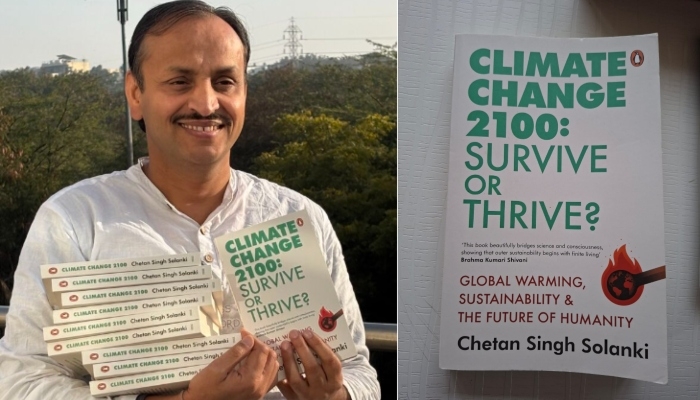
This book, Climate Change 2100 – Survive or Thrive, condenses the essence of those six years of experience. He illustrates with data that unlike past climate shifts that took thousands of years, today’s warming is happening in just a few decades – 100 times faster than any known natural cycle. This book paints a grave doomsday scenario with some hard-hitting facts that will stun you. His contention, rightly, is that we may have infinite needs but Earth has finite resources. So, there is no option but to control our needs.
The fundamental lesson is that our wants and demands may expand, but Earth can produce only finite energy and resources for our satisfaction. At the current pace, we are consuming 1.8 times what Mother Earth can generate. He has launched Finite Earth Movement globally to remind people of the grave future we are staring at.
He gives an example of his experiment in collaboration with Indore Municipal Corporation. With this campaign, 7.6 million units of electricity were saved in Jan 2025, and 8.1 million in the next month. It was achieved just with the conscious behaviour of the citizens and the corporation.
Prof Solanki provides very easy-looking solutions, or rather steps that each of us can take and can slowly change the equation against us. One act of a person, when multiplied by 1 billion acts by 1 billion humans, can definitely throw a cold towel on the seething environment around us and cool down Mother Earth to a large extent. Changing habits and conscious consumption can create an impact strong enough to reduce global warming from 2 C to 1.5 C and save the world from the brink of disaster. His arguments, written with conviction and a light-hearted approach, will help you make your choice as a personal contribution to the cause. You will leave the book with a positive conviction that one must begin with ‘I’ if one wishes to make this world a better place for our coming generations.
He hit the road in a solar bus, deciding not to go back home for the next 11 years. He called it Energy Swaraj Yatra. He has travelled nearly 65000 km so far and given1400 talks, touching 400,000 people. His Energy Literacy Training has reached 2 million people.
This book, Climate Change 2100 – Survive or Thrive, condenses the essence of those six years of experience. He illustrates with data that unlike past climate shifts that took thousands of years, today’s warming is happening in just a few decades – 100 times faster than any known natural cycle. This book paints a grave doomsday scenario with some hard-hitting facts that will stun you. His contention, rightly, is that we may have infinite needs but Earth has finite resources. So, there is no option but to control our needs.
His examples are simple and appealing, educating the reader about how we consume energy. Every act of ours translates into consumption of energy. He reminds us that even when we brush our teeth, it is not just a gram of toothpaste and a brush we use. But we consume energy from toothpaste and brush manufacturing to their packaging. Similarly, a pair of jeans is not simply jeans. It begins with the farming of cotton, various processes before it becomes yarn, and then a fabric before it turns into jeans. Spinning, weaving, and colouring, etc consume fossil fuels in the mills. Then it gets into stitching, branding, and retailing. A cotton shirt uses up to 3000 liters of water and emits about 5 kg of CO2 over its life cycle. Every pair of jeans takes around 7500 liters of water, 35 kg of CO2, and so on. So, before you fall for a bargain, think of the environmental cost. By 2023, there were around 1.47 billion vehicles, and roughly 10000 vehicles are manufactured every hour. Driving one car for 5000 km is equal to cutting down one tree. One city of 10 million people, each using one paper cup daily, is equal to twenty-five trees being cut every day for just a cup of tea or coffee.
The fundamental lesson is that our wants and demands may expand, but Earth can produce only finite energy and resources for our satisfaction. At the current pace, we are consuming 1.8 times what Mother Earth can generate. He has launched Finite Earth Movement globally to remind people of the grave future we are staring at.
He gives an example of his experiment in collaboration with Indore Municipal Corporation. With this campaign, 7.6 million units of electricity were saved in Jan 2025, and 8.1 million in the next month. It was achieved just with the conscious behaviour of the citizens and the corporation.
His predictions for the year 2100 will make you very conscious about your choices or how we overlook those choices. But then, he goes on to tell you how easy, though unfashionable, acts or non-action can help create carbon credits. He draws the picture of doomsday, not very far off in 2100; the sheer size of the problem leaves you despondent. But then he shows the optimistic worldview of 2100 that is possible if all of us act as individuals and do not depend on governments, NGOs, and agencies to do the heavy lifting.
ALSO READ: Book Review: The PQ Advantage- Why Passion Outranks Intelligence
This book also has chapters on his own personal experiences of the last six years of living a life of a gypsy in a solar-powered van that is his home. He has decided to lead by example with the right choices and seems to be quite happy with his life. Prof Solanki goes on to give some interesting and easy-to-follow formulae to use your power of one to reduce the impact of climate change, like AMC and TUPEE. He shows how these simple steps, by a billion or billions of small efforts of changing our habits, can have a major impact. I will not give details of his propositions and spoil the fun of reading and understanding them.
ALSO READ: Book Review: Great Maratha General: Mahadaji Scindia
Prof Solanki provides very easy-looking solutions, or rather steps that each of us can take and can slowly change the equation against us. One act of a person, when multiplied by 1 billion acts by 1 billion humans, can definitely throw a cold towel on the seething environment around us and cool down Mother Earth to a large extent. Changing habits and conscious consumption can create an impact strong enough to reduce global warming from 2 C to 1.5 C and save the world from the brink of disaster. His arguments, written with conviction and a light-hearted approach, will help you make your choice as a personal contribution to the cause. You will leave the book with a positive conviction that one must begin with ‘I’ if one wishes to make this world a better place for our coming generations.
It is a book for those who think there is no threat of climate change, and it is hocus pocus, for those who think that it is a threat but feel helpless, and those who are searching for some solution that they can use to get society involved.
The book is available at online platforms like Amazon and can be purchased for Rs 370/-)
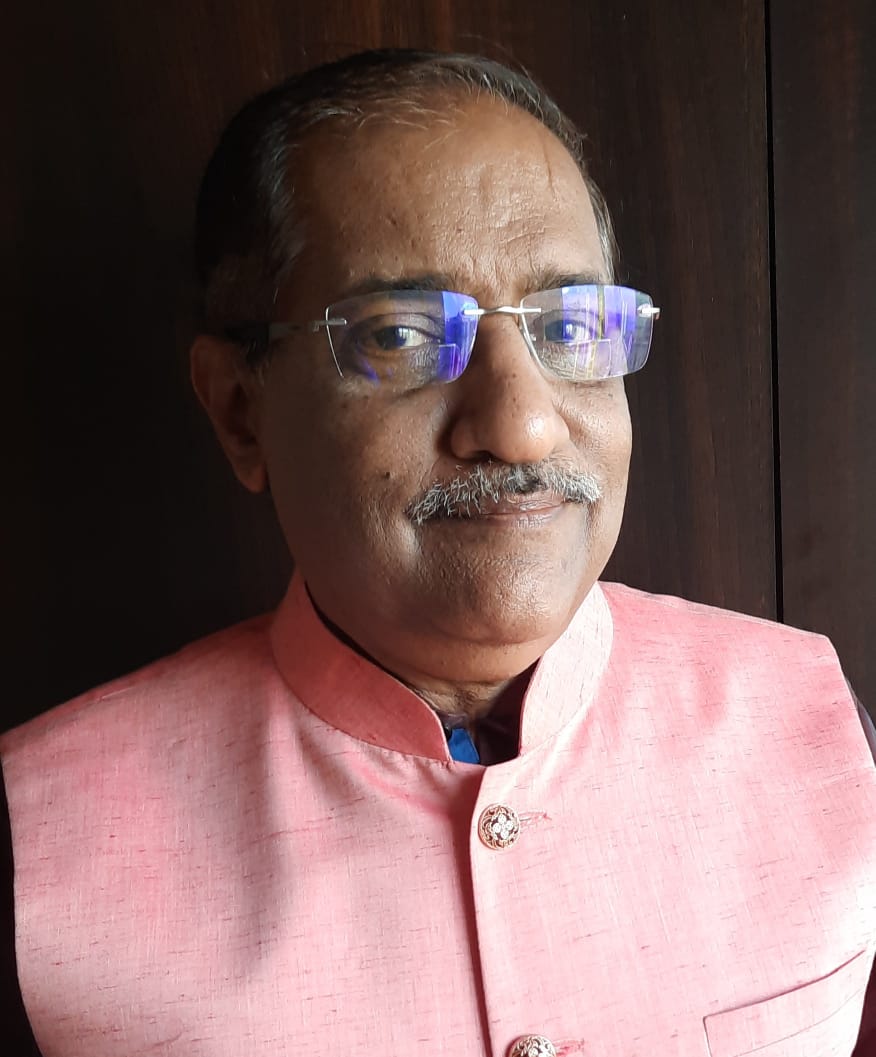
Ratan Sharda
Ratan Sharda has been awarded a PhD for his thesis on RSS. He is an author, columnist and renowned TV panelist. He has written 9 books of which 7 are on RSS, one on Guru Nanak Dev and one on Disaster Management; translated two books about RSS – The Incomparable Guruji Golwalkar and M S Golwalkar: His Vision and Mission, from Hindi to English; written by the foremost RSS thinker Shri Ranga Hari. He has edited/designed 12 books.
His most popular books on RSS are RSS360 degree, Sangh & Swaraj, RSS – Evolution from an Organisation to a Movement, Prof Rajendra Singh Ki Jeevan Yatra and Conflict Resolution: The RSS Way.
Ratan Sharda has travelled extensively in and outside Bharat. He was jailed during 1975-77 in the days of Emergency. He was an ERP consultant for two decades in addition to varied industrial experience of 2 decades. He was the founder secretary of Vishw Kendra (Centre for International Studies), Mumbai for eight years. He is an advisor to many educational institutions and voluntary organisations.