USS Abraham Lincoln Crisis, Demoralization of American Sailors, and Lessons for India


Fatigue Caused by Prolonged Deployment
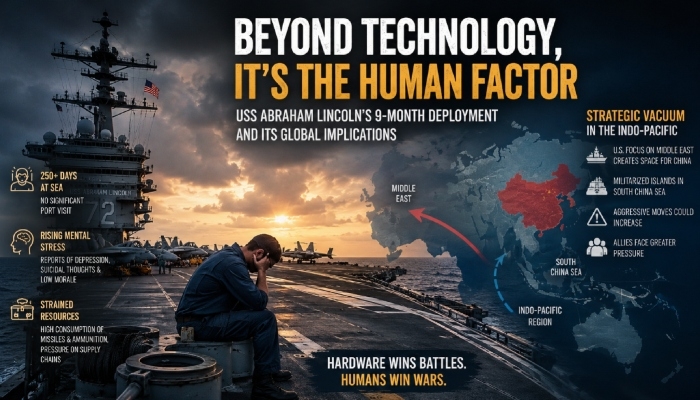
Under normal circumstances, U.S. aircraft carriers are deployed for approximately six to seven months. However, growing tensions in the Middle East forced USS Abraham Lincoln and its Carrier Strike Group to remain at sea for nearly nine months. Many sailors reportedly spent more than 250 consecutive days at sea without a significant port visit.
Life at sea is inherently demanding. Limited personal space, continuous duty cycles, separation from family, constant combat readiness, and a confined environment create substantial physical and psychological stress. Any problems related to food supply, potable water, accommodation, or sanitation further aggravate the situation.
Extended deployments often result in exhaustion, irritability, reduced decision-making ability, and declining operational effectiveness. While advanced technology is a key component of modern warfare, it is ultimately the soldier, sailor, or airman who operates that technology. If military personnel become mentally exhausted, even the most sophisticated weapons systems may fail to deliver their intended results.
Mental Health and the Morale Challenge
Various reports concerning the U.S. Navy have referred to incidents involving depression, suicidal thoughts, and attempts by sailors to jump overboard. Although the U.S. Navy has attempted to downplay some of these concerns, several members of Congress have expressed alarm about the mental health challenges faced by deployed personnel.
One of the fundamental principles of military science states that “morale is the invisible weapon of war.” Britain's resilience during the Second World War and North Vietnam’s endurance against the United States during the Vietnam War were not solely products of military capability; they were also reflections of national and military morale.
The experience aboard USS Abraham Lincoln demonstrates that when the limits of human endurance are exceeded, combat effectiveness inevitably declines. Fatigued personnel are more likely to make mistakes. In complex operations involving aircraft launches, missile systems, radar management, and maritime blockade missions, such errors can have serious operational consequences.
Impact on American Military Effectiveness
The United States has been required to maintain a continuous naval presence in the Middle East to counter Iran and its allied groups. Houthi attacks in the Red Sea, the Israel-Iran confrontation, and instability across the Gulf region have placed tremendous pressure on the U.S. Navy.
These operations have consumed large quantities of missiles, ammunition, and other military supplies. Replenishing these resources has proven more time-consuming and expensive than anticipated. As a result, strains on logistics and supply chains could affect the sustainability of long-term naval operations.
Personnel fatigue and resource constraints also limit America's ability to respond simultaneously to crises across multiple regions. One of the defining strengths of U.S. military power has long been its capacity to address multiple strategic challenges at the same time. However, when substantial military assets become tied down in one theater, the risk of weakened presence elsewhere increases.
The Emerging Strategic Vacuum in the Indo-Pacific
As American attention shifts toward the Middle East, concerns have grown regarding its ability to maintain a robust presence in the Indo-Pacific. The South China Sea, Taiwan Strait, and Western Pacific remain the primary arenas of U.S.-China strategic competition.
If U.S. carrier strike groups remain heavily committed to Middle Eastern contingencies, China could gain greater freedom of action in the Indo-Pacific. Over the past decade, Beijing has transformed artificial islands in the South China Sea into military outposts equipped with runways, missile systems, radar networks, and naval facilities.
A reduction in U.S. presence could encourage China to pursue its territorial claims more aggressively. Countries such as Vietnam, the Philippines, and Malaysia could face increased pressure. China's maritime militia and coast guard fleets are already highly active throughout the region.
The Growing Importance of the South China Sea
The South China Sea carries trillions of dollars' worth of global trade every year. It is also a vital maritime route for India's energy security and commerce with East Asia.
If China succeeds in establishing effective control over this region, the consequences would extend beyond the United States and directly affect India, Japan, South Korea, and ASEAN nations. Any erosion of the principle of Freedom of Navigation could have far-reaching implications for global trade and economic stability.
Russia Is Losing More Soldiers Than It Can Recruit
The ongoing Russia-Ukraine war provides another important lesson regarding military manpower. As the conflict continues, Russia is reportedly losing approximately 6,000 more soldiers per month than it is able to recruit.
Although Moscow continues to recruit thousands of personnel every month, the pace remains insufficient to replace those killed or wounded in combat. This growing manpower deficit highlights one of the most critical challenges in prolonged warfare.
Political and Economic Risks
A large-scale mobilization of additional troops could create serious political and economic challenges for Russia. During the partial mobilization announced in the autumn of 2022, approximately one million Russian citizens—many of them highly skilled professionals—left the country. Less than half have reportedly returned.
Such developments demonstrate how manpower shortages can create wider national consequences extending far beyond the battlefield.
Challenges Facing the Russian Military
It remains unclear whether the Russian military can effectively absorb and train hundreds of thousands of additional recruits. Shortages of equipment, experienced officers, and logistical support continue to present obstacles.
At the same time, repeated Ukrainian attacks on Russian oil-related infrastructure have disrupted fuel supplies and complicated military logistics. These developments underscore the reality that successful warfare depends not only on weapons but also on sustained access to manpower, fuel, and industrial resources.
The Global Challenge of Military Manpower
Countries such as Russia, the United States, and Israel are increasingly facing shortages of trained military personnel due to prolonged operational commitments. Maintaining a steady flow of trained manpower has become one of the most important requirements for modern warfare.
In India's context, retired Agniveers could potentially serve as a trained reserve force during a prolonged conflict or national emergency. Such a reserve pool would provide valuable manpower reinforcement when required.
Key Lessons for India
Building Long-Term Logistics Capability
The Russia-Ukraine war, the Gaza conflict, and the USS Abraham Lincoln experience all reinforce one central lesson: wars are not won solely on the battlefield; they are won through logistics, supply chains, and industrial capacity.
India must maintain substantial stockpiles of ammunition, missiles, fuel, spare parts, and critical military equipment. Expanding indigenous defence production will reduce dependence on foreign suppliers during wartime.
Effective Troop Rotation Systems
Indian deployments in Ladakh, Siachen, Jammu & Kashmir, and the Northeast often involve prolonged operational commitments. Regular troop rotation, adequate rest, and rehabilitation must remain a priority.
Ignoring human resource management can reduce combat effectiveness. In modern warfare, a soldier's mental health is becoming as important as weapon systems themselves.
Mental Health and Morale
The Indian Armed Forces should continue strengthening mental health initiatives, counselling programs, family communication systems, and stress management mechanisms.
Future wars are likely to be longer, technologically intensive, and multidimensional. Preserving the morale of military personnel will therefore become a critical national security requirement.
Strengthening Indo-Pacific Partnerships
India should further deepen defence cooperation with Japan, Australia, Vietnam, the Philippines, and the United States. Expanding QUAD initiatives, naval exercises, intelligence sharing, and Maritime Domain Awareness programs will be essential.
Particularly, closer defence ties with Vietnam and the Philippines could contribute significantly to maintaining strategic balance in the South China Sea. India's BrahMos missile exports and broader maritime security cooperation have already enhanced its strategic role in the region.
Conclusion
The crisis surrounding USS Abraham Lincoln reveals an important reality of modern warfare: even great powers can encounter serious difficulties if human endurance, morale, manpower, and logistics are neglected. Advanced aircraft carriers, sophisticated missiles, and cutting-edge technology cannot compensate indefinitely for exhausted and demoralized personnel.
India should carefully study these experiences. Future conflicts are likely to be prolonged, multidimensional, and resource-intensive. Strong logistics networks, adequate war reserves, trained reserve forces, troop rotation systems, mental health support, and reliable strategic partnerships will therefore remain essential pillars of India's national security.
Victory in war is achieved not only on the battlefield but also through resilient logistics, industrial strength, national endurance, and the morale of those who serve. That is perhaps the most important lesson India can draw from the experience of USS Abraham Lincoln.
BRIG Hemant Mahajan
Passionate writer on National Security related issues, Brig Hemant Mahajan YSM (Retd) is M Sc, M Phil in Defence Studies. He joined IMA Dehradun in July 1973 and passed out as a Commissioned Officer on 15 June 1975. He was commissioned into 7 MARATHA LIGHT INFANTRY. He has served extensively in Counter Insurgency Operations in Insurgency and Terrorist prone areas of Jammu & Kashmir, Punjab and North East and has taken part in all important operations undertaken by the Army since 1975.
Brig Hemant Mahajan served in Jammu & Kashmir, in the deserts of Rajasthan, in Super High Altitude areas of Kargil and Leh, forward areas of Arunachal Pradesh. He was deployed in Punjab in ‘Operation Avert’. He was also involved in maintaining peace post ‘Operation Bluestar’ days in Punjab in the worst affected district of Gurdaspur, Taran Taran and Amritsar.He served in the areas of Darjeeling, Kurseong, Siliguri and Sikkim. He commanded his battalion 7 MARATHA LIGHT INFANTRY in Operation Rakshak in the most difficult areas of Poonch and Rajouri during the times of highest militancy. His unit was responsible for stopping terrorists from Pakistan into Jammu and Kashmir. His unit was awarded Unit Citation, 18 gallantry awards including YSM (gallantry) for the officer.