‘Why insult Saffron?’: Bengal CM Suvendu Adhikari hits back at ‘Saffron Terror’ tag, leads ‘Gerua Samman Yatra’ to Jadavpur
West Bengal Chief Minister Suvendu Adhikari on Wednesday led a 2.5-km ‘Gerua Samman Yatra’ from Golpark to Jadavpur’s 8B crossing, warning that he would not tolerate derogatory references to saffron and promising action against what he described as anti-national slogans and political messaging at Jadavpur University.
Total Views |


West Bengal Chief Minister Suvendu Adhikari on Wednesday (September 9) led a saffron-themed march through south Kolkata, taking the political battle over Jadavpur University to the streets.
The ‘Gerua Samman Yatra’, organised to protest what the BJP described as attempts to malign or insult the colour saffron, began from Golpark and ended at the 8B crossing in Jadavpur.
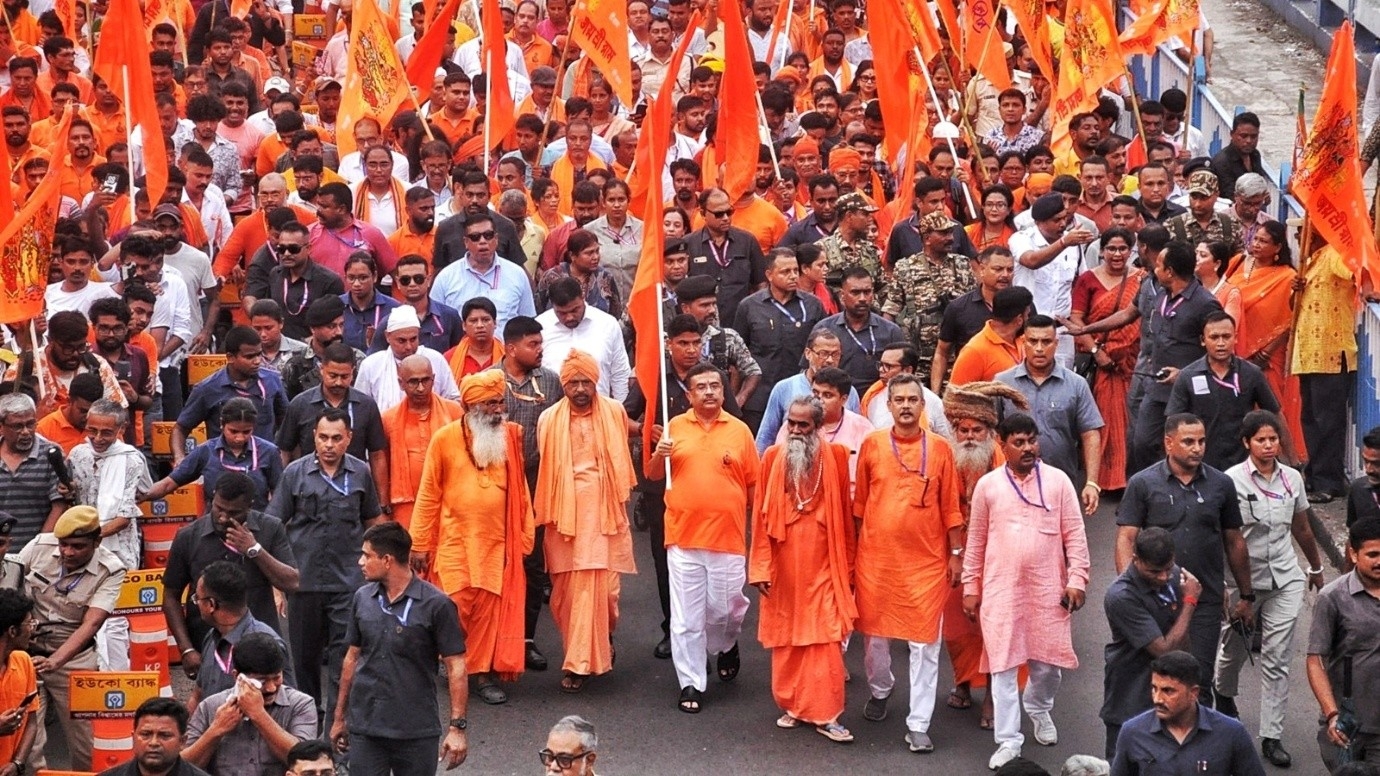
Adhikari began the procession at around 4.35 pm after garlanding a statue of Swami Vivekananda near the Ramakrishna Mission Institute of Culture in Golpark. The approximately 2.5-km procession moved along the south-bound flank of Raja Subodh Chandra Mullick Road and reached the 8B crossing at around 5.10 pm.
The march was joined by BJP supporters from Kolkata and several districts, along with party functionaries and religious figures.
VIDEO | Kolkata: West Bengal CM Suvendu Adhikari leads a 'saffron procession' near Jadavpur University; Naga sadhus take part in the march. pic.twitter.com/vlcdCaqEOL
— Press Trust of India (@PTI_News) September 9, 2026
Adhikari, dressed in saffron, walked through the procession alongside state minister Tapas Roy, Kartik Maharaj, Shanku Deb Panda and other BJP leaders. Naga sadhus were also among those taking part.
Saffron flags dominated the procession as participants raised slogans including “Jai Shri Ram”, “Bharat Mata Ki Jai” and “Sanataner Joy Hok”. Conch shells were blown and ululation accompanied parts of the march.
At the 8B crossing, Vande Mataram and the Gayatri Mantra were played before Adhikari addressed the gathering.
‘We will not tolerate insulting words against saffron’
Addressing the gathering, Adhikari issued a strong warning against what he described as derogatory references to saffron.
“I have come here only to issue a warning. In today’s West Bengal, where there is a spiritual awakening around saffron, we will not tolerate anyone uttering insulting words against or writing derogatory comments about it. This is my clear message,” he said.
His remarks came after Anandabazar Patrika, a newspaper of the ABP Group, described an ABVP protest at Jadavpur University using the phrase “saffron terror”. The description triggered criticism from BJP leaders, with Adhikari questioning why the colour saffron itself was being portrayed negatively.
The BJP has argued that saffron represents sacrifice, courage and India's cultural and spiritual traditions and has accused sections of the political establishment and media of using the colour as a shorthand for political violence.
‘I will uproot the Azadi, Free Palestine and Kishenji gang’
Adhikari used the rally to renew his attack on political slogans and graffiti that he says have no place at an institution such as Jadavpur University.
“I have taken an oath. I will uproot the ‘Kashmir demands azaadi’ gang and those who raise slogans such as ‘Free Palestine’ and ‘Red salute to Kishenji’ from Jadavpur, which houses a centre of excellence and is the land of Rishi Aurobindo,” he said.
He further asserted that the state government knew how to deal with those whom he accused of promoting such messaging.
“Bengal’s chief minister knows how to cleanse the campus of them,” Adhikari said.
His remarks are part of a continuing confrontation over the political character of Jadavpur University, where the BJP has accused sections of the student community of promoting Left-wing and separatist political messaging.
‘Lal Salaam Kishenji’ graffiti remains a major flashpoint
One of the issues repeatedly raised by Adhikari is the “Lal Salaam Kishenji” graffiti reported on the university campus.
No more Lal Salaam to Kishenji.
— BJP West Bengal (@BJP4Bengal) August 28, 2026
No more ‘Free Palestine.’
Say Free ‘Pak Occupied Kashmir’ instead.
No more siding with Breaking India forces.
No more DRUGS, Ex students living in hostels meant for current students.
Chinta Nei, @Suvenduwb Dada aache. pic.twitter.com/H6YXjUYjSp
Kishenji, whose real name was Koteshwar Rao, was a senior Maoist leader who was killed in a police encounter in West Bengal in November 2011.
Adhikari has questioned why a Maoist leader should be commemorated on the walls of a university and what message such political symbolism sends to students.
“What are you teaching the new generation?” he had asked while criticising the mural, arguing that a centre of higher education should not glorify individuals associated with Maoist violence.
‘Azadi’ and Kashmir slogans become political battleground
The Chief Minister has also repeatedly attacked slogans such as “Kashmir demands freedom” and “Azadi”.
He has questioned why slogans relating to Kashmir should be written on the streets of Kolkata or displayed at Jadavpur University, arguing that Kashmir has been at the centre of conflict between India and Pakistan for decades.
Adhikari has contrasted the slogans with revolutionary expressions such as “Inquilab Zindabad”, saying that there should be a distinction between historical slogans associated with India's freedom struggle and slogans that, according to him, question India's territorial integrity.
He has invoked freedom fighters including Netaji Subhas Chandra Bose and Matangini Hazra while making the case for remembering the sacrifices made during India's independence movement.
‘No more Free Palestine’; Adhikari calls for focus on PoK
The Chief Minister in the recent past had also objected to “Free Palestine” slogans raised in political spaces in Bengal.
Instead, he has called for attention to Pakistan-occupied Jammu and Kashmir, using the phrase “Free Pak-Occupied Jammu & Kashmir”.
The issue has become part of Adhikari's broader argument that political movements in Bengal should not promote slogans that, in his view, ignore India's own territorial disputes and national interests.
Three-day Veda programme at 8B, Gita and Hanuman Chalisa events planned
Adhikari also announced a series of religious and cultural programmes at the 8B crossing following the march.
According to the Chief Minister, a three-day Veda recitation programme will be organised at the location, followed by two separate events featuring readings of the Bhagavad Gita and Hanuman Chalisa.
“Hiranmayananda ji Maharaj is organising a three-day Ved Paath programme. I expect all nationalist people to participate in it,” Adhikari said.
He added that he would return to the area twice at the invitation of the West Bengal Sanatan Sanskriti Parishad, once for a Gita recitation and another time for a Hanuman Chalisa programme.
He linked the proposed programmes to his criticism of those whom he accused of insulting the country and saffron while living in India.
Heavy security deployed as BJP march reaches Jadavpur
The politically sensitive route saw a substantial security deployment.
A large contingent of Kolkata Police and central forces was deployed along the procession route and outside Jadavpur University.
The university gates along Raja Subodh Chandra Mullick Road were barricaded as the procession approached the 8B area.
The choice of Jadavpur for the march was politically significant, given the BJP's sustained criticism of the university's student politics and its allegations of an entrenched “threat culture” on the campus.
The BJP had previously organised a “10,000 Voices for Vande Mataram” programme near the university, with Adhikari using the occasion to criticise slogans and political activity allegedly taking place on or around the campus.
Adhikari expands attack beyond slogans
The Chief Minister's criticism of Jadavpur University has also extended to issues such as drug use and hostel occupancy.
He has called for “no more drugs” on the campus and questioned why former students were allegedly continuing to occupy hostels meant for current students.
The issue has allowed the BJP to broaden its criticism of the university from political ideology to questions of campus administration, student welfare and discipline.
Bengal’s cultural heritage at centre of Adhikari’s message
Adhikari has simultaneously sought to frame his campaign around Bengal's cultural and spiritual heritage.
In recent speeches, he has invoked personalities including Chaitanya Mahaprabhu, Ramakrishna Paramahamsa and Rani Rashmoni, arguing that Bengal's historical and cultural traditions need to be protected.
His emphasis on saffron, Vande Mataram, spiritual traditions and India's freedom struggle forms part of a larger BJP effort to frame its political contest in Bengal around nationalism, cultural identity and the state's historical heritage.